Menu
Store
Blog
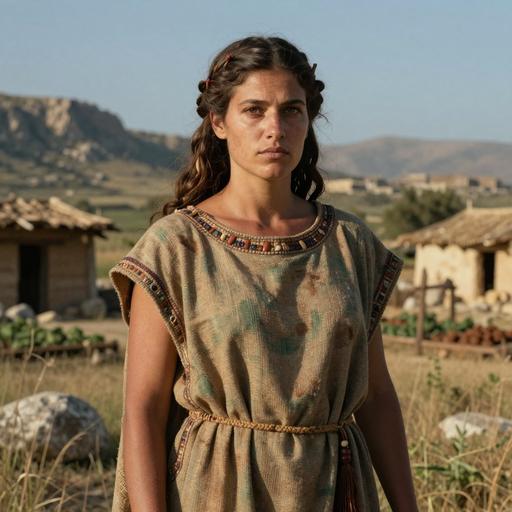
Portrait reconstruction of Rev5
Ancient Individual

A woman buried in Greece in the Neolithic era

Rev5
6434 BCE - 6257 BCE
Female
Neolithic Greece
Greece
Scroll to begin
Chapter I

Identity

The biological and cultural markers that define this ancient individual

Sample ID

Rev5

Date Range

6434 BCE - 6257 BCE

Biological Sex

Female

mtDNA Haplogroup

X2b

Cultural Period

Neolithic Greece

Chapter II

Place

Where this individual was discovered

Country Greece
Locality Revenia
Coordinates 39.4886, 20.9177
Chapter III

Time

When this individual lived in the broader context of human history

Rev5 6434 BCE - 6257 BCE
Chapter IV

Story

The narrative of this ancient life

The Neolithic period in Greece, which spans roughly from 7000 to 3200 BCE, marks a significant era in the Aegean civilization characterized by the transition from nomadic hunter-gatherer societies to settled agricultural communities. This period is critical for understanding the development of complex societies in the region, laying the groundwork for the later flourishing of the Minoan and Mycenaean civilizations.

Geographic Setting

Neolithic Greece predominantly describes the mainland, along with the islands of the Aegean Sea. This region features a diverse landscape, including fertile plains, mountainous terrains, and an extensive coastline, which significantly influenced the way of life and the development of early communities.

Social and Economic Structures

The Neolithic inhabitants of Greece were among the first to adopt farming practices in Europe. They cultivated cereals like barley and wheat and domesticated animals such as sheep, goats, and pigs. This transition to agriculture allowed for the establishment of permanent settlements. Villages often comprised clusters of mud-brick or stone structures, with some, like Sesklo and Dimini, showing early forms of social organization and planning.

Technological and Artistic Developments

The technological advancements during this period were substantial. The production of pottery is one of the defining characteristics of the Neolithic era in Greece. Neolithic pottery, often decorated with geometric motifs, served both utilitarian and ritualistic purposes. Stone tools predominated in the Neolithic toolkit, although the use of bone and wood continued.

Artistic expression found form in figurines, typically made from clay or stone, which are believed to have played a role in religious or cultural practices. These figures frequently depict female forms and could represent fertility symbols or deities.

Cultural and Religious Practices

The spiritual life of Neolithic Greeks is largely interpreted from burial practices and artifacts. There is evidence of ritual activity, possibly ancestor worship or nature-based spirituality, as inferred from burial sites and various altars.

Interaction and Exchange

During the Neolithic period, Greece was not isolated but engaged in networks of trade and cultural exchange across the Aegean and beyond. The exchange of goods, ideas, and technologies with neighboring regions facilitated the dissemination of innovations such as metallurgy, which appeared towards the end of the Neolithic era.

Settlements and Architecture

Settlements like Sesklo in Thessaly are emblematic of Neolithic Greek architecture. Such sites exhibit organized layouts with larger communal structures possibly used for social or administrative functions. The size and complexity of these settlements suggest emerging social stratification and leadership roles.

Legacy and Transformation

As the Neolithic period drew to a close, these communities laid the structural, cultural, and technological foundations for the development of the Bronze Age Aegean civilizations. The achievements of the Neolithic Greeks in agriculture, technology, and social organization significantly influenced subsequent cultural developments in the region.

In summary, Neolithic Greece represents a transformative era in human history, characterized by the rise of agriculture and permanent settlements, the genesis of complex societal structures, and the flow of ideas and technologies across and beyond the Aegean region. This period set the stage for the dynamic civilizations that followed, impacting the course of European prehistory.

Chapter V

Genetics

The genetic ancestry of this ancient individual

Ancient Genetic Admixture

This analysis compares the DNA profile of Rev5 with ancient reference populations, showing the genetic composition in terms of prehistoric ancestral groups.

Neolithic Farmers 68.8%
European Hunter-Gatherers 28.8%
Western Steppe Pastoralists 2.5%

Modern Genetic Admixture

This analysis compares the DNA profile with present-day reference populations, showing what percentage of genetic makeup resembles modern populations from different regions.

Europe 75.0%
Southern European 75.0%
Italian 38.8%
Sardinian 31.0%
Iberian 5.3%
Asia 16.5%
Arab, Egyptian & Levantine 16.4%
Levantine 16.4%
Africa 8.5%
North African 8.5%
North African 5.1%
Egyptian 3.4%

Closest Modern Populations

These are the modern populations showing the closest statistical alignment to A woman buried in Greece in the Neolithic era, ranked by genetic distance. Lower distance values indicate closer statistical similarity.

1
Sardinian
10.0800
2
French Corsica
10.2631
3
Spanish Andalucia
10.5113
4
Spanish Murcia
10.6864
5
Belmonte Jew
10.6899
6
Portuguese
10.8043
7
Spanish Extremadura
10.8571
8
Spanish Alacant
10.8822
9
Spanish Cantabria
10.8992
10
Spanish Castilla La Mancha
10.9179
Chapter VI

Context

Other ancient individuals connected to this sample

Sources

References

Scientific publications and genetic data

Scientific Publication

Early farmers from across Europe directly descended from Neolithic Aegeans

Authors Hofmanová Z, Kreutzer S, Hellenthal G
Abstract

Farming and sedentism first appeared in southwestern Asia during the early Holocene and later spread to neighboring regions, including Europe, along multiple dispersal routes. Conspicuous uncertainties remain about the relative roles of migration, cultural diffusion, and admixture with local foragers in the early Neolithization of Europe. Here we present paleogenomic data for five Neolithic individuals from northern Greece and northwestern Turkey spanning the time and region of the earliest spread of farming into Europe. We use a novel approach to recalibrate raw reads and call genotypes from ancient DNA and observe striking genetic similarity both among Aegean early farmers and with those from across Europe. Our study demonstrates a direct genetic link between Mediterranean and Central European early farmers and those of Greece and Anatolia, extending the European Neolithic migratory chain all the way back to southwestern Asia.

G25 Coordinates

The G25 coordinates for sample Rev5 can be used for detailed admixture analysis in our G25 Studio tool.

Rev5,0.10125866,0.11729824,-0.00828972,-0.00504666,0.07441334,-0.07688702,-0.00228254,0.00582228,0.03114682,0.06308362,-0.005812,0.013735,-0.02402978,-0.0134541,-0.01012782,0.00469702,0.01226344,-0.00034152,-0.00029162,-0.00400784,0.00032882,0.00384206,-0.01104282,-0.0173551,0.00434092
Analyze in G25 Studio
Use code for 40% off Expires Feb 27