Menu
Store
Blog
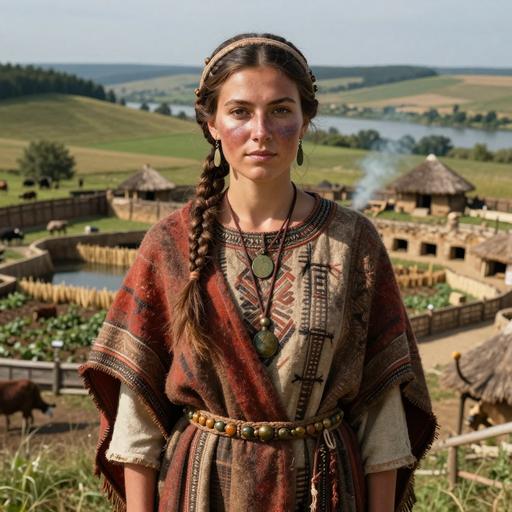
Portrait reconstruction of RISE483
Ancient Individual

A woman buried in Hungary in the Bronze Age era

RISE483
2000 BCE - 1500 BCE
Female
Middle Bronze Age Vatya Culture, Hungary
Hungary
Scroll to begin
Chapter I

Identity

The biological and cultural markers that define this ancient individual

Sample ID

RISE483

Date Range

2000 BCE - 1500 BCE

Biological Sex

Female

mtDNA Haplogroup

H2a1

Cultural Period

Middle Bronze Age Vatya Culture, Hungary

Chapter II

Place

Where this individual was discovered

Country Hungary
Locality Erd 4
Coordinates 47.3410, 18.8960
Chapter III

Time

When this individual lived in the broader context of human history

RISE483 2000 BCE - 1500 BCE
Chapter IV

Story

The narrative of this ancient life

The Middle Bronze Age Vatya culture, flourishing from approximately 2000 to 1500 BCE, was a significant archaeological culture in present-day Hungary. It was primarily located in the region of Transdanubia, the area west of the Danube River, and is renowned for its distinctive contributions to the European Bronze Age cultural landscape.

Geographic Setting and Environment

The Vatya culture occupied a strategic geographical area characterized by fertile plains, river valleys, and rolling hills. This environment fostered rich agricultural activities and facilitated trade with neighboring cultures. The proximity to the Danube River, a major avenue for transportation and communication, contributed significantly to its economic and cultural development.

Economy and Subsistence

Agriculture and animal husbandry were the mainstays of the Vatya economy. The fertile lands allowed for the cultivation of cereals, such as wheat and barley, which were primary dietary staples. In addition to farming, the Vatya people practiced animal husbandry, raising livestock including cattle, sheep, and pigs. This combination provided a stable food supply and raw materials for clothing and tools.

Settlements and Architecture

Vatya settlements were typically fortified and often situated on elevated terrain, such as hilltops or elevated river terraces, which provided natural defenses. These settlements were characterized by circular or oval-shaped enclosures surrounded by ditches and ramparts. The architecture consisted of timber-framed houses with wattle-and-daub walls and thatched roofs. Some excavated sites, such as those at Százhalombatta, reflect complex layouts with organized living spaces and communal areas.

Material Culture and Craftsmanship

The Vatya culture is notable for its advanced metalworking skills. Bronze, an alloy of copper and tin, was employed to produce a variety of tools, weapons, and ornaments. Common artifacts include axes, daggers, and spearheads, which demonstrate both practical use and artistic expression. Pottery from this period, often decorated with intricate geometric patterns and motifs, reflects both aesthetic and functional purposes.

Social Structure and Organization

The social structure of the Vatya culture likely included hierarchies, as inferred from burial practices and settlement layouts. Leaders or elites may have been distinguished by larger or more elaborate burial mounds and richer grave goods. The presence of fortified settlements suggests a level of organization and collective effort, indicating a tribal society with leadership roles.

Burial Practices

Burial customs of the Vatya culture provide insights into their beliefs and social stratification. Inhumation was the dominant practice, with bodies often buried in a flexed position. Grave goods, varying in number and complexity, accompanied the deceased, hinting at social status and personal identity. Specifically, metal objects placed in graves such as tools, weapons, and ornamental items, reflect both the craftsmanship and the significance of these items in the society.

Trade and Interactions

The Vatya culture engaged in extensive trade networks with neighboring cultures, facilitating the exchange of goods, ideas, and technologies. Evidence from metalwork and ceramics indicates interactions with other Bronze Age cultures in Central Europe. These networks allowed for the spread of innovations such as bronze metallurgy and the wheel, which played crucial roles in Vatya's cultural development.

Cultural and Historical Influence

As a part of the broader tapestry of the European Bronze Age, the Vatya culture played a crucial role in the cultural developments of the region. Its innovations in metallurgy and societal structures influenced subsequent cultures and were integral to the transition toward more complex societies in later periods.

In summary, the Middle Bronze Age Vatya culture in Hungary is characterized by its strategic geographical positioning, advanced metalworking and agricultural practices, and complex social organization. Its contributions to trade and cultural exchange significantly impacted the broader European Bronze Age landscape, marking it as a key player in prehistoric European history.

Chapter V

Genetics

The genetic ancestry of this ancient individual

Ancient Genetic Admixture

This analysis compares the DNA profile of RISE483 with ancient reference populations, showing the genetic composition in terms of prehistoric ancestral groups.

Neolithic Farmers 44.4%
Western Steppe Pastoralists 27.0%
European Hunter-Gatherers 25.3%
Ancient Asians 3.3%

Modern Genetic Admixture

This analysis compares the DNA profile with present-day reference populations, showing what percentage of genetic makeup resembles modern populations from different regions.

Europe 85.9%
Southern European 56.1%
Iberian 20.9%
Balkan 20.5%
Sardinian 11.1%
Italian 3.6%
Northwestern European 29.8%
English 14.9%
Northwestern European 9.2%
Scandinavian 5.6%
Asia 13.3%
Arab, Egyptian & Levantine 7.9%
Arabian 5.6%
Levantine 2.3%
Northern West Asian 5.4%
Anatolian 3.0%
Mesopotamian 2.4%
Africa 0.8%
North African 0.8%
Egyptian 0.8%

Closest Modern Populations

These are the modern populations showing the closest statistical alignment to A woman buried in Hungary in the Bronze Age era, ranked by genetic distance. Lower distance values indicate closer statistical similarity.

1
Spanish Murcia
1.9353
2
Spanish Andalucia
1.9779
3
Portuguese
2.0860
4
Spanish Galicia
2.0996
5
Spanish Valencia
2.2330
6
Spanish Eivissa
2.2545
7
Spanish Alacant
2.3025
8
Spanish Castilla La Mancha
2.3313
9
Spanish Extremadura
2.3315
10
Spanish Camp De Tarragona
2.4122
Chapter VI

Context

Other ancient individuals connected to this sample

Sources

References

Scientific publications and genetic data

Scientific Publication

Population genomics of Bronze Age Eurasia

Authors Allentoft ME, Sikora M, Sjögren KG
Abstract

The Bronze Age of Eurasia (around 3000-1000 BC) was a period of major cultural changes. However, there is debate about whether these changes resulted from the circulation of ideas or from human migrations, potentially also facilitating the spread of languages and certain phenotypic traits. We investigated this by using new, improved methods to sequence low-coverage genomes from 101 ancient humans from across Eurasia. We show that the Bronze Age was a highly dynamic period involving large-scale population migrations and replacements, responsible for shaping major parts of present-day demographic structure in both Europe and Asia. Our findings are consistent with the hypothesized spread of Indo-European languages during the Early Bronze Age. We also demonstrate that light skin pigmentation in Europeans was already present at high frequency in the Bronze Age, but not lactose tolerance, indicating a more recent onset of positive selection on lactose tolerance than previously thought.

G25 Coordinates

The G25 coordinates for sample RISE483 can be used for detailed admixture analysis in our G25 Studio tool.

RISE483,0.10982162,0.13764418,0.03715518,-0.00665798,0.04383108,-0.00748186,-0.00485588,-0.00054024,0.02579246,0.02587844,-0.0060826,0.00140004,-0.00388066,-0.00902294,0.01268292,0.00362126,-0.00435898,-0.00056604,0.00136488,0.00144892,0.0028931,0.00156996,-0.00446894,-0.00710724,0.00261327
Analyze in G25 Studio
Use code for 40% off Expires Feb 26