Menu
Store
Blog
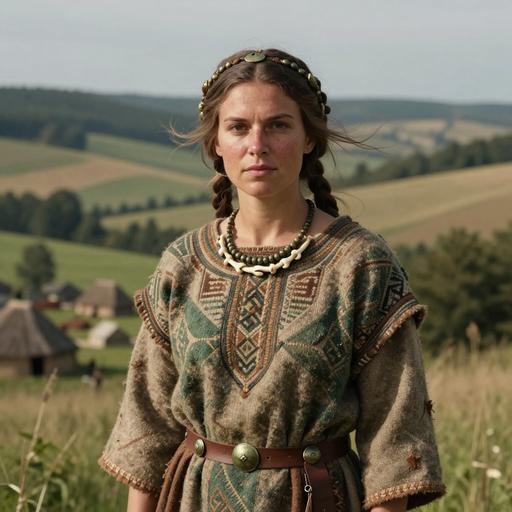
Portrait reconstruction of RISE577
Ancient Individual

A woman buried in Czechia in the Bronze Age era

RISE577
2500 BCE - 1900 BCE
Female
Early Bronze Age Únětice Culture
Czechia
Scroll to begin
Chapter I

Identity

The biological and cultural markers that define this ancient individual

Sample ID

RISE577

Date Range

2500 BCE - 1900 BCE

Biological Sex

Female

mtDNA Haplogroup

T2b

Cultural Period

Early Bronze Age Únětice Culture

Chapter II

Place

Where this individual was discovered

Country Czechia
Locality Velké-Přílepy (Středočeský kraj, okres Praha-západ)
Coordinates 50.1667, 14.3167
Chapter III

Time

When this individual lived in the broader context of human history

RISE577 2500 BCE - 1900 BCE
Chapter IV

Story

The narrative of this ancient life

The Early Bronze Age Únětice Culture, flourishing approximately between 2300 and 1600 BCE, represents a significant archaeological and cultural phenomenon that occupied large areas of Central Europe, particularly in present-day Czech Republic, Germany, Poland, and Slovakia. This culture is named after the village of Únětice, located near Prague, where the first investigations of such sites were conducted. This culture provides an insightful glimpse into the transitional dynamics between Neolithic communities and the more stratified societies of the Bronze Age.

Geographical Context and Settlement Pattern

Únětice Culture settlements were primarily distributed across fertile river valleys and arable landscapes that offered rich resources for agriculture and pastoralism. These areas included the basins of major rivers such as the Danube, Elbe, and Oder. The settlements typically consisted of small to medium-sized hamlets with semi-subterranean houses made from wood and clay. Some evidence suggests larger and more complex settlements existed, indicating varying degrees of social organization.

Economy and Subsistence

The economy of the Únětice Culture was predominantly agrarian, with agriculture and animal husbandry forming the backbone of subsistence strategies. The cultivation of crops such as barley, wheat, and millet complemented the keeping of livestock, including cattle, pigs, sheep, and goats. Evidence suggests that Únětice communities practiced mixed farming, adapting their methods to the specific environmental conditions of their locales. The use of metallurgy within the culture was significant in advancing agricultural technology, notably with bronze tools aiding in both farming and woodworking.

Metallurgy and Craftsmanship

The Únětice Culture is renowned for its advancements in metallurgy, which is central to understanding its place in the Early Bronze Age. It reflects a society with a high degree of skill in metalworking, primarily working with bronze, a critical alloy of copper and tin. The production of bronze tools, weapons, and ornaments signified technological advancement, with items like axes, sickles, and daggers being common. The presence of decorative items such as pins and spirals indicates a culture with both utilitarian and aesthetic metalwork practices. This metallurgical development played a key role in trade, linking Únětice communities with distant regions.

Burial Practices and Social Structure

Burial rites within the Únětice Culture are particularly insightful in understanding its social structure. The common practice involved inhumation in simple pit-graves, often containing rich grave goods, including pottery, metal objects, and sometimes evidence of textiles. Burial goods indicate a hierarchy or stratified society, with some graves, notably 'princely' burials, containing elaborate collections of items denoting high social status or wealth. The orientation of graves and specific burial customs hint at complex belief systems and social affiliations within the culture.

Trade and Interaction

The Únětice Culture was part of extensive trade networks across Europe, which facilitated the movement of goods, technology, and cultural influences. The culture's proficiency in metallurgy, combined with a strategic location, allowed them to be active participants in trade routes that reached as far as the British Isles and the Eastern Mediterranean. Materials such as tin, essential for bronze production, likely reached Únětice peoples through these networks, highlighting their role in broader Bronze Age exchange systems.

Artistic and Cultural Expression

The Únětice Culture, while primarily recognized for its technological achievements, also demonstrated artistic expression through pottery, metalwork, and carved bone or amber ornaments. Ceramics were typically undecorated or simply adorned, reflecting functional styles suitable for daily use. However, the craftsmanship evident in metal objects often displayed intricate designs, showcasing an appreciation for aesthetic value alongside utility.

Legacy and Influence

The legacy of the Únětice Culture lies in its contributions to the development of early European societies, particularly its pioneering role in establishing Bronze Age trade networks and metallurgy techniques. The cultural and technological practices of the Únětice would influence succeeding cultures, such as the Tumulus culture, pointing to a continuity and evolution of traditions fundamental to European prehistory.

In summary, the Early Bronze Age Únětice Culture of Únětice represents a pivotal moment in prehistoric Europe, characterized by significant strides in metallurgy, dynamic trade interactions, and the development of complex social structures. It offers valuable insights into the transformational processes that shaped early European history, marking a transition from Stone Age lifestyles to more advanced and hierarchical Bronze Age societies.

Chapter V

Context

Other ancient individuals connected to this sample

Sources

References

Scientific publications and genetic data

Scientific Publication

Population genomics of Bronze Age Eurasia

Authors Allentoft ME, Sikora M, Sjögren KG
Abstract

The Bronze Age of Eurasia (around 3000-1000 BC) was a period of major cultural changes. However, there is debate about whether these changes resulted from the circulation of ideas or from human migrations, potentially also facilitating the spread of languages and certain phenotypic traits. We investigated this by using new, improved methods to sequence low-coverage genomes from 101 ancient humans from across Eurasia. We show that the Bronze Age was a highly dynamic period involving large-scale population migrations and replacements, responsible for shaping major parts of present-day demographic structure in both Europe and Asia. Our findings are consistent with the hypothesized spread of Indo-European languages during the Early Bronze Age. We also demonstrate that light skin pigmentation in Europeans was already present at high frequency in the Bronze Age, but not lactose tolerance, indicating a more recent onset of positive selection on lactose tolerance than previously thought.

Use code for 40% off Expires Feb 26