Menu
Store
Blog
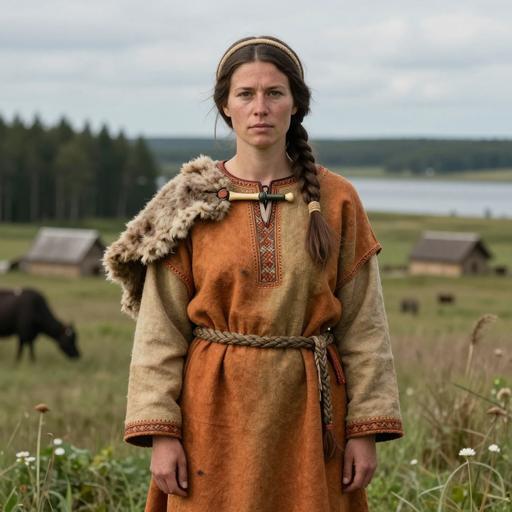
Portrait reconstruction of SOP002
Ancient Individual

A woman buried in Estonia in the Bronze Age era

SOP002
2865 BCE - 2494 BCE
Female
Neolithic Corded Ware Culture, Ida-Viru, Estonia
Estonia
Scroll to begin
Chapter I

Identity

The biological and cultural markers that define this ancient individual

Sample ID

SOP002

Date Range

2865 BCE - 2494 BCE

Biological Sex

Female

mtDNA Haplogroup

R1b1

Cultural Period

Neolithic Corded Ware Culture, Ida-Viru, Estonia

Chapter II

Place

Where this individual was discovered

Country Estonia
Locality Ida-Viru. Sope
Coordinates 59.4176, 27.0414
Chapter III

Time

When this individual lived in the broader context of human history

SOP002 2865 BCE - 2494 BCE
Chapter IV

Story

The narrative of this ancient life

The Corded Ware culture, also known as the Battle Axe culture or Single Grave culture, is a significant archaeological horizon of the late Neolithic period in Europe. It is characterized by its distinct pottery and burial practices and is often associated with the spread of Indo-European languages. The Corded Ware culture expanded across a vast region of Europe, impacting various territories, including present-day Estonia and the Ida-Viru region.

Overview of the Corded Ware Culture

Timeframe and Geography:

  • Period: The Corded Ware culture flourished from approximately 2900 BC to 2350 BC.
  • Geographical Span: It extended across Central Europe, parts of Eastern Europe, and into Northern Europe, including the territories of contemporary Estonia. Ida-Viru, located in the eastern part of Estonia, was among the areas influenced by this culture.

Cultural Characteristics:

  • Pottery: The culture is renowned for its distinctive pottery decorated with cord impressions, from which it derives its name. These decorations were often made by pressing cordage into the wet clay, resulting in characteristic patterns that are easily identifiable.
  • Burial Practices: The Corded Ware people practiced burial customs involving single graves rather than collective burials, which is why it is sometimes referred to as the Single Grave culture. Burials were typically inhumations, with bodies placed in a flexed position. Graves often contained grave goods, such as stone axes, flint tools, and pottery, indicating the importance of these items in their societal practices.
  • Battle Axes: A notable feature of this culture was the presence of polished stone battle axes or shaft-hole axes in their burials, symbolizing status or warrior identity.

Societal Structure:

  • The societal structure of the Corded Ware culture is believed to be patriarchal, with evidence indicating a focus on warrior-like elite groups. The presence of weapons in graves suggests a society that valued martial prowess.
  • Family units and clans likely played a central role in the social organization, with an emphasis on agricultural and pastoral economic activities.

Economy:

  • Subsistence: The Corded Ware culture saw a blend of agriculture and animal husbandry as their primary subsistence strategies. They cultivated cereals and bred livestock such as cattle, sheep, and goats.
  • Technology: They employed advanced stone tool technologies and were adept at crafting polished stone implements. Their tools and weapons, such as flint daggers and arrowheads, reflect their technical proficiency.

The Corded Ware Culture in Ida-Viru, Estonia

Regional Archaeology:

  • In Ida-Viru, as in other parts of Estonia, archaeological findings often include characteristic pottery shards, flint tools, and burial sites reflective of Corded Ware practices.
  • The region’s archaeological record is essential for understanding the broader interactions across the Baltic during the Neolithic period, suggesting trade or exchange networks.

Cultural Interactions:

  • The Corded Ware culture in Estonia represents an intersection of influences, where this incoming cultural wave interacted with local hunter-gatherer communities, leading to cultural synthesis and transformation.

Linguistic Implications:

  • The migration and expansion of the Corded Ware people are often linked to the spread of the Proto-Indo-European language, suggesting that the people in Ida-Viru during this period might have been among the early speakers of languages in this family.

Significance and Legacy

The Corded Ware culture marks a transformative period in European prehistory, characterized by shifts in social structures, subsistence strategies, and technology. In regions like Ida-Viru, Estonia, its influence contributed to the subsequent development of the cultural and linguistic landscape, leaving a lasting legacy that is still explored through ongoing archaeological research. This culture exemplifies a critical juncture where dynamic interactions between migrating and indigenous populations shaped the trajectory of European history.

Chapter V

Genetics

The genetic ancestry of this ancient individual

Ancient Genetic Admixture

This analysis compares the DNA profile of SOP002 with ancient reference populations, showing the genetic composition in terms of prehistoric ancestral groups.

Western Steppe Pastoralists 58.1%
European Hunter-Gatherers 31.0%
Neolithic Farmers 7.1%
Ancient Asians 3.8%

Modern Genetic Admixture

This analysis compares the DNA profile with present-day reference populations, showing what percentage of genetic makeup resembles modern populations from different regions.

Europe 79.4%
Northwestern European 70.3%
English 49.0%
Finnish 15.8%
Northwestern European 4.1%
Scandinavian 1.4%
Eastern European 9.1%
Asia 20.6%
Central Asian, Northern Indian & Pakistani 20.6%
Pakistan 11.7%
Indian 8.9%

Closest Modern Populations

These are the modern populations showing the closest statistical alignment to A woman buried in Estonia in the Bronze Age era, ranked by genetic distance. Lower distance values indicate closer statistical similarity.

1
Moksha
3.7703
2
Mordovian
4.1889
3
Russian Kostroma
4.2636
4
Erzya
4.2770
5
Russian Ryazan
4.3659
6
Moldovan O
4.5409
7
Finnish Southwest
4.5551
8
Finnish Central
4.6715
9
Ukrainian Dnipro
4.7319
10
Russian Kursk
4.7405
Chapter VI

Context

Other ancient individuals connected to this sample

Sources

References

Scientific publications and genetic data

Scientific Publication

Genetic ancestry changes in Stone to Bronze Age transition in the East European plain

Authors Saag L, Vasilyev SV, Varul L
Abstract

The transition from Stone to Bronze Age in Central and Western Europe was a period of major population movements originating from the Ponto-Caspian Steppe. Here, we report new genome-wide sequence data from 30 individuals north of this area, from the understudied western part of present-day Russia, including 3 Stone Age hunter-gatherers (10,800 to 4250 cal BCE) and 26 Bronze Age farmers from the Corded Ware complex Fatyanovo Culture (2900 to 2050 cal BCE). We show that Eastern hunter-gatherer ancestry was present in northwestern Russia already from around 10,000 BCE. Furthermore, we see a change in ancestry with the arrival of farming-Fatyanovo Culture individuals were genetically similar to other Corded Ware cultures, carrying a mixture of Steppe and European early farmer ancestry. Thus, they likely originate from a fast migration toward the northeast from somewhere near modern-day Ukraine-the closest area where these ancestries coexisted from around 3000 BCE.

G25 Coordinates

The G25 coordinates for sample SOP002 can be used for detailed admixture analysis in our G25 Studio tool.

SOP002,0.12519378,0.0982499,0.0548808,0.06047172,0.01868086,0.02582518,0.00782864,0.01090356,-0.00636108,-0.0235241,-0.0009761,-0.0011155,0.00692444,-0.00088332,0.0044066,-0.00118786,-0.00582086,-0.00135976,-0.00138516,-0.00312022,0.00244452,0.0006845,-0.00415524,0.00802234,-0.00116843
Analyze in G25 Studio
Use code for 40% off Expires Feb 27