Menu
Store
Blog
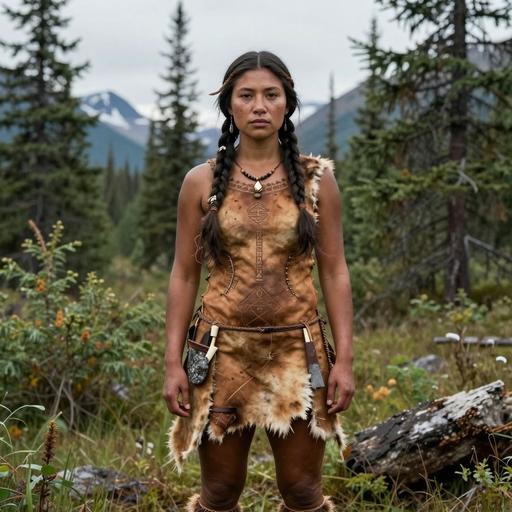
Portrait reconstruction of TrailCreek
Ancient Individual

A woman buried in USA in the Ancient North America era

TrailCreek
7181 BCE - 6829 BCE
Female
Trail Creek, Alaska, USA 9,000 Years Ago
USA
Scroll to begin
Chapter I

Identity

The biological and cultural markers that define this ancient individual

Sample ID

TrailCreek

Date Range

7181 BCE - 6829 BCE

Biological Sex

Female

mtDNA Haplogroup

B2

Cultural Period

Trail Creek, Alaska, USA 9,000 Years Ago

Chapter II

Place

Where this individual was discovered

Country USA
Locality Alaska. Trail Creek
Chapter III

Time

When this individual lived in the broader context of human history

TrailCreek 7181 BCE - 6829 BCE
Chapter IV

Story

The narrative of this ancient life

Around 9,000 years ago, Trail Creek in Alaska was part of a broader cultural framework known as the Paleo-Arctic Tradition. This period is characterized by the adaptation of human groups to the harsh climatic and environmental conditions associated with the Arctic and sub-Arctic regions following the last Ice Age. Here's a detailed description of the era:

Geography and Environment

Trail Creek is situated on the Seward Peninsula in northwestern Alaska. During this period, the environment was transitioning from the colder, drier conditions of the late Pleistocene to a slightly warmer and wetter climate. This shift led to the development of diverse ecosystems, including tundra, boreal forests, and riverine environments. These landscapes provided important resources such as game, fish, and plant materials to early inhabitants.

People and Lifestyle

The people living in Trail Creek around 9,000 BP were descendants of the first groups that crossed the Bering Land Bridge from Siberia into North America. These groups were highly mobile, adapting their lifestyles to the availability of resources across different seasons. Their subsistence economy was primarily based on hunting and gathering, focusing on large game like caribou and smaller animals such as rabbits and birds, along with fishing and foraging for edible plants.

Tools and Technology

The Paleo-Arctic Tradition is renowned for its sophisticated lithic (stone) tool technology. Artifacts from this era often include microblades—small, sharp bladelets produced from core stones, which were used in composite tools. These could be hafted onto bone or antler shafts for hunting and processing tasks. The people of Trail Creek were skilled in the selection and knapping of stones like chert and obsidian to create efficient tools for their daily needs.

Settlement Patterns

Evidence suggests that the inhabitants of Trail Creek lived in semi-nomadic groups. Their dwellings would have been temporary and adaptable to the Arctic environment, likely made from available materials such as bones, hides, and wood. Campsites were strategically located near rivers and coastal areas during the warmer months to exploit the rich aquatic resources and in sheltered inland locations during colder times to access terrestrial game.

Social Organization and Culture

Little is definitively known about the social organization of these early groups, but it is likely that they had a band-level society, typical of hunter-gatherer groups. Social structures were possibly based on kinship ties, with cooperative hunting and sharing of resources being central to group survival. Cultural expressions might include oral traditions, clothing decorated with motifs, and the use of symbolism in tool design.

Challenges and Adaptations

The Trail Creek inhabitants faced various challenges, such as unpredictable weather, seasonal resource scarcity, and the rugged terrain of the Alaskan landscape. Their survival depended on their mobility, knowledge of the land, and ability to develop new technologies and strategies. By maintaining a flexible lifestyle, they were successful in inhabiting an area with one of the most extreme climates on Earth.

Legacy

The Paleo-Arctic Tradition, exemplified by sites like Trail Creek, paved the way for subsequent cultural developments in the Arctic. The technological and adaptive strategies of these early inhabitants laid the groundwork for later Arctic cultures, including the Arctic Small Tool tradition and the subsequent Thule and Inuit societies. As such, the Paleo-Arctic Tradition represents an important chapter in the human occupation of North America.

In summary, the Trail Creek area around 9,000 years ago showcases a resilient and adaptive culture thriving in the challenging environments of post-glacial Alaska. Their sophisticated stone tool technology, strategic settlement patterns, and subsistence strategies underscore their ingenuity and adaptability.

Chapter V

Genetics

The genetic ancestry of this ancient individual

Ancient Genetic Admixture

This analysis compares the DNA profile of TrailCreek with ancient reference populations, showing the genetic composition in terms of prehistoric ancestral groups.

Ancient Asians 51.7%
Ancient Native Americans 31.0%
Western Steppe Pastoralists 10.2%
Ancient Oceanians 4.5%
Ancient Africans 2.7%

Modern Genetic Admixture

This analysis compares the DNA profile with present-day reference populations, showing what percentage of genetic makeup resembles modern populations from different regions.

Asia 52.9%
Northern Asian 31.2%
Siberian 29.6%
Mongolian 1.7%
Central Asian, Northern Indian & Pakistani 13.7%
Indian 9.6%
Central Asian 4.1%
Chinese & Southeast Asian 7.3%
Chinese 4.7%
Indonesian Khmer Thai Myanma 2.6%
Japanese & Korean 0.7%
Japanese 0.7%
America 41.1%
America 41.1%
Native American 41.1%
Europe 4.4%
Eastern European 4.4%
Africa 1.3%
West African 1.3%
Nigerian 1.3%

Closest Modern Populations

These are the modern populations showing the closest statistical alignment to A woman buried in USA in the Ancient North America era, ranked by genetic distance. Lower distance values indicate closer statistical similarity.

1
Cree
7.9798
2
Greenlander East
9.3132
3
Greenlander West
10.2970
4
Tlingit
13.9017
5
Chipewyan
16.0880
6
Amerindian North
18.4287
7
Eskimo Naukan
18.9831
8
Eskimo
19.5803
9
Shor Mountain
19.7596
10
Shor Khakassia
19.8626
Chapter VI

Context

Other ancient individuals connected to this sample

Sources

References

Scientific publications and genetic data

Scientific Publication

Early human dispersals within the Americas

Authors Moreno-Mayar JV, Vinner L, de Barros Damgaard P
Abstract

Studies of the peopling of the Americas have focused on the timing and number of initial migrations. Less attention has been paid to the subsequent spread of people within the Americas. We sequenced 15 ancient human genomes spanning from Alaska to Patagonia; six are ≥10,000 years old (up to ~18× coverage). All are most closely related to Native Americans, including those from an Ancient Beringian individual and two morphologically distinct "Paleoamericans." We found evidence of rapid dispersal and early diversification that included previously unknown groups as people moved south. This resulted in multiple independent, geographically uneven migrations, including one that provides clues of a Late Pleistocene Australasian genetic signal, as well as a later Mesoamerican-related expansion. These led to complex and dynamic population histories from North to South America.

G25 Coordinates

The G25 coordinates for sample TrailCreek can be used for detailed admixture analysis in our G25 Studio tool.

TrailCreek,0.04775996,-0.21869742,0.07093538,0.06570588,-0.0541656,-0.01427226,-0.11681746,-0.13276776,-0.0042417,-0.01171012,0.01783848,-0.00219964,0.0045691,-0.00695742,-0.00977812,-0.00248436,0.00212258,0.0053524,0.00781444,0.00115754,0.00227486,-0.0036586,0.00263848,0.00835292,0.00606776
Analyze in G25 Studio
Use code for 40% off Expires Mar 01