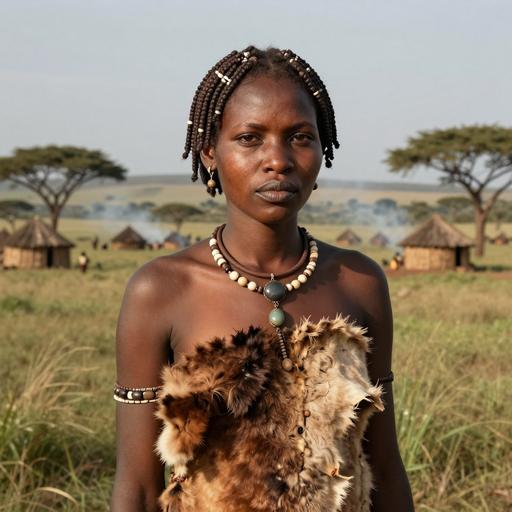
Around 2000 years before present (approximately 1 CE), the region of what is now South Africa was experiencing significant changes and developments, particularly with the arrival and spread of Bantu-speaking peoples. While precise details about this era can be sparse due to limited archaeological records, we can construct a broad understanding based on available evidence and scholarly interpretations.
Indigenous Populations:
Before the arrival of the Bantu-speaking peoples, the region was primarily inhabited by Khoisan groups, which include both the Khoikhoi (often referred to as Khoi) and the San (historically referred to as Bushmen). These are believed to be among the original inhabitants of southern Africa, living there for thousands of years.
Lifestyle and Economy:
- San: The San people were hunter-gatherers, relying on a deep understanding of their environment for survival. They hunted game, foraged for plants, and used tools made from stone, bone, and wood.
- Khoikhoi: In contrast, the Khoikhoi were primarily pastoralists, herding cattle, sheep, and goats. This more settled lifestyle allowed them to develop different societal structures compared to their hunter-gatherer counterparts.
Social Structure:
- Both groups were organized in small, mobile communities with social structures characterized by a high degree of egalitarianism. Decision-making was commonly communal, and leadership was often based on experience and skill rather than inheritance.
Cultural Practices:
- The Khoisan peoples had rich oral traditions and practiced shamanistic beliefs with a strong emphasis on the spiritual connection between people and nature. Rock art from this era depicts religious rituals, hunting scenes, and daily life, reflecting their cosmological views and cultural heritage.
The Arrival of Bantu-speaking Peoples:
Around this time, Bantu-speaking people began migrating into South Africa from the north. This migration was part of a larger Bantu expansion across sub-Saharan Africa.
Origins and Migration:
- The Bantu migration is believed to have begun in what is today Cameroon or Nigeria, spreading over centuries through sub-Saharan Africa. By 2000 years BP, they started entering the southern region, bringing with them new technologies and societal structures.
Agriculture and Ironworking:
- Significantly, the Bantu introduced agriculture and ironworking to the region. They cultivated crops such as millet and sorghum, which were well-suited to various climates in southern Africa.
- The development and adoption of iron tools and weapons revolutionized local economies and societies, allowing communities to clear land more efficiently, cultivate larger areas, and improve their capabilities in crafting and warfare.
Social and Political Structures:
- Bantu societies were generally more centralized and hierarchical than the indigenous Khoisan groups, often organized into chiefdoms. The presence of chiefs or kings and organized military units marked a shift in political structures.
- The Bantu clans followed patrilineal systems, with emphasis on lineage and familial ties for social organization and cultural continuity.
Language and Culture:
- The introduction of Bantu languages significantly influenced the linguistic landscape, leading to the development of a rich tapestry of languages that are still present in South Africa today.
- Cultural practices, including music, dance, and spiritual beliefs, also spread with the Bantu, contributing to a diverse cultural mosaic in the region.
Interaction and Integration:
The arrival of the Bantu did not lead to the immediate displacement of the Khoisan people. Instead, there was likely a period of interaction, trade, and sometimes conflict.
Trade and Exchange:
- The Bantu and Khoisan groups engaged in trade, exchanging goods such as livestock and iron implements. This interaction facilitated cultural exchanges that enriched both societies.
Conflict and Assimilation:
- Social dynamics included both peaceful interactions and conflicts over resources like land and water. Over time, assimilation and intermarriage occurred, contributing to the complex genetic and cultural heritage of modern South African populations.
Environmental Adaptation:
- The Bantu settlers adapted their agricultural practices to the diverse climates of southern Africa, leading to regional diversity in crops and farming techniques.
In summary, South Africa 2000 years BP was a region of significant cultural and technological transformation. The indigenous Khoisan peoples coexisted with incoming Bantu-speaking communities, leading to profound changes in the region's demographic, cultural, and socio-economic landscape. These developments set the stage for the rich and complex history of southern Africa, evident in the diverse cultures that exist today.