Menu
Store
Blog
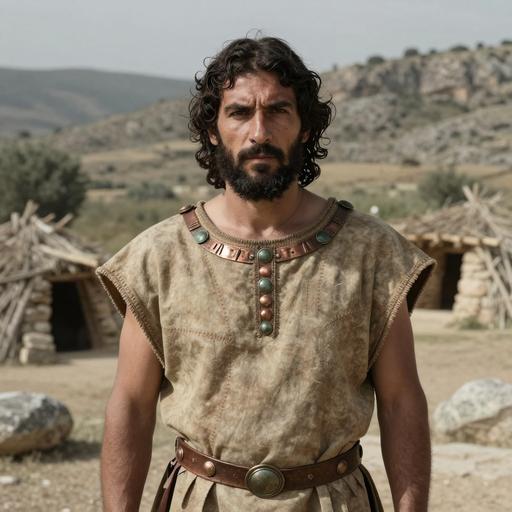
Portrait reconstruction of esp005
Ancient Individual

A man buried in Spain in the Bronze Age era

esp005
1600 BCE - 1300 BCE
Male
Bronze Age Spain
Spain
Scroll to begin
Chapter I

Identity

The biological and cultural markers that define this ancient individual

Sample ID

esp005

Date Range

1600 BCE - 1300 BCE

Biological Sex

Male

mtDNA Haplogroup

K1-a

Y-DNA Haplogroup

R1b-DF27

Cultural Period

Bronze Age Spain

Chapter II

Place

Where this individual was discovered

Country Spain
Locality La Rioja. Cueva de los Lagos
Coordinates 42.3229, -2.4121
Chapter III

Time

When this individual lived in the broader context of human history

esp005 1600 BCE - 1300 BCE
Chapter IV

Story

The narrative of this ancient life

The Bronze Age in the Iberian Peninsula, including what is now modern-day Spain, is a fascinating and complex period that roughly spans from 2300 BCE to 700 BCE. This era marks significant advancements in metallurgy, societal structuring, and cultural development, influenced by various interactions between local and foreign cultures.

Geography and Environment

Bronze Age Spain was characterized by diverse geographical zones including the Mediterranean coastal areas, the interior Meseta, the northern mountainous regions, and the western areas along the Atlantic. These diverse landscapes influenced settlement patterns and economic activities, with coastal regions engaging more in trade while inland areas focused on agriculture and metallurgy.

Social Structure and Settlements

Society during this era was predominantly agricultural, with evidence of small, scattered villages and some larger fortified settlements, particularly in southern Spain. The emergence of such settlements suggests a stratified society, likely with chieftains or tribal leaders who controlled local resources and trade. The presence of fortified sites indicates concerns about security and possibly conflicts or rivalries among different groups or tribes.

Economy and Trade

The economy of Bronze Age Spain was primarily based on agriculture, supplemented by hunting and gathering. The introduction of metallurgy, particularly bronze working, was transformative. Copper ore was widespread, and tin, although less abundant, could be sourced or traded for, allowing for the production of bronze tools and weapons. Trade networks extended across the Mediterranean, connecting Iberian communities with those in the eastern Mediterranean, North Africa, and Europe. This trade was facilitated by the region's coastal access, which played a crucial role in the exchange of goods and cultural influences.

Cultural Influences and Developments

Bronze Age Spain was a melting pot of various cultures. Indigenous cultures such as the Los Millares and El Argar in the southeast were integral to the cultural landscape. The Los Millares culture, in particular, is noted for its significant advancements in fortifications and burial practices, while El Argar culture is known for its social stratification and sophisticated metalworking. These cultures developed distinctive pottery styles and burial practices, including tholos tombs and pit graves.

Contact with other Mediterranean cultures such as the Phoenicians and Mycenaeans likely influenced local Iberian cultures, leading to technological advancements and the adoption of new customs and social structures. The Phoenicians, who settled on the southern coast, significantly impacted local cultures through trade and cultural exchange, introducing new technologies and artistic styles.

Religion and Burial Practices

Religious beliefs during the Bronze Age in Spain are inferred from archaeological finds, including sanctuaries and burial sites. There was a variety of burial practices, which included individual and collective tombs. Megalithic structures, such as dolmens and standing stones, remained significant throughout this period. These structures often served as communal burial sites and possibly as territorial markers or places of worship.

Technological Innovations

The major technological advancement of this era was the development and refinement of metallurgy. The ability to create bronze from copper and tin allowed for the production of stronger and more durable tools and weapons, spurring advancements in agriculture, warfare, and craftsmanship. Artifacts such as swords, axes, and jewelry from this period demonstrate high levels of skill and artistry.

Conclusion

Bronze Age Spain was a dynamic and formative period in the history of the Iberian Peninsula, characterized by technological innovation, increasing social complexity, and cultural exchanges. These developments laid the groundwork for the subsequent Iron Age cultures and the eventual Romanization of the region. The archaeological record from this period, consisting of settlements, artifacts, and burial sites, provides valuable insights into the lives of the people who lived in prehistoric Iberia.

Chapter V

Genetics

The genetic ancestry of this ancient individual

Ancient Genetic Admixture

This analysis compares the DNA profile of esp005 with ancient reference populations, showing the genetic composition in terms of prehistoric ancestral groups.

Neolithic Farmers 39.0%
European Hunter-Gatherers 36.3%
Western Steppe Pastoralists 22.6%
Ancient Africans 2.1%

Modern Genetic Admixture

This analysis compares the DNA profile with present-day reference populations, showing what percentage of genetic makeup resembles modern populations from different regions.

Europe 98.1%
Southern European 66.2%
Iberian 41.0%
Italian 12.9%
Sardinian 12.3%
Northwestern European 31.9%
English 17.5%
Northwestern European 11.9%
Scandinavian 2.5%
Africa 0.9%
African Hunter-Gatherer 0.9%
America 0.6%
America 0.6%
Native American 0.6%

Closest Modern Populations

These are the modern populations showing the closest statistical alignment to A man buried in Spain in the Bronze Age era, ranked by genetic distance. Lower distance values indicate closer statistical similarity.

1
Spanish Burgos
1.9391
2
Basque Soule
1.9805
3
Spanish La Rioja
1.9952
4
French Bearn
2.0756
5
Spanish Biscay
2.1026
6
Basque French
2.1218
7
French South
2.1691
8
French Bigorre
2.1832
9
French Chalosse
2.2153
10
Basque Navarre Center
2.2356
Chapter VI

Context

Other ancient individuals connected to this sample

Sources

References

Scientific publications and genetic data

Scientific Publication

Four millennia of Iberian biomolecular prehistory illustrate the impact of prehistoric migrations at the far end of Eurasia

Authors Valdiosera C, Günther T, Vera-Rodríguez JC
Abstract

Population genomic studies of ancient human remains have shown how modern-day European population structure has been shaped by a number of prehistoric migrations. The Neolithization of Europe has been associated with large-scale migrations from Anatolia, which was followed by migrations of herders from the Pontic steppe at the onset of the Bronze Age. Southwestern Europe was one of the last parts of the continent reached by these migrations, and modern-day populations from this region show intriguing similarities to the initial Neolithic migrants. Partly due to climatic conditions that are unfavorable for DNA preservation, regional studies on the Mediterranean remain challenging. Here, we present genome-wide sequence data from 13 individuals combined with stable isotope analysis from the north and south of Iberia covering a four-millennial temporal transect (7,500-3,500 BP). Early Iberian farmers and Early Central European farmers exhibit significant genetic differences, suggesting two independent fronts of the Neolithic expansion. The first Neolithic migrants that arrived in Iberia had low levels of genetic diversity, potentially reflecting a small number of individuals; this diversity gradually increased over time from mixing with local hunter-gatherers and potential population expansion. The impact of post-Neolithic migrations on Iberia was much smaller than for the rest of the continent, showing little external influence from the Neolithic to the Bronze Age. Paleodietary reconstruction shows that these populations have a remarkable degree of dietary homogeneity across space and time, suggesting a strong reliance on terrestrial food resources despite changing culture and genetic make-up.

G25 Coordinates

The G25 coordinates for sample esp005 can be used for detailed admixture analysis in our G25 Studio tool.

esp005,0.12171018,0.15380022,0.04675224,2.592E-05,0.05349674,-0.00256406,-0.0007387,0.00518228,0.02820966,0.04246,-0.0081944,0.01311952,-0.0226334,-0.00984988,0.00804018,-0.00067554,-0.01071902,-0.00157436,-0.00106946,-0.00205084,0.005738,0.00556014,-0.01114054,-0.01031058,0.0021789
Analyze in G25 Studio
Use code for 40% off Expires Feb 26