Menu
Currency
Main
Store
Blog

Loading Report

Preparing your ancestry journey

Connecting to ancient matches...

Preparing your report

Skip to main content
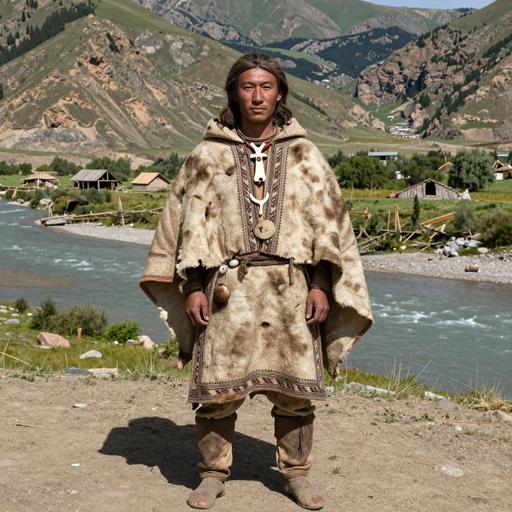
Portrait reconstruction of A man buried in Russia in the Early Bronze Age era
Ancient Individual

A man buried in Russia in the Early Bronze Age era

A man buried in Russia during the Afanasievo Culture

A fragment of the ancient world, preserved across millennia in strands of DNA.

I3949
2844 BCE - 2496 BCE
Male
Russia
Scroll to begin
Chapter I

Identity

The biological and cultural markers that define this ancient individual

Sample ID

I3949

Date Range

2844 BCE - 2496 BCE

Cultural Period

Afanasievo Culture

Biological Sex

Male

mtDNA Haplogroup

U5a1d2b*

Y-DNA Haplogroup

Q-FT380500

Chapter II

Place

Where this individual was discovered

Country Russia
Locality Altai Mountains. Yenisey River. left bank of Karasuk tributary. Karasuk III
Coordinates 48.8327, 83.9097
Chapter III

Time

When this individual lived in the broader context of human history

I3949 2844 BCE - 2496 BCE
Chapter IV

Story

The narrative of this ancient life

The Afanasievo culture, existing from approximately 3500 to 2500 BCE, represents one of the early manifestations of the Indo-European cultural and linguistic family. It played a crucial role in shaping the prehistoric landscape across parts of what is now southern Siberia and Central Asia. Named after the village of Afanasievo in the Russian Altai Mountains where the first archaeological findings were gathered, this culture provides a fascinating glimpse into the lives of one of the earliest groups to spread Indo-European languages.

Geographical and Chronological Context: The Afanasievo culture appeared in the Altai-Sayan region, spanning across southern Siberia into Mongolia and the foothills of the Altai Mountains. This culture emerged during the Bronze Age, sharing temporal proximity with other significant early European cultures, such as the Yamnaya on the western steppes.

Archaeological Characteristics: The Afanasievo people are primarily known through their burial sites, which display rich mortuary practices. Burials were typically conducted in rectangular pits with stone coverings, and the dead were often laid on their backs, sometimes interred with personal belongings and cattle remains. These practices suggest a community deeply reliant on livestock and indicative of a pastoral lifestyle, a hallmark of many Proto-Indo-European societies.

Material Culture and Technology: The material culture of the Afanasievo is characterized by distinctive pottery, which includes flat-bottomed jars, often embellished with geometric patterns. Stone was the primary material for tool-making, including polished axe heads and other implements. There is also evidence of basic metallurgy, with copper items having been recovered, signaling an early transition from the Stone Age toward more advanced metal use.

Economy and Subsistence: The Afanasievo people were primarily pastoralists, herding cattle, sheep, and goats. This aligns with the economic patterns of many Steppe cultures, supporting a semi-nomadic lifestyle with elements of settled pastoralism. The presence of domesticated animals, particularly horses, suggests a culture adept in animal husbandry and potentially the early use of horses in transport and communication.

Cultural and Linguistic Significance: One of the most compelling aspects of the Afanasievo culture is its possible connection to the broader spread of Indo-European languages. The similarities between Afanasievo and cultures like Yamnaya, especially in burial practices and economic structures, support theories that the Afanasievo culture might have played a role in the eastern expansion of Indo-European peoples. This connection is crucial for understanding the prehistoric dissemination and development of Indo-European languages across Eurasia.

Interactions and Legacy: While the Afanasievo culture thrived, it likely interacted with neighboring cultures, influencing and being influenced by them. Its eventual overlap with the Okunev culture suggests a period of cultural transition or amalgamation. The precise nature of these interactions remains a subject of archaeological investigation, but they underscore the dynamic nature of cultural exchange in prehistoric times.

In summary, the Afanasievo culture is a pivotal chapter in the prehistoric narrative of Eurasia, offering insights into the early movements and influences of Indo-European groups across the vast steppes. Its legacy is visible in the continuities observed in subsequent regional developments as well as its contributions to the historical tapestry that has shaped modern linguistic and cultural landscapes.

Context

Related Samples

This individual exists within a broader network of ancient samples. No ancient genome stands alone.

Sample ID Culture/Period Date Location Action
I3388 Afanasievo Culture 2800 BCE Altai Mountains. Yenisey River. left bank of Karasuk tributary. Karasuk III, Russia View
I3949 Afanasievo Culture 2844 BCE Altai Mountains. Yenisey River. left bank of Karasuk tributary. Karasuk III, Russia View
I3950 Afanasievo Culture 2879 BCE Altai Mountains. Yenisey River. left bank of Karasuk tributary. Karasuk III, Russia View
I6714 Afanasievo Culture 2618 BCE Altai Mountains. Yenisey River. left bank of Karasuk tributary. Karasuk III, Russia View
I3388 2800 BCE Altai Mountains. Yenisey River. left bank of Karasuk tributary. Karasuk III, Russia View
I3949 2844 BCE Altai Mountains. Yenisey River. left bank of Karasuk tributary. Karasuk III, Russia View
I3950 2879 BCE Altai Mountains. Yenisey River. left bank of Karasuk tributary. Karasuk III, Russia View
I6714 2618 BCE Altai Mountains. Yenisey River. left bank of Karasuk tributary. Karasuk III, Russia View
Sample ID Culture/Period Date Location Action
I6712 Afanasievo Culture 2857 BCE Middle Yenisei region. Afanasieva Gora, Russia View
I6711 Afanasievo Culture 2950 BCE Middle Yenisei region. Afanasieva Gora, Russia View
I6713 Afanasievo Culture 3000 BCE Middle Yenisei region. Afanasieva Gora, Russia View
I6715 Afanasievo Culture 3300 BCE Altai Mountains. Yenisey River. left bank of Karasuk tributary. Karasuk III, Russia View
I2069 Afanasievo Culture 3331 BCE Altai Autonomous Republic. Ust-Kanski. Altai Mountains. Kaminnaya Cave, Russia View
I2071 Afanasievo Culture 3088 BCE Altai Mountains. Ust'-Kuyum, Russia View
I3951 Afanasievo Culture 2881 BCE Altai Mountains. Yenisey River. left bank of Karasuk tributary. Karasuk III, Russia View
I3954 Afanasievo Culture 2874 BCE Altai Mountains. Yenisey River. left bank of Karasuk tributary. Karasuk III, Russia View
I1829 Afanasievo Culture 3011 BCE Altai Mountains. Saldyar-1 cemetery, Russia View
I3952 Afanasievo Culture 2868 BCE Altai Mountains. Yenisey River. left bank of Karasuk tributary. Karasuk III, Russia View
I5269 Afanasievo Culture 3016 BCE Elo 1, Russia View
I5270 Afanasievo Culture 3323 BCE Elo 1, Russia View
I5271 Afanasievo Culture 3011 BCE Elo 1, Russia View
I5272 Afanasievo Culture 3006 BCE Elo Bashi, Russia View
I5273 Afanasievo Culture 3011 BCE Lower Tyumechin 1, Russia View
I5277 Afanasievo Culture 3092 BCE Elo Bashi, Russia View
I5278 Afanasievo Culture 3082 BCE Lower Tyumechin 1, Russia View
I5279 Afanasievo Culture 3011 BCE Lower Tyumechin 1, Russia View
I3387 Afanasievo Culture 2950 BCE Middle Yenisei region. Afanasieva Gora, Russia View
I10565 Afanasievo Culture 2889 BCE Middle Yenisei region. Afanasieva Gora, Russia View
I10564 Afanasievo Culture 3300 BCE Middle Yenisei region. Afanasieva Gora, Russia View
I11112 Afanasievo Culture 3050 BCE Krasnoyarsk Krai. Minusinsk Rayon. Podsukhanika II, Russia View
I11752 Afanasievo Culture 2900 BCE Inskoy Dol, Russia View
I3388 Afanasievo Culture 2800 BCE Altai Mountains. Yenisey River. left bank of Karasuk tributary. Karasuk III, Russia View
I3949 Afanasievo Culture 2844 BCE Altai Mountains. Yenisey River. left bank of Karasuk tributary. Karasuk III, Russia View
I3950 Afanasievo Culture 2879 BCE Altai Mountains. Yenisey River. left bank of Karasuk tributary. Karasuk III, Russia View
I6714 Afanasievo Culture 2618 BCE Altai Mountains. Yenisey River. left bank of Karasuk tributary. Karasuk III, Russia View
RISE511 Afanasievo Culture 2909 BCE Bateni, Russia View
RISE507.508.merge Afanasievo Culture 3323 BCE River Kuyum, Russia View
RISE510 Afanasievo Culture 2848 BCE Bateni, Russia View
Sources

References

Scientific publications and genetic data that inform this profile.

Scientific Publication

A unified genealogy of modern and ancient genomes

Authors Wohns AW, Wong Y, Jeffery B, Akbari A, Mallick S et al.
Abstract

The sequencing of modern and ancient genomes from around the world has revolutionized our understanding of human history and evolution. However, the problem of how best to characterize ancestral relationships from the totality of human genomic variation remains unsolved. Here, we address this challenge with nonparametric methods that enable us to infer a unified genealogy of modern and ancient humans. This compact representation of multiple datasets explores the challenges of missing and erroneous data and uses ancient samples to constrain and date relationships. We demonstrate the power of the method to recover relationships between individuals and populations as well as to identify descendants of ancient samples. Finally, we introduce a simple nonparametric estimator of the geographical location of ancestors that recapitulates key events in human history.

Use code for 25% off Expires Jul 12