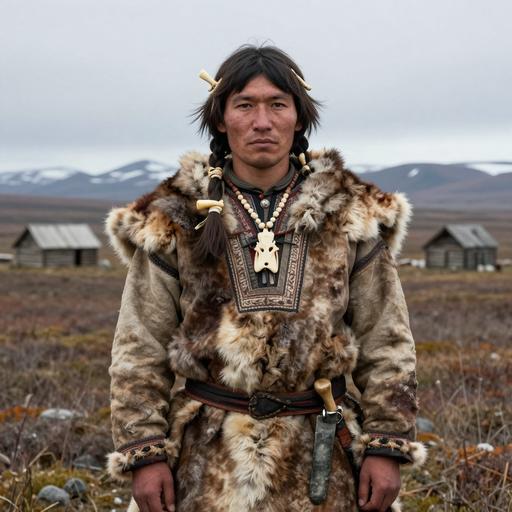
I7332 - A man buried in Russia in the Early Iron Age era

Download PDF creates a visual, rasterized copy. Use Print for selectable text and better assistive-technology support.

Menu
Currency
Main
Store
Blog

Loading Report

Preparing your ancestry journey

Connecting to ancient matches...

Preparing your report

Skip to main content
Portrait reconstruction of A man buried in Russia in the Early Iron Age era
Ancient Individual

A man buried in Russia in the Early Iron Age era

A man buried in Russia during the Old Bering Sea Culture Ekven, Russia

A fragment of the ancient world, preserved across millennia in strands of DNA.

I7332
690 CE - 1070 CE
Male
Russia
Scroll to begin
Chapter I

Identity

The biological and cultural markers that define this ancient individual

Sample ID

I7332

Date Range

690 CE - 1070 CE

Cultural Period

Old Bering Sea Culture Ekven, Russia

Biological Sex

Male

mtDNA Haplogroup

A2a

Y-DNA Haplogroup

Q-A15256

Social Role

Fisher (AI estimate, era-typical)

Chapter II

Place

Where this individual was discovered

Country Russia
Locality Ekven. Chukotka. Bering Strait
Chapter III

Time

When this individual lived in the broader context of human history

I7332 690 CE - 1070 CE
Chapter IV

Story

The narrative of this ancient life

The Old Bering Sea culture, notably exemplified by the site at Ekven in Chukotka, Russia, is an archaeological manifestation of the Arctic cultures that thrived from approximately 200 BCE to 500 CE. This culture is integral to our understanding of the prehistoric peoples inhabiting the Bering Strait region, encompassing what is now parts of eastern Russia and western Alaska. The Ekven site offers rich insights due to its exceptionally preserved archaeological finds, which reveal aspects of the lifestyle, technology, art, and spirituality of its people.

Geographic and Environmental Context

Ekven is located on the Chukotka Peninsula in northeastern Siberia, an area characterized by its permafrost and tundra. The harsh Arctic climate influenced the adaptive strategies of its inhabitants, including their hunting, clothing, and architectural styles. The Bering Sea, rich in marine resources, played a central role in the subsistence and culture of the Old Bering Sea peoples.

Material Culture and Technology

The Old Bering Sea culture is renowned for its sophisticated use of ivory, bone, and stone. The people skillfully crafted tools and implements primarily from walrus ivory and bones of other marine mammals. These items include harpoons, knives, scrapers, and bowls, which were essential for hunting and daily life. Their tool technology demonstrates an intimate understanding of both their environment and the materials available to them.

One of the most remarkable aspects of this culture is its art: intricately carved ivory artifacts featuring complex geometric patterns and animal motifs. These designs are believed to hold symbolic or spiritual significance, possibly related to shamanistic practices. The artistic style of the Old Bering Sea culture is often regarded as one of the most distinctive in Arctic archaeology.

Subsistence and Economy

The economy of the Old Bering Sea culture was heavily reliant on marine resources. The people were skilled hunters of seals, walrus, and whales, which provided not only food but also raw materials for tools, clothing, and housing. They supplemented their diet with land-based resources like caribou, birds, and plants when available.

The Bering Sea peoples' seasonal movements likely mirrored the migratory patterns of the animals they depended on, showcasing a deep ecological knowledge and adaptability.

Social Structure and Settlement

Archaeological evidence suggests that settlements like Ekven were semi-permanent, with homes constructed from driftwood, sod, and whale bones. These structures were well-insulated against the Arctic cold. The layout and size of the settlements suggest a communal lifestyle, potentially reflecting a societal structure organized around extended family groups or clans.

Burial sites unearthed at Ekven and other locations provide valuable information about social stratification and beliefs. The presence of grave goods, including tools, jewelry, and carvings, indicates a belief in an afterlife and suggests a complex spiritual world.

Spirituality and Art

The depictions found in carvings and artifacts suggest the Old Bering Sea culture held a profound connection with the natural and spiritual world. Shamans likely played a significant role in mediating between humans, nature, and the spirit world. The emphasis on animal motifs in their art indicates that animals were central to their myths and rituals, possibly serving as totems or spiritual guides.

Significance and Legacy

The Old Bering Sea culture is a precursor to later Arctic cultures such as the Punuk and Thule, which eventually influenced the Inupiat and Yupik peoples. The innovations and traditions developed during this period laid the groundwork for future adaptations to the rigorous Arctic environment, illustrating a continuous thread of cultural evolution across millennia.

The study of the Old Bering Sea culture, especially through sites like Ekven, sheds light on the ingenuity and resilience of human populations in one of the world's most challenging environments. As climate change and modern developments impact the Arctic, understanding these ancient cultures provides valuable lessons in sustainability and adaptation.

Chapter V

Genetics

These comparisons show genetic similarity, not identity or origin. The populations listed are those whose genomes show statistical alignment to this ancient individual.

Similarity reflects shared history, not shared identity. These are analytical comparisons, not claims about who this person was.

Modern Genetic Admixture

This analysis compares the DNA profile with present-day reference populations, showing statistical similarity to modern reference populations from different regions. The excavation site records where this individual was found, not a fixed modern genetic identity.

Asia 61.2%
Northern Asian 51.3%
Siberian 42.4%
Mongolian 8.9%
Japanese & Korean 6.6%
Japanese 6.6%
Chinese & Southeast Asian 2.9%
Tibetan 2.9%
America 38.5%
America 38.5%
Native American 38.5%

Closest Modern Populations

These are the modern populations showing the closest statistical alignment to A man buried in Russia in the Early Iron Age era, ranked by genetic distance. Lower distance values indicate closer statistical similarity. Cross-region similarity can reflect shared ancestry, population movement, continuity, or later admixture.

1
Eskimo Naukan
4.7081
2
Eskimo
5.4147
Context

Related Samples

This individual exists within a broader network of ancient samples. No ancient genome stands alone.

Sample ID Culture/Period Date Location Action
I7336 Ust-Belaya Angara Culture, Russia 4350 BCE Baikal Region. Angara river basin. Mouth of the Belaya River, Russia View
I7757 Old Bering Sea Culture Uelen, Russia 900 CE Uelen Chukotka. Bering Strait, Russia View
I7332 Old Bering Sea Culture Ekven, Russia 690 CE Ekven. Chukotka. Bering Strait, Russia View
I7346 Old Bering Sea Culture Ekven, Russia 620 CE Ekven. Chukotka. Bering Strait, Russia View
I7780 Ust-Belaya Angara Culture, Russia 2840 BCE Baikal Region. Angara river basin. Mouth of the Belaya River, Russia View
I7341 710 CE Chukotka. Bering Strait. Ekven, Russia View
Sample ID Culture/Period Date Location Action
I7333 Old Bering Sea Culture Ekven, Russia 510 CE Chukotka. Bering Strait. Ekven, Russia View
I7347 Old Bering Sea Culture Ekven, Russia 1050 CE Chukotka. Bering Strait. Ekven, Russia View
I7349 Old Bering Sea Culture Ekven, Russia 640 CE Chukotka. Bering Strait. Ekven, Russia View
I7621 Old Bering Sea Culture Ekven, Russia 480 CE Chukotka. Bering Strait. Ekven, Russia View
I7348 Old Bering Sea Culture Ekven, Russia 630 CE Chukotka. Bering Strait. Ekven, Russia View
I7331 Old Bering Sea Culture Ekven, Russia 720 CE Chukotka. Bering Strait. Ekven, Russia View
I7339 Old Bering Sea Culture Ekven, Russia 690 CE Chukotka. Bering Strait. Ekven, Russia View
I7340 Old Bering Sea Culture Ekven, Russia 810 CE Chukotka. Bering Strait. Ekven, Russia View
I7338 Old Bering Sea Culture Ekven, Russia 1210 CE Chukotka. Bering Strait. Ekven, Russia View
I7343 Old Bering Sea Culture Ekven, Russia 970 CE Chukotka. Bering Strait. Ekven, Russia View
I7344 Old Bering Sea Culture Ekven, Russia 730 CE Chukotka. Bering Strait. Ekven, Russia View
I7337 Old Bering Sea Culture Ekven, Russia 620 CE Chukotka. Bering Strait. Ekven, Russia View
I20756 Old Bering Sea Culture Ekven, Russia 970 CE Chukotka. Bering Strait. Ekven, Russia View
I7332 Old Bering Sea Culture Ekven, Russia 690 CE Ekven. Chukotka. Bering Strait, Russia View
I7346 Old Bering Sea Culture Ekven, Russia 620 CE Ekven. Chukotka. Bering Strait, Russia View
I7341 Old Bering Sea Culture Ekven, Russia 710 CE Chukotka. Bering Strait. Ekven, Russia View
I7342 Old Bering Sea Culture Ekven, Russia 348 BCE Chukotka. Bering Strait. Ekven, Russia View
Sources

References

Scientific publications and genetic data that inform this profile.

G25 Coordinates

These coordinates represent a position in genetic space, a tool for comparison, not a conclusion. You can use these to perform custom admixture analysis in G25 Studio.

I7332,0.04948284,-0.34621398,0.11105606,0.05224636,-0.11650758,-0.03151266,-0.13064412,-0.15049178,0.00605752,-0.01241134,0.02413216,-0.00726378,0.00739764,-0.0194058,-0.0325704,-0.01580824,0.00139246,0.01756622,0.0345271,0.01770516,0.02395896,-0.04338248,0.00879318,0.0261544,0.03587273
Continue in G25 Studio
Use code for 35% off Expires Aug 15