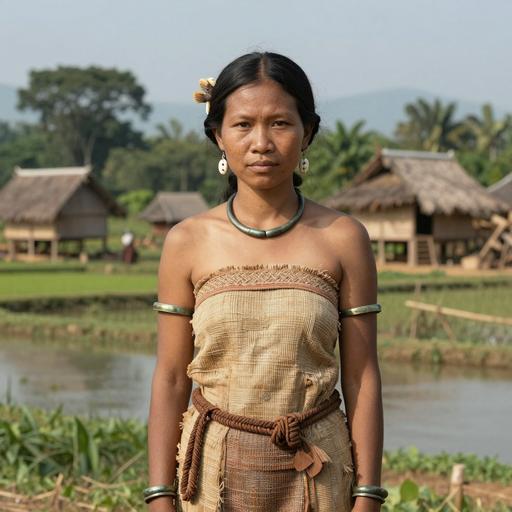
The Late Neolithic to Bronze Age period in Thailand marks a significant epoch in the cultural and technological development of Southeast Asian civilizations. This era, roughly dating from around 2000 BCE to 500 BCE, represents a transition from hunting and gathering societies to more complex and organized communities with advances in agriculture, metallurgy, and trade. During this time, the foundations were laid for societal structures that would influence future civilizations in the region.
Geography and Environmental Context
Thailand’s geographical landscape, including the fertile plains of the Chao Phraya River basin, the highlands of the northern region, and the coastal areas, played a crucial role in shaping the culture and lifestyle of its ancient inhabitants. The climate, largely tropical and conducive to rice cultivation and other forms of agriculture, supported burgeoning populations and settlements.
Neolithic Beginnings
The Late Neolithic period in Thailand is characterized by small, sedentary communities with a subsistence economy primarily reliant on agriculture, hunting, and gathering. The domestication of rice, a pivotal advancement, allowed substantial growth in population density and led to the development of permanent settlements. Pottery and stone tools from this era, which often featured intricate designs, provide insights into the everyday life and artistic sensibilities of the inhabitants.
Transition to the Bronze Age
The transition to the Bronze Age in Thailand began around 1500 BCE, marked by significant advancements in metallurgy. Archaeological sites such as Ban Chiang, Ban Non Wat, and Ban Prasat highlight the early use of bronze for crafting tools, weapons, and ornaments. The discovery of these materials suggests a growing sophistication in technological skills and social structures. Bronze metallurgy likely arrived through both independent innovation and external influences via extensive trade networks.
Social and Political Structures
As metallurgy and agriculture advanced, so too did social complexity. The formation of larger communities necessitated more intricate social and political organizations. Evidence suggests that these societies may have had hierarchical structures, with emerging elite classes as seen in the varied burial goods found in different graves. The diverse range of artifacts, including jewelry, pottery, and tools, reflects the presence of specialized craftspeople within these societies.
Cultural and Artistic Developments
Artistic expressions during this era included pottery adorned with unique spiral and linear decorations, which are emblematic of Late Neolithic to early Bronze Age art in Southeast Asia. The period also saw the development of textile production and weaving, as indicated by discoveries of spindle whorls and loom weights. These artifacts highlight the value placed on textile crafts and the possible symbolic or ritualistic uses of these items.
Trade and Exchange Networks
The Late Neolithic to Bronze Age period in Thailand was also marked by the increased complexity of trade and exchange networks. Goods such as stone, shell, and pottery, as well as technological innovations like metallurgy, were exchanged over vast distances, suggesting a network that connected what is now Thailand to other parts of Southeast Asia, possibly extending to South Asia and China. This interconnectedness facilitated cultural exchanges that influenced linguistic, technological, and social developments.
Religious and Ritualistic Practices
Though the specifics of religious practices during the Late Neolithic to Bronze Age in Thailand remain partially obscured, burial site excavations offer clues. Variations in grave goods and burial positioning suggest beliefs in an afterlife and a social stratification in burial rites. Ritual objects and possibly ceremonial structures point to a complex spiritual life and the role of religious leaders or shamans within these communities.
Legacy and Influence
The developments during the Late Neolithic to Bronze Age in Thailand provided the groundwork for the rise of more complex societies in the subsequent Iron Age and early historical periods. These advancements laid the foundation for the sophisticated polities and cultures that would emerge in Thailand and the greater Southeast Asian region, influencing linguistic, cultural, and technological trajectories for centuries to come.
In summary, the Late Neolithic to Bronze Age period in Thailand was a time of profound transformation, marked by technological innovation, societal organization, and cultural development. These changes not only shaped the future of the region but also contributed to the broader narrative of human civilization’s evolution in Southeast Asia.