Menu
Store
Blog
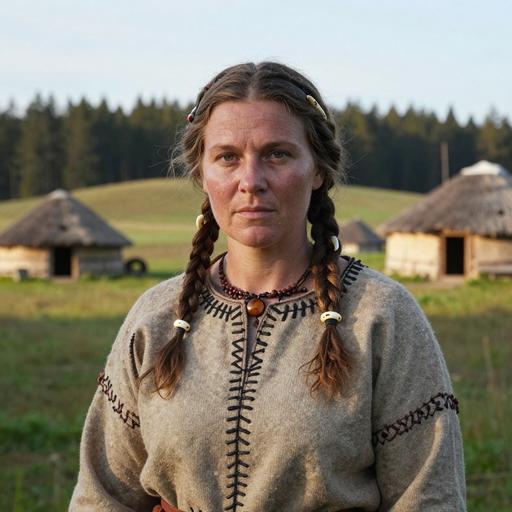
Portrait reconstruction of kar1
Ancient Individual

A woman buried in Estonia in the Bronze Age era

kar1
2447 BCE - 2136 BCE
Female
Corded Ware Culture, Estonia
Estonia
Scroll to begin
Chapter I

Identity

The biological and cultural markers that define this ancient individual

Sample ID

kar1

Date Range

2447 BCE - 2136 BCE

Biological Sex

Female

mtDNA Haplogroup

H1f1a

Cultural Period

Corded Ware Culture, Estonia

Chapter II

Place

Where this individual was discovered

Country Estonia
Locality Karlova
Coordinates 58.3668, 26.7345
Chapter III

Time

When this individual lived in the broader context of human history

kar1 2447 BCE - 2136 BCE
Chapter IV

Story

The narrative of this ancient life

The Corded Ware Culture (CWC) in Estonia is part of a broader prehistoric culture that spanned much of Northern and Central Europe during the late Neolithic and early Copper Age, approximately between 2900 BCE and 2350 BCE. This culture is particularly notable for its role in the dispersal of Proto-Indo-European languages and is often associated with significant population movements and cultural transformations.

Geography and Environment:

The Corded Ware Culture in Estonia developed in a region characterized by its northern latitude, which influenced its climate, biodiversity, and resources. Estonia's landscape during the Corded Ware period included extensive forests, numerous lakes, rivers, and a Baltic Sea coastline—an environment that the inhabitants adapted to in their subsistence strategies.

Social and Cultural Characteristics:

  1. Settlement and Housing:

    • The Corded Ware people were semi-sedentary, often establishing small, dispersed settlements. Housing structures were typically modest and built with local materials like wood and clay, reflecting the necessity of adaptability to a mixed economy of farming, herding, and foraging.
  2. Economy and Subsistence:

    • Agriculture was a crucial part of the Corded Ware economy, with evidence suggesting the cultivation of cereals like barley and wheat. They supplemented farming with animal husbandry, particularly cattle, sheep, and pigs, which denoted a transition towards a more settled, agrarian lifestyle.
    • Fishing and hunting remained vital, taking advantage of Estonia’s rich aquatic and forest resources. Gathered resources, such as berries and nuts, also played a role in their diet.
  3. Technology and Craftsmanship:

    • The Corded Ware Culture is named after its distinctive pottery, which is decorated with cord-like impressions. These ceramics illustrate a shared aesthetic and technological tradition across the culture's expanse.
    • People in this culture were adept at working bone, flint, and later, copper, indicating evolving technological capabilities. Tools like axes, arrowheads, and sickles reveal their multifunctional economy and the importance of woodcutting and farming.
  4. Burial Practices and Beliefs:

    • Corded Ware burial practices often involved single graves, sometimes beneath small mounds, reflecting both individual status and potentially spiritual beliefs. Graves typically included a set of personal artifacts, such as pottery, stone axes, and ornaments, indicating the presence of burial rituals or notions of an afterlife.
  5. Symbolic and Linguistic Aspects:

    • The Corded Ware Culture is hypothesized to have played a critical role in the spread of Proto-Indo-European languages across Europe. This linguistic movement suggests substantial cultural exchange, migration, or assimilation with other contemporary societies.

Interactions and Impact:

  • The Corded Ware Culture interacted with neighboring cultures, such as the Funnelbeaker and Narva cultures. These interactions likely included trade, as evidenced by the exchange of goods and materials like amber and flint.
  • The transition to the Corded Ware Culture in Estonia represents significant socio-cultural changes from the preceding Neolithic societies. These changes may have been driven by technological innovations, shifts in subsistence strategies, and external influences.

Legacy:

The Corded Ware Culture left a lasting influence on the archaeological and linguistic landscape of Europe and Estonia. It provides key insights into the early spread of Indo-European languages and the transition to more complex societies, with continuity visible in subsequent archaeological cultures.

In summary, the Corded Ware Culture in Estonia was characterized by its distinctive pottery, mixed economy, and significant role in the evolution of Indo-European languages. Its legacy is reflected in the cultural and linguistic foundations of later European societies.

Chapter V

Genetics

The genetic ancestry of this ancient individual

Ancient Genetic Admixture

This analysis compares the DNA profile of kar1 with ancient reference populations, showing the genetic composition in terms of prehistoric ancestral groups.

European Hunter-Gatherers 41.9%
Western Steppe Pastoralists 40.6%
Ancient Asians 7.7%
Neolithic Farmers 7.4%
Ancient Africans 2.4%

Modern Genetic Admixture

This analysis compares the DNA profile with present-day reference populations, showing what percentage of genetic makeup resembles modern populations from different regions.

Europe 99.6%
Northwestern European 57.0%
Finnish 31.3%
English 12.0%
Northwestern European 10.9%
Scandinavian 2.8%
Eastern European 39.8%
Southern European 2.8%
Balkan 2.8%

Closest Modern Populations

These are the modern populations showing the closest statistical alignment to A woman buried in Estonia in the Bronze Age era, ranked by genetic distance. Lower distance values indicate closer statistical similarity.

1
Russian Tver
1.8835
2
Estonian
2.1434
3
Russian Yaroslavl
2.1630
4
Russian Kursk
2.2764
5
Russian Ryazan
2.3286
6
Russian Pskov
2.4060
7
Russian Kaluga
2.4613
8
Russian Kostroma
2.5712
9
Russian Orel
2.6513
10
Ukrainian Dnipro
2.6616
Chapter VI

Context

Other ancient individuals connected to this sample

Sources

References

Scientific publications and genetic data

Scientific Publication

The genomic ancestry of the Scandinavian Battle Axe Culture people and their relation to the broader Corded Ware horizon

Authors Malmström H, Günther T, Svensson EM
Abstract

The Neolithic period is characterized by major cultural transformations and human migrations, with lasting effects across Europe. To understand the population dynamics in Neolithic Scandinavia and the Baltic Sea area, we investigate the genomes of individuals associated with the Battle Axe Culture (BAC), a Middle Neolithic complex in Scandinavia resembling the continental Corded Ware Culture (CWC). We sequenced 11 individuals (dated to 3330-1665 calibrated before common era (cal BCE)) from modern-day Sweden, Estonia, and Poland to 0.26-3.24× coverage. Three of the individuals were from CWC contexts and two from the central-Swedish BAC burial 'Bergsgraven'. By analysing these genomes together with the previously published data, we show that the BAC represents a group different from other Neolithic populations in Scandinavia, revealing stratification among cultural groups. Similar to continental CWC, the BAC-associated individuals display ancestry from the Pontic-Caspian steppe herders, as well as smaller components originating from hunter-gatherers and Early Neolithic farmers. Thus, the steppe ancestry seen in these Scandinavian BAC individuals can be explained only by migration into Scandinavia. Furthermore, we highlight the reuse of megalithic tombs of the earlier Funnel Beaker Culture (FBC) by people related to BAC. The BAC groups likely mixed with resident middle Neolithic farmers (e.g. FBC) without substantial contributions from Neolithic foragers.

G25 Coordinates

The G25 coordinates for sample kar1 can be used for detailed admixture analysis in our G25 Studio tool.

kar1,0.12547018,0.10635318,0.08099094,0.07234636,0.03467144,0.02925006,0.01001346,0.0159137,-0.00256814,-0.0291473,-0.00189384,-0.00754762,0.01729186,0.01746572,-0.00635162,0.00116672,-0.00072298,-0.00200406,0.00268754,-0.0003965,0.00120224,-0.00254684,0.00031484,0.00298742,-0.0013848
Analyze in G25 Studio
Use code for 40% off Expires Feb 26