Menu
Store
Blog
Western Azerbaijan (Tovuz district)

Mentesh Tepe: Echoes of Early Caucasus

Three genomes illuminate a fragmentary Shulaveri‑Shomutepe presence in western Azerbaijan

6000 CE - 4000 BCE
Scroll to begin
Chapter I

The Story

Understanding the Mentesh Tepe: Echoes of Early Caucasus culture

Archaeogenetic and archaeological evidence from Mentesh Tepe (Tovuz district, Azerbaijan) links early Bronze Age Shulaveri‑Shomutepe occupation to broader Caucasus population dynamics. Limited (n=3) DNA data show J-lineage Y-DNA and highlight the provisional nature of conclusions.

Time Period

ca. 6000–4000 BCE

Region

Western Azerbaijan (Tovuz district)

Common Y-DNA

J (observed in 2 of 3 samples; preliminary)

Common mtDNA

Not reported / limited sample size

Chapter II

Timeline

Key moments in the history of this culture

5000 BCE

Occupation of Mentesh Tepe

Radiocarbon‑anchored occupation consistent with Shulaveri‑Shomutepe horizons; settlement and farming activity at the site.

Chapter III

Origins & Emergence

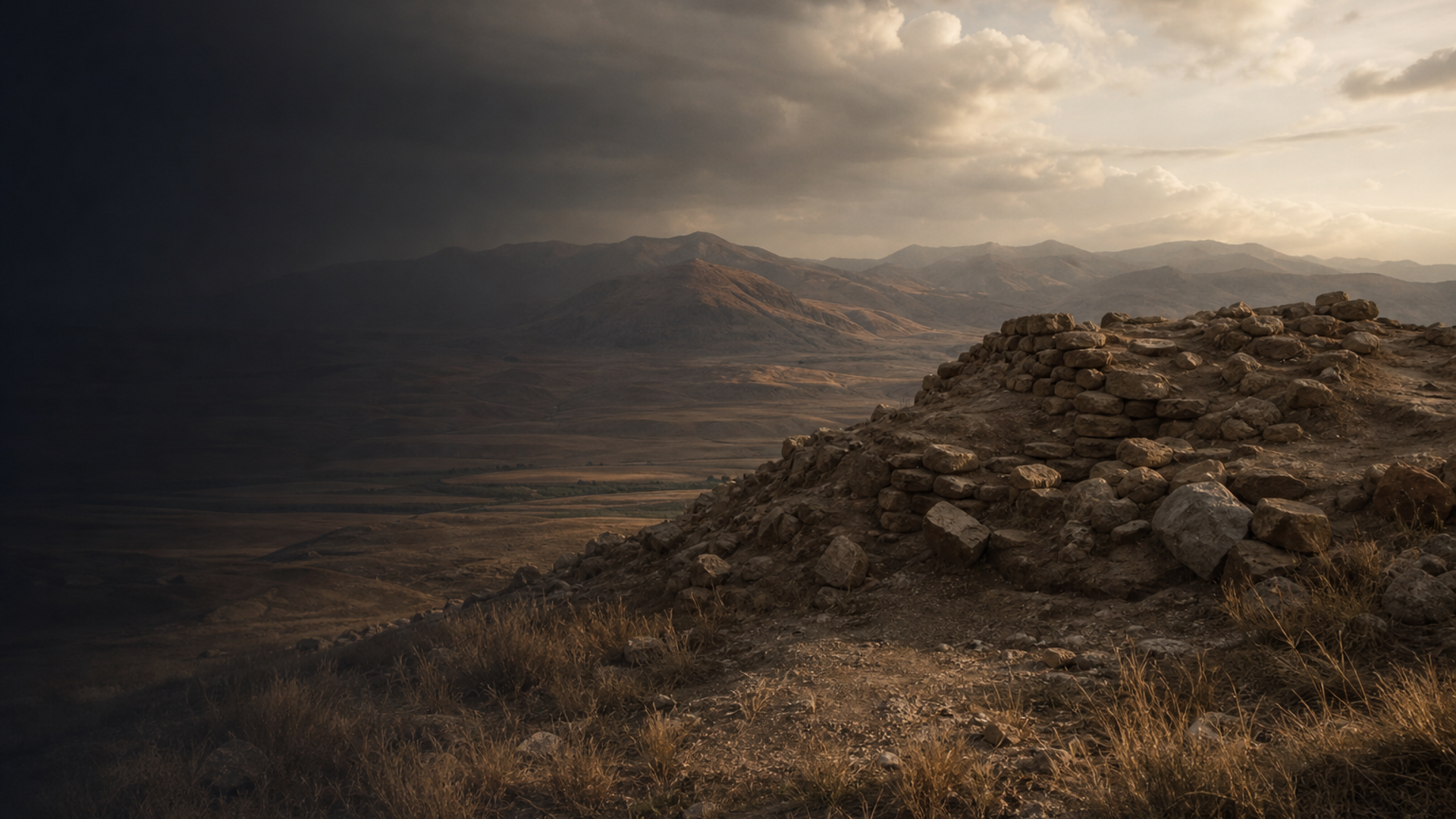
The mound of Mentesh Tepe, in the rolling lowlands of western Azerbaijan (Tovuz district), sits at a crossroads of the early Neolithic and Bronze Age worlds. Archaeological layers and radiocarbon determinations place occupation within the long span conventionally associated with the Shulaveri‑Shomutepe cultural horizon, a local Neolithic–Chalcolithic tradition that persisted and transformed into the early Bronze Age in the southern Caucasus. Architectural remains — circular mudbrick houses, hearths, and densely packed rubbish pits — evoke a settled, agrarian community whose material culture blends local traditions with influences from Anatolia and the Iranian plateau.

Material culture from Mentesh Tepe includes simple painted pottery, obsidian and flint tools, and early copper artifacts in later layers. These finds mirror broader Shulaveri‑Shomutepe assemblages known from prominent sites such as Shulaveri and Shomutepe, suggesting shared lifeways of crop cultivation, herding, and household craft. Archaeological data indicate long-term continuity of local practices, yet also hint at episodic contacts with neighboring highland and lowland groups.

Genetic results for this group are extremely limited (n=3) and must be treated as preliminary. Nonetheless, the presence of Y‑DNA J in two individuals aligns with wider patterns across the Caucasus where J lineages appear in multiple time depths. Limited evidence suggests these people belonged to a network of interconnected communities rather than an isolated pocket: the archaeological and genetic signals together paint a picture of rooted local life with external threads of contact and exchange.

  • Mentesh Tepe located in Tovuz district, western Azerbaijan
  • Occupation linked to Shulaveri‑Shomutepe cultural horizon
  • Material culture shows local farming economy with external contacts
Chapter IV

Daily Life & Society

Daily life at Mentesh Tepe can be imagined through the residues of hearths, grinding stones, and domestic pottery. House plans reveal circular and semi‑subterranean structures used for both living and craft production. Botanical remains from related Shulaveri‑Shomutepe contexts indicate cultivation of cereals and pulses, while faunal assemblages point to sheep, goat, and cattle herding — a mixed agricultural economy adapted to the patchwork of river valleys and foothills.

Artefacts suggest multifaceted craft specializations: obsidian tool production linked to known Anatolian sources, simple copper items in later layers, and painted ceramics that mark communal identities. Burial evidence in the broader Shulaveri‑Shomutepe tradition is often modest — inhumations with few grave goods — implying social structures that emphasize household groups over elite hierarchies. Spatial patterns of debris and storage pits indicate seasonal activities and food economies organized at village scale.

Archaeological evidence indicates sustained occupation and resilience in the face of environmental variability. The cinematic impression is of smoky hearths at dusk, women and men tending fields and flocks, and travelers bringing new raw materials and ideas along ancient routes. Yet all reconstructions must be cautious: direct connections between individual behaviors and the sparse genomic data from three sampled people remain tentative and inferential.

  • Mixed farming economy: cereals, pulses, pastoralism
  • Household crafts: obsidian tools, pottery, early copper use
Chapter V

Genetic Profile

Three individuals sampled from Mentesh Tepe provide a narrow but valuable genetic window. Two males carried Y‑DNA haplogroup J, a lineage frequently encountered in the Caucasus and Near East across multiple periods. No strong claims can be made about population structure from three genomes alone; the small sample size (n=3) makes any inference provisional.

Archaeogenetic research across the southern Caucasus commonly reveals a mosaic of ancestries: local Caucasus hunter‑gatherer elements, Neolithic farmer‑related components (linked to Anatolia and the Levant), and later inputs from steppe‑related groups in subsequent millennia. The limited Mentesh Tepe data are compatible with such a mosaic — the presence of J lineages could reflect continuity of local male lineages or contact with Neolithic/Chalcolithic networks where J was prevalent. Mitochondrial haplogroups for the sampled individuals were not robustly reported, meaning maternal lineages remain uncharacterized for these burials.

Genetic signals should be read in tandem with artifacts and chronology. Radiocarbon dating anchors the samples within a long regional sequence, and material culture indicates ties to Shulaveri‑Shomutepe lifeways. Future, larger sample sets and genome‑wide analyses are necessary to test hypotheses about migration, kinship, and gene flow. For now, the genetic picture is evocative but fragmentary — a hint of continuity and connection framed by archaeological context.

  • Two of three males carried Y‑DNA haplogroup J (preliminary)
  • Sample size small (n=3): conclusions are provisional and limited
Chapter VI

Legacy & Modern Connections

Mentesh Tepe stands as a faint but resonant chapter in the deep history of the Caucasus. The material imprint of daily life — pottery, tools, house plans — feeds modern understanding of regional continuity in subsistence and craft traditions. Genetically, the preliminary detection of Y‑DNA J ties these individuals to lineages that persist in the Caucasus and Near East, suggesting long‑term threads of male lineage continuity or recurrent contact.

Caution is essential: three samples cannot map the full complexity of population change across millennia. Nonetheless, when combined with evidence from neighboring sites and broader ancient DNA studies, Mentesh Tepe contributes to a picture of the southern Caucasus as a place of rooted communities engaged in exchange networks. For contemporary populations, these layers of archaeology and genetics underscore how modern genomes carry echoes of ancient valleys, hearths, and crossroads. Future fieldwork and expanded genomic sampling will convert these tentative echoes into clearer voices from the past.

  • Preliminary genetic links to regional J lineages suggest possible continuity
  • Cultural materials reinforce the site's role within Shulaveri‑Shomutepe networks
AI Powered

AI Assistant

Ask questions about the Mentesh Tepe: Echoes of Early Caucasus culture

AI Assistant by DNAGENICS

Unlock this feature
Ask questions about the Mentesh Tepe: Echoes of Early Caucasus culture. Our AI assistant can explain genetic findings, historical context, archaeological evidence, and modern connections.
Sample AI Analysis

The Mentesh Tepe: Echoes of Early Caucasus culture represents a fascinating chapter in human history...

Genetic analysis reveals connections to earlier populations while showing evidence of unique adaptations and cultural innovations. The ancient DNA samples provide insights into migration patterns, social structures, and the biological relationships between ancient populations.

This is a preview of the AI analysis. Unlock the full AI Assistant to explore detailed insights about:

  • Genetic composition and ancestry
  • Migration patterns and origins
  • Daily life and cultural practices
  • Modern genetic legacy
Use code for 35% off Expires May 21