A woman buried in Romania in the era

Download PDF creates a visual, rasterized copy. Use Print for selectable text and better assistive-technology support.

Loading Report

Preparing your ancestry journey

Preparing the available report content...

Your report will open automatically.

Skip to main content
Reference library / Sample profile

A woman buried in Romania in the era

Explore the recorded context, genetic comparisons and research behind this reference sample.

RomaniaThe Paleolithic Period

A reference profile describes this sample. It does not establish a personal or family relationship.

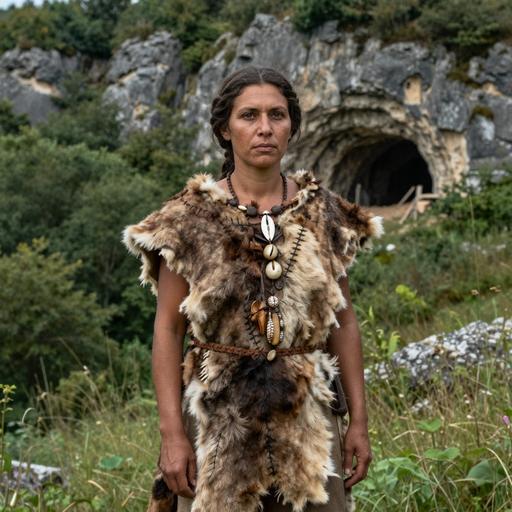
AI portrait reconstruction for A woman buried in Romania in the  era
AI-generated artistic reconstruction, not a photograph of the individual.
Record

Sample details

Recorded details and available lineage markers.

Individual

Palaeolithic individual, Romania

Sample ID: PM1

Date Range

32735 BCE - 32181 BCE

Cultural Period

The Paleolithic Period

Biological Sex

Female

mtDNA Haplogroup

U6*

Y-DNA Haplogroup

Not available

Social Role

Gatherer (AI estimate, era-typical)

Geography

Location

Where this individual was discovered

Country Romania
Locality Baia de Fier. Peştera Muierii

A location map is not available for this record.

Chronology

Date range

When this individual lived in the broader context of human history

Palaeolithic individual, Romania 32735 BCE - 32181 BCE
Context

Historical context

Background information associated with the reference record.

Overview

The Paleolithic Period encompasses most of human prehistory during the Pleistocene, before farming and urban life. It is defined less by fixed political boundaries than by broad changes in stone-tool technology, settlement strategies, and—toward the end—more frequent evidence for symbolism.

Region & Environment

Paleolithic environments varied widely, ranging from cold glacial landscapes to milder interglacial conditions. Changing temperatures, sea levels, and ecosystems influenced where people could live, which animals were available, and how plant resources were exploited. Across regions, people repeatedly adjusted their mobility to local water, shelter, and hunting opportunities.

Historical Context

Paleolithic history is marked by long-term biological and technological change rather than a single “event.” Over time, archaeological sequences show trends such as improvements in knapping methods and the increased use of standardized tool forms. In many regions, later Paleolithic phases also produce clearer evidence for complex planning and repeated use of particular places.

Populations & Lifeways

Most Paleolithic communities were hunter-gatherers with flexible seasonal and multi-year movement. Diet likely varied by geography and time, combining hunting of available game with gathered wild plant foods. Evidence for fire use, sheltering, and tool maintenance indicates ongoing adaptation to local hazards and opportunities.

Archaeology & Material Culture

Stone tools are the primary evidence for Paleolithic lifeways. Toolkits commonly include cores and flaked implements shaped by distinct technological traditions, with later phases often emphasizing more refined blade or microlith production. In some areas, archaeologists also recover hearths or occupation surfaces, worked bone/antler in later periods, and—especially in parts of the Upper Paleolithic—art objects and engraved pieces.

Culture & Society

Paleolithic “culture” is best understood through recurring practices visible in the archaeological record, such as shared approaches to tool-making, patterns of raw-material procurement, and repeated activities at particular sites. Symbolic behavior appears intermittently and unevenly across space and time, likely reflecting social communication, learning, and group identities.

Legacy & Transition

The Paleolithic ended gradually with the spread of Neolithic economies in many regions. The transition involved major shifts in land use, food production, and sedentism, building on some earlier developments in planning, storage, and environmental knowledge while transforming social organization.

Analysis

Genetic comparisons

These comparisons show genetic similarity, not identity or origin. The populations listed are those whose genomes show statistical alignment to this ancient individual.

Similarity reflects shared history, not shared identity. These are analytical comparisons, not claims about who this person was.

Modern Genetic Admixture

This analysis compares the DNA profile with present-day reference populations, showing statistical similarity to modern reference populations from different regions. The excavation site records where this individual was found, not a fixed modern genetic identity.

Europe 63.0%
Northwestern European 35.3%
Finnish 19.2%
Northwestern European 7.3%
English 5.2%
Scandinavian 3.6%
Southern European 17.8%
Iberian 13.0%
Sardinian 4.8%
Eastern European 9.9%
Asia 17.9%
Central Asian, Northern Indian & Pakistani 12.7%
Indian 12.7%
Chinese & Southeast Asian 3.9%
Indonesian Khmer Thai Myanma 1.9%
Chinese 1.7%
Arab, Egyptian & Levantine 1.3%
Arabian 1.3%
Africa 10.7%
North African 4.1%
Egyptian 3.8%
African Hunter-Gatherer 2.2%
West African 2.2%
Ghanaian, Liberian, Sierra Leonean 2.2%
Northern East African 2.2%
Ethiopian 1.9%
Oceania 5.9%
Melanesian 5.9%
Papuan 5.9%
America 2.6%
America 2.6%
Native American 2.6%

Closest Modern Populations

These are the modern populations showing the closest statistical alignment to A woman buried in Romania in the era, ranked by genetic distance. Lower distance values indicate closer statistical similarity. Cross-region similarity can reflect shared ancestry, population movement, continuity, or later admixture.

1
Roma Bilbao
8.9034
2
Roma Granada
9.0452
3
Roma Madrid
9.2655
4
Roma Porto
9.4288
5
Roma Barcelona
9.6137
6
Roma Balkans
10.1276
7
Tatar Mishar
10.8220
8
Tatar Kazan
10.8387
9
Turkish Rumeli
10.8615
10
Turkish Balikesir
11.1636
Context

Related Samples

This individual exists within a broader network of ancient samples. No ancient genome stands alone.

Individual Culture/Period Date Location Action
European Paleolithic individual, Romania Early Upper Paleolithic Peștera Muierii, Romania 32735 BCE Baia de Fier. Peştera Muierii, Romania View
Palaeolithic individual, Romania 32735 BCE Baia de Fier. Peştera Muierii, Romania View
Page 1
Individual Culture/Period Date Location Action
Palaeolithic individual, Russia 43980 BCE Ust'-Ishim. Siberia, Russia View
Palaeolithic individual, Russia 30250 BCE Yana RHS, Russia View
Palaeolithic individual, Romania 32735 BCE Baia de Fier. Peştera Muierii, Romania View
Palaeolithic individual, Russia 43980 BCE Ust'-Ishim. Siberia, Russia View
Palaeolithic individual, Russia 22621 BCE Mal'ta, Russia View
Palaeolithic individual, Russia 15001 BCE Afontova Gora, Russia View
Palaeolithic individual, China 32159 BCE Amur River Basin, China View
Palaeolithic individual, Romania 32735 BCE Baia de Fier. Peştera Muierii, Romania View
Page 1
Sources

References

Scientific publications and genetic data that inform this profile.

G25 Coordinates

These coordinates represent a position in genetic space, a tool for comparison, not a conclusion. You can use these to perform custom admixture analysis in G25 Studio.

PM1,0.04698404,0.03813646,0.00534384,0.04827286,0.0228087,-0.0079827,-0.00906228,0.00225452,0.0212795,0.00692494,-0.00601934,2.854E-05,-0.00405992,-0.00185218,0.00436232,-0.00297786,-0.00152724,0.00081386,0.00264436,-0.00142234,0.0018617,0.00099238,-0.00296976,0.00529132,0.00326323
Continue in G25 Studio
Use code for 30% off • Expires Nov 16