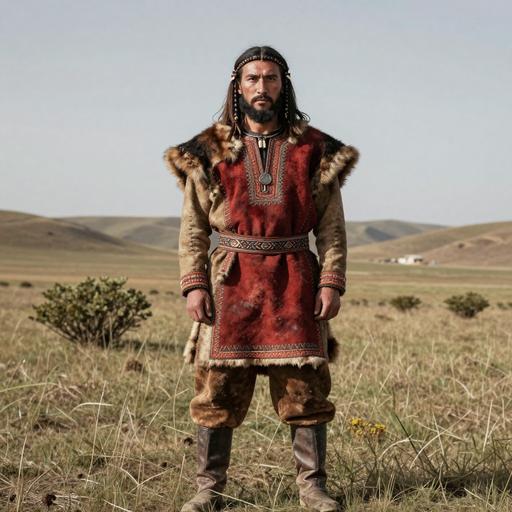
A man buried in Kazakhstan in the Iron Age era

Download PDF creates a visual, rasterized copy. Use Print for selectable text and better assistive-technology support.

Loading Report

Preparing your ancestry journey

Preparing the available report content...

Your report will open automatically.

Skip to main content
Reference library / Sample profile

A man buried in Kazakhstan in the Iron Age era

Explore the recorded context, genetic comparisons and research behind this reference sample.

KazakhstanIron Age Pazyryk Culture Berel, Kazakhstan

A reference profile describes this sample. It does not establish a personal or family relationship.

AI portrait reconstruction for A man buried in Kazakhstan in the Iron Age era
AI-generated artistic reconstruction, not a photograph of the individual.
Record

Sample details

Recorded details and available lineage markers.

Individual

Pazyryk individual, Kazakhstan

Sample ID: I0563

Date Range

400 BCE - 300 BCE

Cultural Period

Iron Age Pazyryk Culture Berel, Kazakhstan

Biological Sex

Male

mtDNA Haplogroup

C4a1

Y-DNA Haplogroup

R1a1a1b2

Social Role

Warrior (AI estimate, era-typical)

Geography

Location

Where this individual was discovered

Country Kazakhstan
Locality Berel
Coordinates 49.3356, 86.3504
Chronology

Date range

When this individual lived in the broader context of human history

Pazyryk individual, Kazakhstan 400 BCE - 300 BCE
Context

Historical context

Background information associated with the reference record.

The Pazyryk Culture, part of the larger Scythian and Saka nomadic traditions, represents a fascinating era of Iron Age society in the Eurasian steppes, particularly around the Altai Mountains region, which includes parts of modern-day Kazakhstan. Berel, in Kazakhstan, is a significant archaeological site providing invaluable insights into this culture.

Geographical Context

The Berel site, located in the northeastern part of Kazakhstan, lies in the rugged landscapes of the Altai Mountains. This region is characterized by its steppe, forest, and mountainous environments, which provided a unique combination of resources and challenges. The Pazyryk People inhabited this area during the early Iron Age, roughly from the 6th to the 3rd century BCE.

Cultural Characteristics

1. Nomadic Lifestyle: The Pazyryk Culture, like many of its Scythian counterparts, was primarily nomadic. They relied heavily on animal husbandry, particularly horses, which were central to their way of life – not only for transportation but also for warfare and trade.

2. Social Structure: The social structure of the Pazyryk people was hierarchical, with evidence suggesting the existence of an elite class possibly comprising chieftains or warriors. This is inferred from the opulence of the burial mounds, known as kurgans, where the elite were interred with rich grave goods.

3. Burial Practices: One of the most distinguishing features of the Pazyryk Culture is their burial practices. The kurgans uncovered at Berel and other sites often contain human and equine remains, buried with a plethora of grave goods. These goods include textiles, tools, jewelry, wooden objects, and remarkably well-preserved items due to the permafrost that acted as a natural preservative.

4. Art and Craftsmanship: The Pazyryk people were skilled artisans. Their art often featured animal motifs, executed in what is now commonly known as the \Animal Style". This form of art depicted stylized animals and mythical creatures in dynamic poses, demonstrating the symbolic importance of animals in their culture.

5. Technology and Metallurgy: Being an Iron Age culture, the Pazyryk were skilled metalworkers. They produced iron weapons and tools, as well as gold and bronze ornaments. The craftsmanship of these items indicates a high level of technical skill and artistic creativity.

Archaeological Discoveries

The Berel site has yielded numerous archaeological treasures, providing a window into the Pazyryk lifestyle:

  • Kurgans: The burial mounds at Berel are particularly famous. Excavations have uncovered tombs with well-preserved remains, including human bodies, horses, and an array of artifacts.

  • Textiles: Some of the most significant finds from Pazyryk sites are textiles, including carpets and clothing, which have provided insights into the weaving techniques and styles of the era.

  • Preserved Corpses: Due to the permafrost conditions, some human and horse mummies have been discovered in a remarkably preserved state, offering clues about their diet, health, and even tattoos.

Cultural Significance

The Pazyryk Culture is significant not only for its contributions to our understanding of Iron Age nomadic societies but also for its influence on later cultures. The art and crafts of the Pazyryk people reflect a cosmopolitan culture that engaged in long-distance trade and cultural exchanges across the Eurasian steppes.

Interactions and Influence

The Pazyryk Culture existed at a crossroads of civilizations. They interacted with numerous other cultures, including those to the east like the Xiongnu and to the west like the early Slavic and Persian cultures. These interactions facilitated the exchange of goods, technologies, and ideas.

Legacy

The Pazyryk people left behind a legacy that continues to intrigue historians, archaeologists, and the general public. Their artifacts provide a tangible connection to the past and offer insights into the life, beliefs, and art of the ancient nomadic peoples of the Eurasian steppes. Their cultural and artistic expressions continue to be a subject of study for understanding the broader tapestry of human history during the Iron Age.

In essence, the Pazyryk Culture of Berel, Kazakhstan, epitomizes the rich and dynamic history of the nomadic tribes that roamed the Eurasian steppes, leaving behind a legacy of art, craftsmanship, and insights into the human experience of their era."

Analysis

Genetic comparisons

These comparisons show genetic similarity, not identity or origin. The populations listed are those whose genomes show statistical alignment to this ancient individual.

Similarity reflects shared history, not shared identity. These are analytical comparisons, not claims about who this person was.

Modern Genetic Admixture

This analysis compares the DNA profile with present-day reference populations, showing statistical similarity to modern reference populations from different regions. The excavation site records where this individual was found, not a fixed modern genetic identity.

Asia 78.6%
Northern Asian 41.3%
Siberian 28.4%
Mongolian 12.9%
Central Asian, Northern Indian & Pakistani 29.0%
Central Asian 26.5%
Pakistan 2.6%
Japanese & Korean 5.4%
Japanese 5.4%
Chinese & Southeast Asian 2.9%
Tibetan 2.9%
Europe 18.8%
Eastern European 13.6%
Northwestern European 5.2%
English 3.3%
Finnish 1.9%
America 2.6%
America 2.6%
Native American 2.6%

Closest Modern Populations

These are the modern populations showing the closest statistical alignment to A man buried in Kazakhstan in the Iron Age era, ranked by genetic distance. Lower distance values indicate closer statistical similarity. Cross-region similarity can reflect shared ancestry, population movement, continuity, or later admixture.

1
Teleut
2.2477
2
Khakass
2.3561
3
Shor
3.7526
Context

Related Samples

This individual exists within a broader network of ancient samples. No ancient genome stands alone.

Individual Culture/Period Date Location Action
Tuva IA Aldy Bel individual, Russia Iron Age Aldy-Bel Culture, Tuva, Russia 900 BCE Arzan, Russia View
Orenburg Early Sarmatian individual, Russia Iron Age Early Sarmatian, Russia 400 BCE Pokrovka, Russia View
Pazyryk individual, Kazakhstan Iron Age Pazyryk Culture Berel, Kazakhstan 400 BCE Berel, Kazakhstan View
Steppe Nomads individual, Kazakhstan Iron Age Saka Culture, Kazakhstan 777 BCE Izmaylovka Kurgan. East Kazakhstan, Kazakhstan View
IA Zevakino Chilikta-2 individual, Kazakhstan Iron Age 2 Zevakino-Chilikta, Kazakhstan 900 BCE Zevakino. East Kazakhstan, Kazakhstan View
Tuva IA Aldy Bel individual, Russia Iron Age Aldy-Bel Culture, Tuva, Russia 900 BCE Arzan, Russia View
IA individual, Kazakhstan Iron Age Saka Culture, Kazakhstan 777 BCE Izmaylovka (East Kazakhstan Region, Ulan District), Kazakhstan View
Page 1
Individual Culture/Period Date Location Action
Pazyryk individual, Kazakhstan Iron Age Pazyryk Culture Berel, Kazakhstan 400 BCE Berel, Kazakhstan View
Page 1
Sources

References

Scientific publications and genetic data that inform this profile.

G25 Coordinates

These coordinates represent a position in genetic space, a tool for comparison, not a conclusion. You can use these to perform custom admixture analysis in G25 Studio.

I0563,0.06894966,-0.23897634,0.07781536,0.0116556,-0.05567184,-0.01816722,0.0056762,0.01100166,0.0008228,-0.00795808,-0.00591102,-0.00019898,0.00356748,-0.0144777,0.00578936,0.0001733,-0.01137184,0.00078502,0.00701262,0.0103154,-0.01712428,0.00024726,-0.00136042,0.00178868,7.011E-05
Continue in G25 Studio
Use code for 30% off • Expires Nov 16