A man buried in Russia in the Iron Age era

Download PDF creates a visual, rasterized copy. Use Print for selectable text and better assistive-technology support.

Loading Report

Preparing your ancestry journey

Preparing the available report content...

Your report will open automatically.

Skip to main content
Reference library / Sample profile

A man buried in Russia in the Iron Age era

Explore the recorded context, genetic comparisons and research behind this reference sample.

RussiaIron Age Early Sarmatian, Russia

A reference profile describes this sample. It does not establish a personal or family relationship.

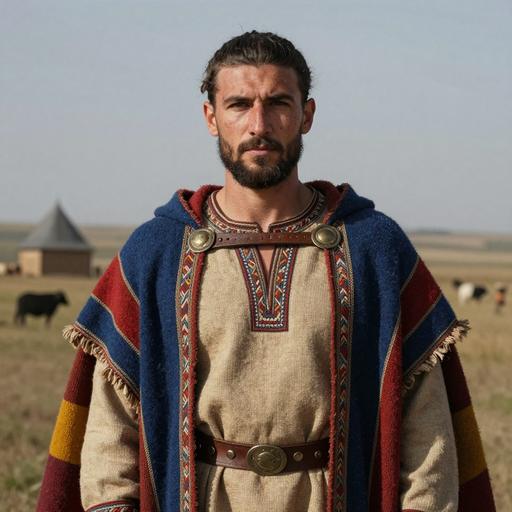
AI portrait reconstruction for A man buried in Russia in the Iron Age era
AI-generated artistic reconstruction, not a photograph of the individual.
Record

Sample details

Recorded details and available lineage markers.

Individual

Orenburg Early Sarmatian individual, Russia

Sample ID: I0575

Date Range

400 BCE - 200 BCE

Cultural Period

Iron Age Early Sarmatian, Russia

Biological Sex

Male

mtDNA Haplogroup

M

Y-DNA Haplogroup

R1b1a1a2a2

Social Role

Pastoralist (AI estimate, era-typical)

Geography

Location

Where this individual was discovered

Country Russia
Locality Pokrovka
Coordinates 51.9908, 53.8702
Chronology

Date range

When this individual lived in the broader context of human history

Orenburg Early Sarmatian individual, Russia 400 BCE - 200 BCE
Context

Historical context

Background information associated with the reference record.

The Early Sarmatian period, part of the broader Iron Age in the Eurasian Steppe, is a fascinating era marked by the dominance of the Sarmatian tribes. These tribes, primarily of Iranian origin, inhabited the vast region that stretched across what is now southern Russia, Ukraine, and parts of Kazakhstan, around the 4th to 1st centuries BCE. The Early Sarmatian culture is often identified as a distinct phase within the wider context of Scythian culture, given its evolution from and interaction with these groups.

Geographic and Environmental Context

The Sarmatians occupied the Pontic-Caspian Steppe, an expansive grassland that facilitated their nomadic way of life. This region's geography -- characterized by open plains, rivers like the Volga and Don, and proximity to the Caspian and Black Seas -- played a crucial role in shaping the economic and social dynamics of Early Sarmatian society. The harsh, continental climate with cold winters and hot summers demanded resilience and adaptability from its inhabitants.

Lifestyle and Economy

The Early Sarmatians were predominantly nomadic pastoralists, relying heavily on horse breeding, which was central to both their economy and culture. Horses were not only a vital mode of transportation but also a cornerstone of their military prowess. Wealth was primarily measured in livestock, particularly horses, sheep, and cattle, which provided them with food, clothing, and materials for yurts, their portable homes.

Trade also played a significant role in the Sarmatian economy. Positioned strategically along major trade routes like the Silk Road, they engaged in commerce with neighboring cultures, exchanging horses, animal pelts, and other goods for items like metalwork, textiles, and pottery from regions as far off as Greece, the Near East, and China.

Social Structure and Culture

Sarmatian society was aristocratic and hierarchical, with a warrior elite commanding significant respect and authority. Women in Sarmatian culture were notable for their unique status; many participated in warfare alongside men and were often buried with weapons, indicating their inclusion within the warrior class. This has led to comparisons with the Amazons of Greek mythology, suggesting a distinctive gender dynamic within their society.

The Sarmatians practiced animistic and shamanistic religious beliefs, venerating natural elements and possessing rich mythological traditions. Artifacts such as gold ornaments, elaborate weapons, and decorated horse gear reveal a rich artistic culture heavily influenced by the Scythian animal style, featuring dynamic depictions of real and mythical animals.

Material Culture

Early Sarmatian material culture was characterized by impressive metalwork, evident in their weaponry and ceremonial objects. They produced swords, daggers, and spearheads that often exhibited intricate craftsmanship and ornamental designs. Gold was a favored material, used both for practical items and for elaborate jewelry and belt buckles, signifying wealth and status.

Kurgans, large burial mounds, are another hallmark of Sarmatian culture. These structures often contained a wealth of grave goods, including weapons, jewelry, and household items, reflecting the belief in an afterlife where such items would be needed.

Interactions and Conflicts

The Early Sarmatians were both competitors and collaborators with neighboring tribes and cultures. They clashed with the Scythians for control of territories, yet also assimilated aspects of their culture. Their interactions with Greek colonies on the Black Sea coast facilitated cultural exchange, influencing Sarmatian art and technology. The spread of Iron Age metallurgy in the region further enhanced their military capabilities.

By the late Iron Age, the Sarmatians began expanding westward, coming into contact with Roman territories. These interactions eventually led to Sarmatian mercenaries serving in the Roman army, further intertwining their legacy with European history.

Legacy

The Early Sarmatian culture laid the groundwork for the later Sarmatian and Alanic tribes, influencing the ethno-political landscape of Eastern Europe. Their impact is seen in the cultural and genetic diversity of the region, as their practices and people blended with successive waves of nomadic and settled populations. Archaeological excavations continue to uncover the depth of Sarmatian contributions to the history of Eurasian nomadic cultures, revealing a dynamic society adept at navigating the challenges of the Iron Age steppe environment.

Analysis

Genetic comparisons

These comparisons show genetic similarity, not identity or origin. The populations listed are those whose genomes show statistical alignment to this ancient individual.
Similarity reflects shared history, not shared identity. These are analytical comparisons, not claims about who this person was.

Modern Genetic Admixture

This analysis compares the DNA profile with present-day reference populations, showing statistical similarity to modern reference populations from different regions. The excavation site records where this individual was found, not a fixed modern genetic identity.

Europe 59.5%
Eastern European 31.4%
Northwestern European 28.1%
English 13.6%
Scandinavian 9.2%
Finnish 5.0%
Asia 38.5%
Northern West Asian 22.8%
Caucasian 22.8%
Central Asian, Northern Indian & Pakistani 14.9%
Pakistan 10.9%
Indian 2.9%
Central Asian 1.1%
Northern Asian 0.8%
Siberian 0.8%
America 2.0%
America 2.0%
Native American 2.0%

Closest Modern Populations

These are the modern populations showing the closest statistical alignment to A man buried in Russia in the Iron Age era, ranked by genetic distance. Lower distance values indicate closer statistical similarity. Cross-region similarity can reflect shared ancestry, population movement, continuity, or later admixture.

1
Tatar Mishar
5.7702
2
Tatar Kazan
6.8784
3
Mordovian
7.4974
4
Moksha
7.5439
5
Erzya
7.5726
6
Pamiri Rushan
7.7315
7
Komi A
7.7421
8
Russian Krasnoborsky
8.1604
9
Russian Kostroma
8.2355
10
Russian Leshukonsky
8.3076
Context

Related Samples

This individual exists within a broader network of ancient samples. No ancient genome stands alone.

Individual Culture/Period Date Location Action
Tuva IA Aldy Bel individual, Russia Iron Age Aldy-Bel Culture, Tuva, Russia 900 BCE Arzan, Russia View
Orenburg Early Sarmatian individual, Russia Iron Age Early Sarmatian, Russia 400 BCE Pokrovka, Russia View
Pazyryk individual, Kazakhstan Iron Age Pazyryk Culture Berel, Kazakhstan 400 BCE Berel, Kazakhstan View
Steppe Nomads individual, Kazakhstan Iron Age Saka Culture, Kazakhstan 777 BCE Izmaylovka Kurgan. East Kazakhstan, Kazakhstan View
IA Zevakino Chilikta-2 individual, Kazakhstan Iron Age 2 Zevakino-Chilikta, Kazakhstan 900 BCE Zevakino. East Kazakhstan, Kazakhstan View
Tuva IA Aldy Bel individual, Russia Iron Age Aldy-Bel Culture, Tuva, Russia 900 BCE Arzan, Russia View
IA individual, Kazakhstan Iron Age Saka Culture, Kazakhstan 777 BCE Izmaylovka (East Kazakhstan Region, Ulan District), Kazakhstan View
Page 1
Individual Culture/Period Date Location Action
Orenburg Early Sarmatian individual, Russia Iron Age Early Sarmatian, Russia 400 BCE Pokrovka, Russia View
Page 1
Sources

References

Scientific publications and genetic data that inform this profile.

G25 Coordinates

These coordinates represent a position in genetic space, a tool for comparison, not a conclusion. You can use these to perform custom admixture analysis in G25 Studio.

I0575,0.11417906,0.0634063,0.02733274,0.05380552,-0.01065856,0.02122138,0.00808508,0.00727732,-0.014149,-0.02488276,0.00035954,-0.00099736,0.00691182,-0.01023422,0.0037282,-0.00208236,-0.00870836,-0.00123332,-0.00723438,-0.00838184,0.00368426,0.00147672,-0.00599266,0.00745018,-0.00083444
Continue in G25 Studio
Use code for 30% off • Expires Nov 16