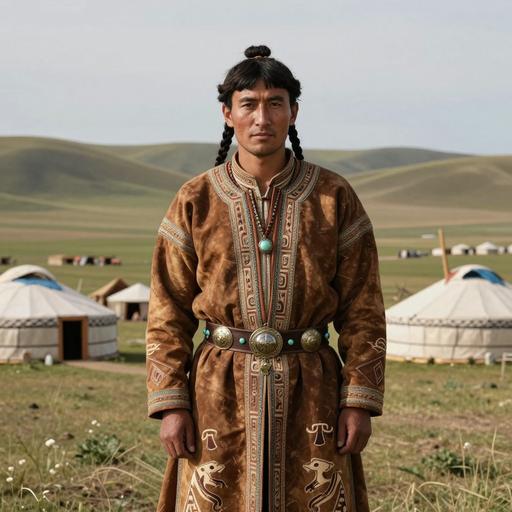
A man buried in Kazakhstan in the Iron Age era

Download PDF creates a visual, rasterized copy. Use Print for selectable text and better assistive-technology support.

Loading Report

Preparing your ancestry journey

Preparing the available report content...

Your report will open automatically.

Skip to main content
Reference library / Sample profile

A man buried in Kazakhstan in the Iron Age era

Explore the recorded context, genetic comparisons and research behind this reference sample.

KazakhstanKazakhstan IA Saka

A reference profile describes this sample. It does not establish a personal or family relationship.

AI portrait reconstruction for A man buried in Kazakhstan in the Iron Age era
AI-generated artistic reconstruction, not a photograph of the individual.
Record

Sample details

Recorded details and available lineage markers.

Individual

IA individual, Kazakhstan

Sample ID: IS2

Date Range

777 BCE - 547 BCE

Cultural Period

Kazakhstan IA Saka

Biological Sex

Male

mtDNA Haplogroup

HV_CRS

Y-DNA Haplogroup

Q-L332

Social Role

Warrior (AI estimate, era-typical)

Geography

Location

Where this individual was discovered

Country Kazakhstan
Locality Izmaylovka (East Kazakhstan Region, Ulan District)
Coordinates 50.2813, 81.4174
Chronology

Date range

When this individual lived in the broader context of human history

IA individual, Kazakhstan 777 BCE - 547 BCE
Context

Historical context

Background information associated with the reference record.

Kazakhstan’s Iron Age includes the Saka horizon, commonly understood as part of the wider Scythian–Saka steppe phenomenon. Material remains from burial sites and settlements reveal how mobile herding, craft production, and interregional exchange shaped lifeways across the grasslands.

Region & Environment

The setting is the Kazakh steppe, characterized by vast grassland expanses with seasonal variation in temperature and grazing conditions. Mobility between pastures would have depended on water sources in river valleys and lowlands, while higher or more open areas could support seasonal use. This environmental patchiness encouraged flexible movements and periodic regrouping around reliable resources.

Historical Context

Between the late 1st millennium BCE and the early centuries BCE, steppe societies were increasingly connected through trade routes and shared cultural practices. Saka groups are often placed within a broader Scythian–Saka constellation of communities that experienced both local competition and wide-ranging interactions. These connections likely involved movement of goods, people, and ideas, even as political arrangements varied over time.

Populations & Lifeways

Saka-associated populations are typically described as pastoralists, herding livestock and moving between pastures as conditions changed. Seasonal mobility likely coexisted with areas of more durable habitation, particularly where resources or social activities concentrated. Crafting and maintenance of transport gear, clothing components, and weapons would have been important parts of daily life, alongside food preparation from animal products.

Archaeology & Material Culture

Archaeology for the Saka period is especially visible in burial archaeology, where graves can contain metal weapons, ornaments, and distinctive decorative objects. Artifact assemblages also document skilled metalworking, including the production of items associated with mounted life and personal display. Pottery and other everyday materials, where preserved, help ground interpretations of foodways and habitation practices.

Culture & Society

Burials and portable wealth highlight the social importance of status, identity, and possibly lineage-based relationships. Weapons and display objects suggest that mobility on horseback and participation in intergroup conflict or competition were socially significant. Across the steppe, shared artistic motifs and material preferences indicate ongoing cultural contact and communication networks.

Legacy & Transition

As the Iron Age progressed toward the last centuries BCE, steppe societies continued to reorganize under changing political pressures and shifting patterns of exchange. The Saka horizon contributes to the long-term development of steppe traditions of pastoralism, mounted warfare, and metalcraft. Later steppe cultures drew on these established practices while adapting to new regional dynamics.

Analysis

Genetic comparisons

These comparisons show genetic similarity, not identity or origin. The populations listed are those whose genomes show statistical alignment to this ancient individual.

Similarity reflects shared history, not shared identity. These are analytical comparisons, not claims about who this person was.

Modern Genetic Admixture

This analysis compares the DNA profile with present-day reference populations, showing statistical similarity to modern reference populations from different regions. The excavation site records where this individual was found, not a fixed modern genetic identity.

Asia 55.2%
Northern West Asian 21.1%
Caucasian 21.1%
Central Asian, Northern Indian & Pakistani 20.2%
Pakistan 11.4%
Indian 5.3%
Central Asian 3.5%
Chinese & Southeast Asian 11.8%
Tibetan 11.1%
Chinese 0.7%
Northern Asian 1.2%
Siberian 1.2%
Japanese & Korean 1.0%
Japanese 1.0%
Europe 39.9%
Eastern European 27.1%
Northwestern European 12.8%
English 12.8%
America 4.9%
America 4.9%
Native American 4.9%

Closest Modern Populations

These are the modern populations showing the closest statistical alignment to A man buried in Kazakhstan in the Iron Age era, ranked by genetic distance. Lower distance values indicate closer statistical similarity. Cross-region similarity can reflect shared ancestry, population movement, continuity, or later admixture.

1
Tatar Kazan
5.9044
2
Tatar Lipka
6.1869
3
Besermyan
6.2388
4
Tajik Tajikistan Hisor
7.1079
5
Udmurt
7.3079
6
Tajik Tajikistan Ayni
7.6568
7
Pamiri Sarikoli
7.6595
8
Tatar Crimean Steppe
8.0225
9
Turkmen
8.3933
10
Tajik Tajikistan Kulob
8.4164
Context

Related Samples

This individual exists within a broader network of ancient samples. No ancient genome stands alone.

Individual Culture/Period Date Location Action
Tuva IA Aldy Bel individual, Russia Iron Age Aldy-Bel Culture, Tuva, Russia 900 BCE Arzan, Russia View
Orenburg Early Sarmatian individual, Russia Iron Age Early Sarmatian, Russia 400 BCE Pokrovka, Russia View
Pazyryk individual, Kazakhstan Iron Age Pazyryk Culture Berel, Kazakhstan 400 BCE Berel, Kazakhstan View
Steppe Nomads individual, Kazakhstan Iron Age Saka Culture, Kazakhstan 777 BCE Izmaylovka Kurgan. East Kazakhstan, Kazakhstan View
IA Zevakino Chilikta-2 individual, Kazakhstan Iron Age 2 Zevakino-Chilikta, Kazakhstan 900 BCE Zevakino. East Kazakhstan, Kazakhstan View
Tuva IA Aldy Bel individual, Russia Iron Age Aldy-Bel Culture, Tuva, Russia 900 BCE Arzan, Russia View
IA individual, Kazakhstan Iron Age Saka Culture, Kazakhstan 777 BCE Izmaylovka (East Kazakhstan Region, Ulan District), Kazakhstan View
Page 1
Individual Culture/Period Date Location Action
Steppe Nomads individual, Kazakhstan Iron Age Saka Culture, Kazakhstan 777 BCE Izmaylovka Kurgan. East Kazakhstan, Kazakhstan View
Steppe Nomads individual, Kazakhstan Iron Age Saka Culture, Kazakhstan 752 BCE Tian Shan. Central Steppe. Kargaly 1, Kazakhstan View
IA Saka individual, Kazakhstan Iron Age Saka Culture, Kazakhstan 752 BCE Kargaly-1 (Almaty Region, Zhambyl District), Kazakhstan View
IA individual, Kazakhstan Iron Age Saka Culture, Kazakhstan 777 BCE Izmaylovka (East Kazakhstan Region, Ulan District), Kazakhstan View
Page 1
Sources

References

Scientific publications and genetic data that inform this profile.

G25 Coordinates

These coordinates represent a position in genetic space, a tool for comparison, not a conclusion. You can use these to perform custom admixture analysis in G25 Studio.

IS2,0.09581358,-0.01019606,0.02655088,0.0515797,-0.03223378,0.01265926,-0.00589722,-0.00889718,-0.01065342,-0.02059584,0.0049751,8.662E-05,0.00565286,-0.01006892,-0.00278918,0.00161938,0.00152902,-0.00046388,-0.00240976,-0.00175316,-0.00361084,0.00041988,0.00047792,-0.0003535,-0.00067486
Continue in G25 Studio
Use code for 30% off • Expires Nov 16