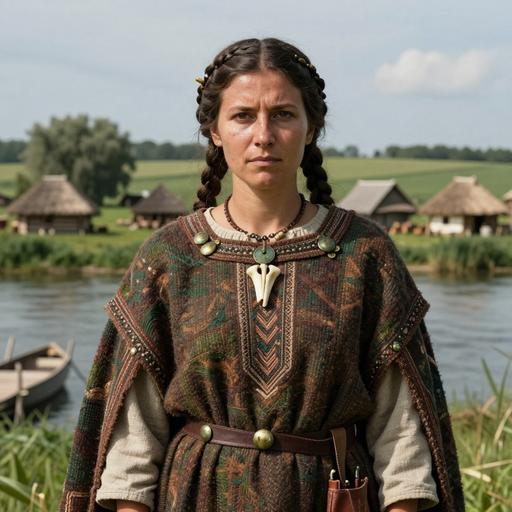
A woman buried in Hungary in the Late Bronze Age era

Download PDF creates a visual, rasterized copy. Use Print for selectable text and better assistive-technology support.

Loading Report

Preparing your ancestry journey

Preparing the available report content...

Your report will open automatically.

Skip to main content
Reference library / Sample profile

A woman buried in Hungary in the Late Bronze Age era

Explore the recorded context, genetic comparisons and research behind this reference sample.

HungaryHungary LBA

A reference profile describes this sample. It does not establish a personal or family relationship.

AI portrait reconstruction for A woman buried in Hungary in the Late Bronze Age era
AI-generated artistic reconstruction, not a photograph of the individual.
Record

Sample details

Recorded details and available lineage markers.

Individual

Urnfield Culture individual, Hungary

Sample ID: I20773

Date Range

1700 BCE - 800 BCE

Cultural Period

Hungary LBA

Biological Sex

Female

mtDNA Haplogroup

Not available

Y-DNA Haplogroup

Not available

Social Role

Laborer (AI estimate, era-typical)

Geography

Location

Where this individual was discovered

Country Hungary
Locality Besenyszög Berek-ér partja
Coordinates 47.2141, 20.2613
Chronology

Date range

When this individual lived in the broader context of human history

Urnfield Culture individual, Hungary 1700 BCE - 800 BCE
Context

Historical context

Background information associated with the reference record.

The Late Bronze Age in Hungary (1300–800 BCE) falls within a broad Urnfield cultural sphere across much of Central Europe. In the Carpathian Basin, local communities combined farming and herding with metalworking traditions and participated in exchange networks that helped spread styles and technologies.

Region & Environment

The period focuses on the Carpathian Basin’s productive plains and river-valley environments. Fertile soils supported agriculture, while uplands and grasslands provided pasture and resources such as timber. Access to waterways supported movement of people and goods, influencing how communities could connect with wider networks.

Historical Context

Between the late second and early first millennium BCE, Central Europe experienced shifts in settlement and burial practices that are often grouped under the Urnfield horizon. These changes reflect cultural reorganization over time rather than a single event, and they likely involved regional dynamics as different communities negotiated resources and contacts.

Populations & Lifeways

Household life centered on mixed economies: crop cultivation and animal husbandry, with additional exploitation of local resources. Cremation and the deposition of remains in urns are central features of many Urnfield-related cemeteries, reflecting shared ritual norms across regions. Material differences in burial contexts suggest varying degrees of wealth and social roles.

Archaeology & Material Culture

Material culture is marked by cremation cemeteries and associated pottery traditions, with urns and grave goods that help distinguish local variants. Bronze objects—such as tools and ornaments—demonstrate ongoing production and knowledge of metalworking. Assemblages also show that communities were not isolated: comparable artifact forms and decorative practices indicate interaction across regional boundaries.

Culture & Society

Urnfield practices point to shared ritual traditions and communication through mortuary customs. Yet the presence of regionally distinct pottery and metalwork traits suggests local identities remained important. Social organization is expressed through how grave goods were selected and arranged, providing archaeological visibility into status and community membership.

Legacy & Transition

As the Late Bronze Age moved toward the early first millennium BCE, changing climatic, economic, and political conditions contributed to new cultural patterns in Central Europe. In Hungary, archaeological transitions are visible through shifts in burial and artifact forms, setting the stage for later Iron Age developments in the Carpathian Basin.

Context

Related Samples

This individual exists within a broader network of ancient samples. No ancient genome stands alone.

Individual Culture/Period Date Location Action
Indo-European individual, Romania Glavanesti Culture of Romania 3500 BCE Glăvăneşti, Romania View
Bodrogkeresztur individual, Romania The Bodrogkeresztur Culture 4500 BCE Urziceni, Romania View
MN AVK individual, Hungary Middle Neolithic Alföld Linear Pottery Culture, Hungary 4300 BCE Polgár-Ferenci hát. M3-31, Hungary View
Scythian individual, Hungary Iron Age Scythian Culture, Hungary 4000 BCE Kesznyéten-Szérűskert; Great Hungarian Plain. Borsodi-Mezőség, Hungary View
Scythian individual, Hungary Iron Age Scythian Culture, Hungary 400 BCE Kesznyéten-Szérűskert, Hungary View
Urnfield Culture individual, Hungary Late Bronze Age to Early Iron Age Hungary 1700 BCE Mezőkeresztes-Cethalom. M3-10 lelőhely; Great Hungarian Plain. Borsodi-Mezőség, Hungary View
Urnfield Culture individual, Hungary Late Bronze Age Hungary 1700 BCE Besenyszög Berek-ér partja, Hungary View
EIA Mezocsat individual, Hungary Late Bronze Age to Early Iron Age Hungary 1700 BCE Mezőkeresztes-Cethalom. M3-10 lelőhely; Great Hungarian Plain. Borsodi-Mezőség, Hungary View
Scythian individual, Hungary Iron Age Scythian Culture, Hungary 400 BCE Kesznyéten-Szérűskert, Hungary View
LBA Halva individual, Hungary Late Bronze Age Halomsíros (Tumulus) Culture, Hungary 1700 BCE Hajdudorog-Szallasfold, Hungary View
MBA Fuzesabony individual, Hungary Middle Bronze Age Füzesabony Culture, Hungary 2300 BCE Polgar Kenderfold, Hungary View
LBA individual, Hungary Late Bronze Age Hungary 1500 BCE Besenyszög Berek-ér partja. Köröm-Kápolnadomb, Hungary View
IA Celt individual, Hungary The La Tene Culture in Hungary 500 BCE Besenyszög Berek-ér partja. Köröm-Kápolnadomb, Hungary View
Arctic Cultures individual, Russia Old Bering Sea Culture Ekven, Russia 970 CE Chukotka. Bering Strait. Ekven, Russia View
Ukraine N individual, Ukraine 5500 BCE Dereivka I, Ukraine View
Page 1
Individual Culture/Period Date Location Action
Urnfield Culture individual, Hungary Late Bronze Age Hungary 1700 BCE Besenyszög Berek-ér partja, Hungary View
LBA individual, Hungary Late Bronze Age Hungary 1500 BCE Besenyszög Berek-ér partja. Köröm-Kápolnadomb, Hungary View
LBA individual, Hungary Late Bronze Age Hungary 1050 BCE Vas county. Kápolnadomb. Gór, Hungary View
LBA individual, Hungary Late Bronze Age Hungary 1046 BCE Vas county. Kápolnadomb. Gór, Hungary View
Page 1
Use code for 30% off • Expires Nov 16