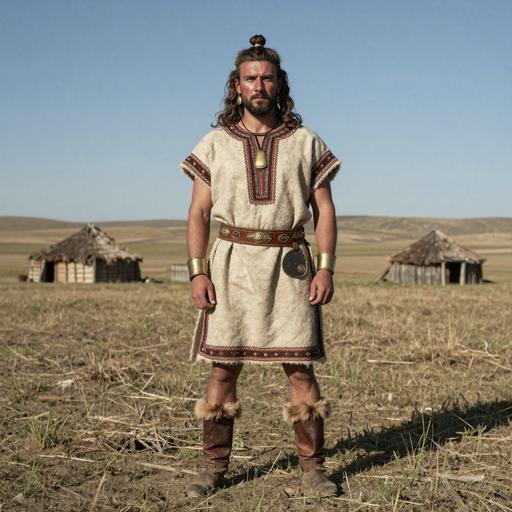
A man buried in Hungary in the Iron Age era

Download PDF creates a visual, rasterized copy. Use Print for selectable text and better assistive-technology support.

Loading Report

Preparing your ancestry journey

Preparing the available report content...

Your report will open automatically.

Skip to main content
Reference library / Sample profile

A man buried in Hungary in the Iron Age era

Explore the recorded context, genetic comparisons and research behind this reference sample.

HungaryHungary IA Scythian

A reference profile describes this sample. It does not establish a personal or family relationship.

AI portrait reconstruction for A man buried in Hungary in the Iron Age era
AI-generated artistic reconstruction, not a photograph of the individual.
Record

Sample details

Recorded details and available lineage markers.

Individual

Scythian individual, Hungary

Sample ID: I20767

Date Range

4000 BCE - 100 CE

Cultural Period

Hungary IA Scythian

Biological Sex

Male

mtDNA Haplogroup

Not available

Y-DNA Haplogroup

Not available

Social Role

Warrior (AI estimate, era-typical)

Geography

Location

Where this individual was discovered

Country Hungary
Locality Kesznyéten-Szérűskert; Great Hungarian Plain. Borsodi-Mezőség
Coordinates 47.9822, 21.0604
Chronology

Date range

When this individual lived in the broader context of human history

Scythian individual, Hungary 4000 BCE - 100 CE
Context

Historical context

Background information associated with the reference record.

Region & Environment

Iron Age Hungary in this timeframe is centered on the Carpathian Basin, a broad lowland ringed by mountain systems. Rivers and plains supported mixed farming and grazing, while steppe grasslands to the east and south helped link the region to wider horse-riding networks.

Historical Context

Between roughly 700 and 300 BCE, political and economic change in the Carpathian Basin unfolded alongside interactions reaching from the Pontic steppe. “Scythian” is a broad archaeological and historical label used for steppe-related mobile groups and for the spread of characteristic forms through exchange, mobility, and diplomacy rather than a single uniform polity.

Populations & Lifeways

Local farming communities lived in settlements and cultivated cereals while also participating in herding and seasonal movements. People in the region were connected to longer-distance networks that carried prestige goods and equestrian technologies; some communities likely hosted mobile specialists or maintained regular contact with steppe groups.

Archaeology & Material Culture

Archaeological signatures commonly linked to Scythian influence in the area include items produced in “animal style” aesthetics and horse-gear components, as well as assemblages that combine imported or steppe-derived objects with locally made goods. Grave contexts—when available—often provide evidence for changing burial practice, along with metalwork and personal adornment that help trace contact and status.

Culture & Society

Material culture suggests stratified communities where access to high-status goods mattered. Reliance on herding and horseback movement in neighboring regions likely shaped ideals of display and power, while local craft traditions remained important in producing everyday wares and some distinctive regional styles.

Legacy & Transition

By the late 4th to 3rd centuries BCE, the Carpathian Basin continued to experience shifting influences as older connections waned and new ones emerged. The resulting transition set the stage for subsequent Iron Age developments in Central Europe, visible archaeologically through changes in burial practice, craft production, and the character of long-distance exchange.

Analysis

Genetic comparisons

These comparisons show genetic similarity, not identity or origin. The populations listed are those whose genomes show statistical alignment to this ancient individual.

Similarity reflects shared history, not shared identity. These are analytical comparisons, not claims about who this person was.

Modern Genetic Admixture

This analysis compares the DNA profile with present-day reference populations, showing statistical similarity to modern reference populations from different regions. The excavation site records where this individual was found, not a fixed modern genetic identity.

Europe 91.4%
Northwestern European 48.4%
Scandinavian 22.8%
Finnish 18.0%
English 7.6%
Southern European 43.0%
Balkan 43.0%
Asia 7.3%
Central Asian, Northern Indian & Pakistani 7.1%
Indian 7.1%
Oceania 1.3%
Melanesian 1.3%
Papuan 1.3%

Closest Modern Populations

These are the modern populations showing the closest statistical alignment to A man buried in Hungary in the Iron Age era, ranked by genetic distance. Lower distance values indicate closer statistical similarity. Cross-region similarity can reflect shared ancestry, population movement, continuity, or later admixture.

1
Moldovan O
2.7161
2
Ukrainian Zakarpattia
2.8126
3
Czech
2.8849
4
Hungarian
2.9302
5
Slovakian
2.9968
6
Polish Silesian
3.2130
7
German Hamburg
3.4309
8
Croatian
3.5579
9
Ukrainian Lviv
3.6175
10
Polish
3.6534
Context

Related Samples

This individual exists within a broader network of ancient samples. No ancient genome stands alone.

Individual Culture/Period Date Location Action
Indo-European individual, Romania Glavanesti Culture of Romania 3500 BCE Glăvăneşti, Romania View
Bodrogkeresztur individual, Romania The Bodrogkeresztur Culture 4500 BCE Urziceni, Romania View
MN AVK individual, Hungary Middle Neolithic Alföld Linear Pottery Culture, Hungary 4300 BCE Polgár-Ferenci hát. M3-31, Hungary View
Scythian individual, Hungary Iron Age Scythian Culture, Hungary 4000 BCE Kesznyéten-Szérűskert; Great Hungarian Plain. Borsodi-Mezőség, Hungary View
Scythian individual, Hungary Iron Age Scythian Culture, Hungary 400 BCE Kesznyéten-Szérűskert, Hungary View
Urnfield Culture individual, Hungary Late Bronze Age to Early Iron Age Hungary 1700 BCE Mezőkeresztes-Cethalom. M3-10 lelőhely; Great Hungarian Plain. Borsodi-Mezőség, Hungary View
Urnfield Culture individual, Hungary Late Bronze Age Hungary 1700 BCE Besenyszög Berek-ér partja, Hungary View
EIA Mezocsat individual, Hungary Late Bronze Age to Early Iron Age Hungary 1700 BCE Mezőkeresztes-Cethalom. M3-10 lelőhely; Great Hungarian Plain. Borsodi-Mezőség, Hungary View
Scythian individual, Hungary Iron Age Scythian Culture, Hungary 400 BCE Kesznyéten-Szérűskert, Hungary View
LBA Halva individual, Hungary Late Bronze Age Halomsíros (Tumulus) Culture, Hungary 1700 BCE Hajdudorog-Szallasfold, Hungary View
MBA Fuzesabony individual, Hungary Middle Bronze Age Füzesabony Culture, Hungary 2300 BCE Polgar Kenderfold, Hungary View
LBA individual, Hungary Late Bronze Age Hungary 1500 BCE Besenyszög Berek-ér partja. Köröm-Kápolnadomb, Hungary View
IA Celt individual, Hungary The La Tene Culture in Hungary 500 BCE Besenyszög Berek-ér partja. Köröm-Kápolnadomb, Hungary View
Arctic Cultures individual, Russia Old Bering Sea Culture Ekven, Russia 970 CE Chukotka. Bering Strait. Ekven, Russia View
Ukraine N individual, Ukraine 5500 BCE Dereivka I, Ukraine View
Page 1
Individual Culture/Period Date Location Action
Scythian individual, Hungary Iron Age Scythian Culture, Hungary 4000 BCE Kesznyéten-Szérűskert; Great Hungarian Plain. Borsodi-Mezőség, Hungary View
Scythian individual, Hungary Iron Age Scythian Culture, Hungary 400 BCE Kesznyéten-Szérűskert, Hungary View
Scythian individual, Hungary Iron Age Scythian Culture, Hungary 772 BCE , Hungary View
Scythian individual, Hungary Iron Age Scythian Culture, Hungary 513 BCE , Hungary View
Scythian individual, Hungary Iron Age Scythian Culture, Hungary 749 BCE , Hungary View
Scythian individual, Hungary Iron Age Scythian Culture, Hungary 737 BCE , Hungary View
Scythian individual, Hungary Iron Age Scythian Culture, Hungary 726 BCE , Hungary View
IA Scythian individual, Hungary 566 BCE Kesznyéten-Szérűskert (Borsod-Abaúj-Zemplén County, Tiszaújváros), Hungary View
Page 1
Sources

References

Scientific publications and genetic data that inform this profile.

G25 Coordinates

These coordinates represent a position in genetic space, a tool for comparison, not a conclusion. You can use these to perform custom admixture analysis in G25 Studio.

I20767,0.12457716,0.11207012,0.05604658,0.0485159,0.03131902,0.01665096,0.0079782,0.00965038,-0.0002838,-0.01474636,-0.001123,-0.00154388,0.0075485,0.0028058,0.0012441,0.00387628,0.0055402,-0.001206,-0.00430876,0.00213362,-0.00071046,0.00053738,-0.00063206,0.00384234,-0.00028633
Continue in G25 Studio
Use code for 30% off • Expires Nov 16