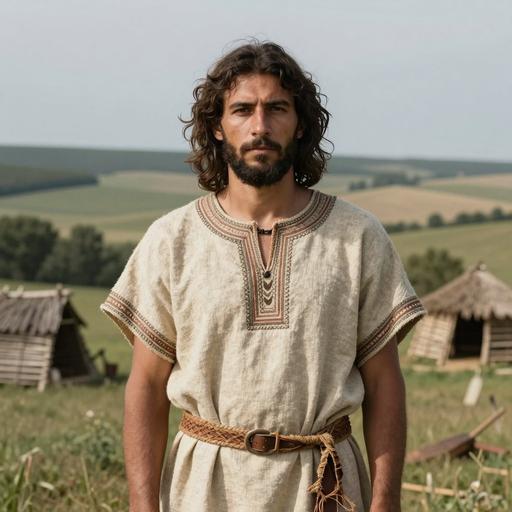
A man buried in Hungary in the Middle Bronze Age era

Download PDF creates a visual, rasterized copy. Use Print for selectable text and better assistive-technology support.

Loading Report

Preparing your ancestry journey

Preparing the available report content...

Your report will open automatically.

Skip to main content
Reference library / Sample profile

A man buried in Hungary in the Middle Bronze Age era

Explore the recorded context, genetic comparisons and research behind this reference sample.

HungaryHungary MBA Fuzesabony

A reference profile describes this sample. It does not establish a personal or family relationship.

AI portrait reconstruction for A man buried in Hungary in the Middle Bronze Age era
AI-generated artistic reconstruction, not a photograph of the individual.
Record

Sample details

Recorded details and available lineage markers.

Individual

MBA Fuzesabony individual, Hungary

Sample ID: I20750

Date Range

2300 BCE - 1600 BCE

Cultural Period

Hungary MBA Fuzesabony

Biological Sex

Male

mtDNA Haplogroup

U4b2

Y-DNA Haplogroup

R-Z283

Social Role

Farmer (AI estimate, era-typical)

Geography

Location

Where this individual was discovered

Country Hungary
Locality Polgar Kenderfold
Coordinates 47.8664, 21.1199
Chronology

Date range

When this individual lived in the broader context of human history

MBA Fuzesabony individual, Hungary 2300 BCE - 1600 BCE
Context

Historical context

Background information associated with the reference record.

Region & Environment

During the Middle Bronze Age (c. 1900–1400 BCE), the region that is today Hungary offered a mosaic of environments: broad river plains, lowlands suitable for agriculture, and nearby uplands providing pastures and routes through the landscape. Settlements tended to take advantage of arable soils and access to water, while people also used surrounding woodland and grazing areas.

Historical Context

This period belongs to the Central European Bronze Age, when long-distance exchanges in raw materials and finished metal affected local communities. The Middle Bronze Age framework included shared technological trends—such as bronze casting practices—while cultural identities are visible archaeologically through distinctive pottery styles and settlement patterns. In Hungary, the Füzesabony horizon represents one regional manifestation within these broader networks.

Populations & Lifeways

Populations were largely agrarian, combining crop cultivation with animal husbandry. Life was organized around households and village communities, with seasonal movement likely playing a role in maintaining herds and using pasture resources. Social life would have been shaped by obligations to craft production, maintenance of settlements, and participation in exchange networks, though the exact scale of leadership or hierarchy is difficult to measure without specific excavated contexts.

Archaeology & Material Culture

Archaeological visibility for this era is strongest through ceramics, metal objects, and settlement remains. Pottery of the Füzesabony Culture is a key diagnostic category, often found in domestic contexts and sometimes in larger assemblages associated with community activities. Bronze artifacts—when present—indicate participation in metallurgical traditions common to the broader Bronze Age world. The distribution of settlements and the character of refuse deposits help reconstruct daily activities such as food processing, storage, and craft work.

Culture & Society

Material culture suggests a balance between local traditions and wider cultural contact. Shared technological skills in metallurgy and recurring ceramic forms point to participation in regional exchange, while stylistic differences help define cultural boundaries. Communities likely maintained relationships through trade, intermarriage, and the movement of specialists and goods, producing overlapping networks rather than isolated societies.

Legacy & Transition

Toward the end of the Middle Bronze Age, archaeologically visible changes—such as shifts in pottery styles and regional assemblage composition—signal transformation across Central Europe. These developments set the stage for later Bronze Age phases and the eventual emergence of Iron Age cultural horizons in the Carpathian Basin. The Füzesabony horizon thus marks a stage of continuity and reorganization within a longer sequence of Central European change.

Analysis

Genetic comparisons

These comparisons show genetic similarity, not identity or origin. The populations listed are those whose genomes show statistical alignment to this ancient individual.

Similarity reflects shared history, not shared identity. These are analytical comparisons, not claims about who this person was.

Modern Genetic Admixture

This analysis compares the DNA profile with present-day reference populations, showing statistical similarity to modern reference populations from different regions. The excavation site records where this individual was found, not a fixed modern genetic identity.

Europe 98.6%
Northwestern European 62.3%
Scandinavian 26.3%
English 21.3%
Northwestern European 14.7%
Eastern European 23.6%
Southern European 12.7%
Balkan 10.7%
Iberian 2.0%
Africa 1.4%
African Hunter-Gatherer 1.4%

Closest Modern Populations

These are the modern populations showing the closest statistical alignment to A man buried in Hungary in the Middle Bronze Age era, ranked by genetic distance. Lower distance values indicate closer statistical similarity. Cross-region similarity can reflect shared ancestry, population movement, continuity, or later admixture.

1
Swedish
2.4433
2
Czech
2.4943
3
Polish
2.5644
4
Polish Kashubian
2.5797
5
German Hamburg
2.7312
6
Polish Silesian
2.8757
7
German East
2.9384
8
Slovakian
2.9871
9
Ukrainian Dnipro
3.2374
10
Ukrainian Rivne
3.2678
Context

Related Samples

This individual exists within a broader network of ancient samples. No ancient genome stands alone.

Individual Culture/Period Date Location Action
Indo-European individual, Romania Glavanesti Culture of Romania 3500 BCE Glăvăneşti, Romania View
Bodrogkeresztur individual, Romania The Bodrogkeresztur Culture 4500 BCE Urziceni, Romania View
MN AVK individual, Hungary Middle Neolithic Alföld Linear Pottery Culture, Hungary 4300 BCE Polgár-Ferenci hát. M3-31, Hungary View
Scythian individual, Hungary Iron Age Scythian Culture, Hungary 4000 BCE Kesznyéten-Szérűskert; Great Hungarian Plain. Borsodi-Mezőség, Hungary View
Scythian individual, Hungary Iron Age Scythian Culture, Hungary 400 BCE Kesznyéten-Szérűskert, Hungary View
Urnfield Culture individual, Hungary Late Bronze Age to Early Iron Age Hungary 1700 BCE Mezőkeresztes-Cethalom. M3-10 lelőhely; Great Hungarian Plain. Borsodi-Mezőség, Hungary View
Urnfield Culture individual, Hungary Late Bronze Age Hungary 1700 BCE Besenyszög Berek-ér partja, Hungary View
EIA Mezocsat individual, Hungary Late Bronze Age to Early Iron Age Hungary 1700 BCE Mezőkeresztes-Cethalom. M3-10 lelőhely; Great Hungarian Plain. Borsodi-Mezőség, Hungary View
Scythian individual, Hungary Iron Age Scythian Culture, Hungary 400 BCE Kesznyéten-Szérűskert, Hungary View
LBA Halva individual, Hungary Late Bronze Age Halomsíros (Tumulus) Culture, Hungary 1700 BCE Hajdudorog-Szallasfold, Hungary View
MBA Fuzesabony individual, Hungary Middle Bronze Age Füzesabony Culture, Hungary 2300 BCE Polgar Kenderfold, Hungary View
LBA individual, Hungary Late Bronze Age Hungary 1500 BCE Besenyszög Berek-ér partja. Köröm-Kápolnadomb, Hungary View
IA Celt individual, Hungary The La Tene Culture in Hungary 500 BCE Besenyszög Berek-ér partja. Köröm-Kápolnadomb, Hungary View
Arctic Cultures individual, Russia Old Bering Sea Culture Ekven, Russia 970 CE Chukotka. Bering Strait. Ekven, Russia View
Ukraine N individual, Ukraine 5500 BCE Dereivka I, Ukraine View
Page 1
Individual Culture/Period Date Location Action
MBA Fuzesabony individual, Hungary Middle Bronze Age Füzesabony Culture, Hungary 2300 BCE Polgar Kenderfold, Hungary View
MBA Fuzesabony individual, Hungary 1930 BCE Mezőzombor-Községi-temető (Borsod-Abaúj-Zemplén County, Szerencs), Hungary View
MBA Fuzesabony individual, Hungary 1787 BCE Mezőzombor-Községi-temető (Borsod-Abaúj-Zemplén County, Szerencs), Hungary View
MBA Fuzesabony individual, Hungary 1733 BCE Mezőzombor-Községi-temető (Borsod-Abaúj-Zemplén County, Szerencs), Hungary View
Page 1
Sources

References

Scientific publications and genetic data that inform this profile.

G25 Coordinates

These coordinates represent a position in genetic space, a tool for comparison, not a conclusion. You can use these to perform custom admixture analysis in G25 Studio.

I20750,0.13282292,0.12380882,0.0667695,0.06245988,0.03670158,0.02512698,0.00688634,0.01210298,0.00123018,-0.01673846,-0.00794206,-0.00142258,0.00774156,0.00649104,0.0045297,0.0039756,-0.00332274,0.00051984,0.00230576,0.00250006,0.00230288,0.00024126,0.00182584,0.00684814,-0.00165339
Continue in G25 Studio
Use code for 30% off • Expires Nov 16