A woman buried in Belgium in the Pleistocene era

Download PDF creates a visual, rasterized copy. Use Print for selectable text and better assistive-technology support.

Loading Report

Preparing your ancestry journey

Preparing the available report content...

Your report will open automatically.

Skip to main content
Reference library / Sample profile

A woman buried in Belgium in the Pleistocene era

Explore the recorded context, genetic comparisons and research behind this reference sample.

BelgiumGoyet Cave Neanderthal

A reference profile describes this sample. It does not establish a personal or family relationship.

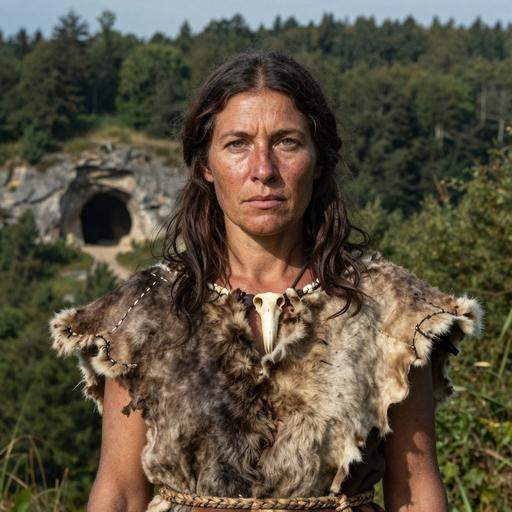
AI portrait reconstruction for A woman buried in Belgium in the Pleistocene era
AI-generated artistic reconstruction, not a photograph of the individual.
Record

Sample details

Recorded details and available lineage markers.

Individual

Neanderthal individual, Belgium

Sample ID: Goyet_final

Date Range

40782 BCE - 40217 BCE

Cultural Period

Goyet Cave Neanderthal

Biological Sex

Female

mtDNA Haplogroup

ND1b1a1b2a

Y-DNA Haplogroup

Not available

Social Role

Gatherer (AI estimate, era-typical)

Geography

Location

Where this individual was discovered

Country Belgium
Locality Goyet Cave
Coordinates 50.4460, 5.0080
Chronology

Date range

When this individual lived in the broader context of human history

Neanderthal individual, Belgium 40782 BCE - 40217 BCE
Context

Historical context

Background information associated with the reference record.

Overview

The Goyet Cave Neanderthal period documents Neanderthal activity in northwestern Europe during a time dominated by Mousterian technologies. Cave deposits at Goyet preserve traces of tool making, hunting or processing activities, and repeated occupation.

Region & Environment

Goyet lies in Belgium within the broader landscapes of western Europe where climate and ecosystems varied through Pleistocene cycles. Cave settings offered shelter from weather and provided stable conditions for preserving organic materials and stone artifacts. Nearby habitats would have included woodland and open areas, supporting prey species and foraging opportunities.

Historical Context

Between about 40,000 and 35,000 BCE, Neanderthals remained present in parts of Europe while glacial-interglacial fluctuations influenced resource availability. The Mousterian technological tradition characterizes many Neanderthal sites in this broader interval, and Goyet fits within that pattern.

Populations & Lifeways

Neanderthal groups occupying caves like Goyet likely organized their activities around seasonal and short-term movements, returning to sheltered locations when conditions were favorable. Lifeways included producing and maintaining stone tools for cutting, scraping, and processing animal and plant materials. Food acquisition would have depended on local faunal distributions and the needs of the group during each occupation.

Archaeology & Material Culture

Goyet’s material record is defined primarily by stone tools consistent with Mousterian practice. Toolkits typically include worked flake components and retouched pieces designed for tasks related to processing materials. The cave context can also preserve animal bone fragments and hearth or burning features where present, helping reconstruct what activities occurred during occupations.

Culture & Society

Stone-tool traditions reflect shared learning and practical knowledge within Neanderthal groups. While the archaeology cannot specify individuals or group identities, recurring technological choices suggest stable behavioral patterns for everyday work, including tool production strategies and task-focused equipment.

Legacy & Transition

As the Late Pleistocene progressed, Neanderthals persisted in many parts of Europe until later major demographic changes near the end of the Pleistocene. The Goyet sequence contributes to understanding Neanderthal technological flexibility during fluctuating environmental conditions and provides a baseline for comparing later archaeological traditions.

Analysis

Genetic comparisons

These comparisons show genetic similarity, not identity or origin. The populations listed are those whose genomes show statistical alignment to this ancient individual.

Similarity reflects shared history, not shared identity. These are analytical comparisons, not claims about who this person was.

Modern Genetic Admixture

This analysis compares the DNA profile with present-day reference populations, showing statistical similarity to modern reference populations from different regions. The excavation site records where this individual was found, not a fixed modern genetic identity.

Africa 90.3%
African Hunter-Gatherer 88.0%
West African 2.3%
Ghanaian, Liberian, Sierra Leonean 2.3%
Europe 5.7%
Eastern European 5.7%
Asia 2.1%
Northern Asian 1.2%
Siberian 0.9%
Japanese & Korean 0.6%
Japanese 0.6%
Oceania 1.5%
Melanesian 1.5%
Papuan 1.5%

Closest Modern Populations

These are the modern populations showing the closest statistical alignment to A woman buried in Belgium in the Pleistocene era, ranked by genetic distance. Lower distance values indicate closer statistical similarity. Cross-region similarity can reflect shared ancestry, population movement, continuity, or later admixture.

1
Baka
3.6481
2
Bedzan
5.0479
3
Bakola
5.6979
4
Biaka
6.7329
Context

Related Samples

This individual exists within a broader network of ancient samples. No ancient genome stands alone.

Individual Culture/Period Date Location Action
Neanderthal individual, Russia Mezmaiskaya 2 Neanderthal 43015 BCE Mezmaiskaya, Russia View
Neanderthal individual, Russia Mezmaiskaya 1 Neanderthal 68050 BCE North Caucasus. Republic of Adygea. Mezmaiskaya Cave, Russia View
Neanderthal individual, France Les Cottes Neanderthal 41201 BCE Les Cottes, France View
Neanderthal individual, Croatia Vindija G1 Neanderthal, Croatia 45000 BCE Vindija Cave, Croatia View
Neanderthal individual, Belgium Goyet Cave Neanderthal 40782 BCE Goyet Cave, Belgium View
Neanderthal individual, Belgium Spy Neanderthal, Belgium 39431 BCE Spy Cave, Belgium View
Neanderthal individual, Belgium 40782 BCE Goyet Cave, Belgium View
Neanderthal individual, France 41201 BCE Les Cottes, France View
Neanderthal individual, Russia 68050 BCE North Caucasus. Republic of Adygea. Mezmaiskaya Cave, Russia View
Neanderthal individual, Russia 43015 BCE Mezmaiskaya, Russia View
Neanderthal individual, Belgium 39431 BCE Spy Cave, Belgium View
Page 1
Individual Culture/Period Date Location Action
Neanderthal individual, Belgium Goyet Cave Neanderthal 40782 BCE Goyet Cave, Belgium View
Page 1
Sources

References

Scientific publications and genetic data that inform this profile.

G25 Coordinates

These coordinates represent a position in genetic space, a tool for comparison, not a conclusion. You can use these to perform custom admixture analysis in G25 Studio.

Goyet_final,-0.6262276,0.06093106,0.02114328,0.03743962,0.0043554,-0.00085612,0.12898156,-0.10188504,-0.01708322,0.0272509,0.01316806,-0.11775388,-0.04088804,-0.00458634,-0.00011318,-0.0015009,0.00169998,-0.02043446,0.00679138,-0.00056558,0.00295878,-0.00143668,-0.0018985,-0.00015328,-0.00300185
Continue in G25 Studio
Use code for 30% off • Expires Nov 16