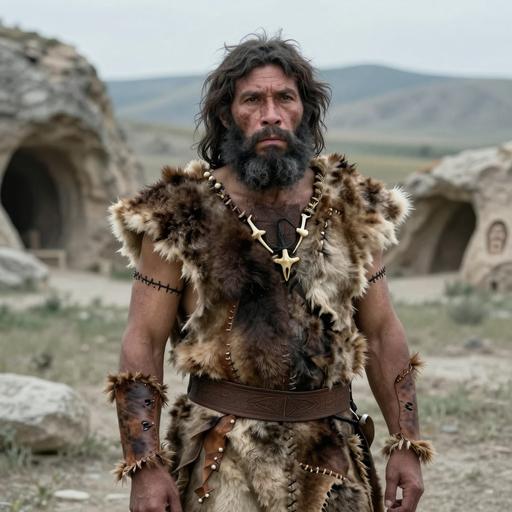
A man buried in Russia in the Pleistocene era

Download PDF creates a visual, rasterized copy. Use Print for selectable text and better assistive-technology support.

Loading Report

Preparing your ancestry journey

Preparing the available report content...

Your report will open automatically.

Skip to main content
Reference library / Sample profile

A man buried in Russia in the Pleistocene era

Explore the recorded context, genetic comparisons and research behind this reference sample.

RussiaMezmaiskaya 2 Neanderthal

A reference profile describes this sample. It does not establish a personal or family relationship.

AI portrait reconstruction for A man buried in Russia in the Pleistocene era
AI-generated artistic reconstruction, not a photograph of the individual.
Record

Sample details

Recorded details and available lineage markers.

Individual

Neanderthal individual, Russia

Sample ID: Mezmaiskaya2_final

Date Range

43015 BCE - 40206 BCE

Cultural Period

Mezmaiskaya 2 Neanderthal

Biological Sex

Male

mtDNA Haplogroup

ND1b1a*

Y-DNA Haplogroup

Not available

Social Role

Hunter (AI estimate, era-typical)

Geography

Location

Where this individual was discovered

Country Russia
Locality Mezmaiskaya
Coordinates 44.1667, 40.0000
Chronology

Date range

When this individual lived in the broader context of human history

Neanderthal individual, Russia 43015 BCE - 40206 BCE
Context

Historical context

Background information associated with the reference record.

Region & Environment

The North Caucasus offers a mix of mountainous terrain and adjacent lowlands, producing varied ecological zones that can be exploited seasonally. During the Pleistocene, climate variability influenced animal distributions and the availability of resources.

Rock-shelter settings in such landscapes could provide protection and preserve evidence of repeated Neanderthal activity across colder and more variable intervals.

Historical Context

The date range for Mezmaiskaya 2 (40,000–30,000 BP) falls within a period when Neanderthals persisted in parts of Eurasia. This era saw continued technological and behavioral responses to fluctuating environments.

Mousterian stone-tool traditions remain a central marker for Middle Paleolithic occupations in many regions, suggesting continuity in aspects of technological practice.

Populations & Lifeways

Neanderthals occupying the North Caucasus would have relied on hunting and the processing of animal resources, using stone tools suited to butchery and other everyday tasks. The recurrence of human evidence and associated archaeological deposits at sheltered sites suggests that Neanderthal groups used favorable locations repeatedly.

Specific details of group size, mobility patterns, and seasonal rounds cannot be determined from a label alone, but the broader Middle Paleolithic pattern supports flexible use of landscapes.

Archaeology & Material Culture

The Mousterian attribution indicates prepared core reduction and the production of retouched flake tools within Middle Paleolithic assemblages. Archaeological deposits in cave or shelter contexts can preserve dense lithic scatters and debris from tool maintenance.

Where preservation allows, associated faunal remains and lithic tool types help reconstruct episodes of carcass processing and tool use, though interpretations should remain cautious without site-specific details.

Culture & Society

“Mousterian” points to learned technological systems that carried recognizable characteristics across broader regions. While the exact social meaning of tool styles remains difficult to infer, repeated use of such methods implies skill transmission and shared conventions.

The “Mezmaiskaya” cultural label is best understood as tying these remains to a particular site/context and its archaeological horizon.

Legacy & Transition

Evidence like Mezmaiskaya 2 helps map Neanderthal presence in the North Caucasus through the later Middle Paleolithic. Across Eurasia, transitions after this period involved changes in tool traditions and broader human population dynamics.

The main legacy of this context is to document how Neanderthals continued to occupy and utilize sheltered mountain environments toward the end of the Mousterian-era.

Context

Related Samples

This individual exists within a broader network of ancient samples. No ancient genome stands alone.

Individual Culture/Period Date Location Action
Neanderthal individual, Russia Mezmaiskaya 2 Neanderthal 43015 BCE Mezmaiskaya, Russia View
Neanderthal individual, Russia Mezmaiskaya 1 Neanderthal 68050 BCE North Caucasus. Republic of Adygea. Mezmaiskaya Cave, Russia View
Neanderthal individual, France Les Cottes Neanderthal 41201 BCE Les Cottes, France View
Neanderthal individual, Croatia Vindija G1 Neanderthal, Croatia 45000 BCE Vindija Cave, Croatia View
Neanderthal individual, Belgium Goyet Cave Neanderthal 40782 BCE Goyet Cave, Belgium View
Neanderthal individual, Belgium Spy Neanderthal, Belgium 39431 BCE Spy Cave, Belgium View
Neanderthal individual, Belgium 40782 BCE Goyet Cave, Belgium View
Neanderthal individual, France 41201 BCE Les Cottes, France View
Neanderthal individual, Russia 68050 BCE North Caucasus. Republic of Adygea. Mezmaiskaya Cave, Russia View
Neanderthal individual, Russia 43015 BCE Mezmaiskaya, Russia View
Neanderthal individual, Belgium 39431 BCE Spy Cave, Belgium View
Page 1
Individual Culture/Period Date Location Action
Neanderthal individual, Russia Mezmaiskaya 2 Neanderthal 43015 BCE Mezmaiskaya, Russia View
Page 1
Use code for 30% off • Expires Nov 16