A woman buried in Belgium in the era

Download PDF creates a visual, rasterized copy. Use Print for selectable text and better assistive-technology support.

Loading Report

Preparing your ancestry journey

Preparing the available report content...

Your report will open automatically.

Skip to main content
Reference library / Sample profile

A woman buried in Belgium in the era

Explore the recorded context, genetic comparisons and research behind this reference sample.

BelgiumNeanderthals

A reference profile describes this sample. It does not establish a personal or family relationship.

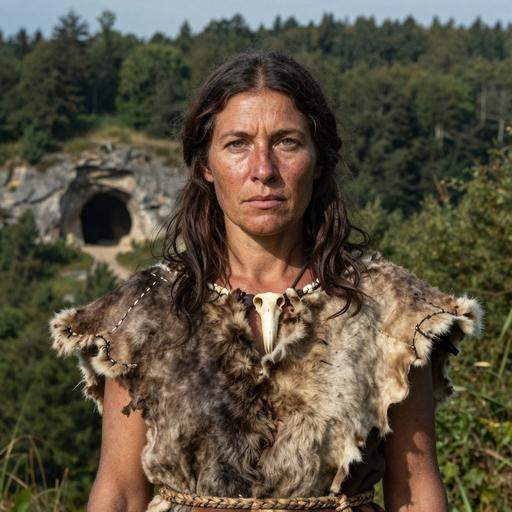
AI portrait reconstruction for A woman buried in Belgium in the  era
AI-generated artistic reconstruction, not a photograph of the individual.
Record

Sample details

Recorded details and available lineage markers.

Individual

Neanderthal individual, Belgium

Sample ID: Goyet_final

Date Range

40782 BCE - 40217 BCE

Cultural Period

Neanderthals

Biological Sex

Female

mtDNA Haplogroup

ND1b1a1b2a

Y-DNA Haplogroup

Not available

Social Role

Gatherer (AI estimate, era-typical)

Geography

Location

Where this individual was discovered

Country Belgium
Locality Goyet Cave

A location map is not available for this record.

Chronology

Date range

When this individual lived in the broader context of human history

Neanderthal individual, Belgium 40782 BCE - 40217 BCE
Context

Historical context

Background information associated with the reference record.

Overview

Neanderthals were extinct human populations best documented through Middle Paleolithic archaeology, especially across Europe and parts of Western Asia. They are widely associated with Mousterian-style stone technologies and with evidence for living in cold-climate landscapes.

Region & Environment

Neanderthals occupied a broad Eurasian range during the late Pleistocene, much of which experienced significant climatic fluctuation. Many key sites are located in temperate to cold zones where Neanderthals exploited terrestrial resources such as large game, as well as available plant and other resources when present. Caves, rock shelters, and open-air sites provided locations to manage weather exposure and to organize daily tasks.

Historical Context

Neanderthals lived during the Middle-to-Late Pleistocene transitions that saw changing glacial conditions and shifting habitats. Their archaeological record shows repeated use of landscapes and consistent technological traditions across long periods, even as environments varied. Over time, demographic and ecological pressures intensified in parts of their range, culminating in their eventual disappearance.

Populations & Lifeways

Evidence from site assemblages indicates that Neanderthals organized labor around tool-making, hunting-related activities, and regular use of shelters. Animal remains and butchery-related traces point to strategic acquisition and processing of meat and other animal products. Neanderthals also used fire, as indicated by hearth-related features at some sites, and their tool kits suggest planned provisioning of cutting and scraping implements.

Archaeology & Material Culture

Neanderthal material culture is dominated by stone tools, including flake-based technologies that reflect skilled knapping and reduction strategies. Tool forms and their use-wear patterns vary by task and locality, but they consistently emphasize cutting, scraping, and woodworking-related activities. Archaeological indicators of habitation include hearths, bedding-like deposits, and structured refuse areas in some cave contexts. In select cases, burials or burial-like arrangements are reported, though interpretation and regional variation remain areas of careful scholarly debate.

Culture & Society

The archaeological record suggests Neanderthals practiced shared learned behaviors within groups, visible in recurring technological patterns and repeated site use. Interaction between Neanderthal groups and between contemporaneous populations is implied in some regions by changing assemblage patterns, but specifics are not always recoverable. Evidence for tool standardization and repeated behaviors supports the idea of social learning and flexible adaptation to local conditions.

Legacy & Transition

Neanderthals went extinct, and their disappearance is archaeologically associated with major Late Pleistocene demographic and environmental changes. In many parts of Eurasia, later Paleolithic populations left different tool and settlement signatures, and Neanderthals are not directly represented in later archaeological phases. Their study remains crucial for understanding human evolution, adaptation, and the behavioral diversity possible within the Middle Paleolithic.

Analysis

Genetic comparisons

These comparisons show genetic similarity, not identity or origin. The populations listed are those whose genomes show statistical alignment to this ancient individual.

Similarity reflects shared history, not shared identity. These are analytical comparisons, not claims about who this person was.

Modern Genetic Admixture

This analysis compares the DNA profile with present-day reference populations, showing statistical similarity to modern reference populations from different regions. The excavation site records where this individual was found, not a fixed modern genetic identity.

Africa 90.3%
African Hunter-Gatherer 88.0%
West African 2.3%
Ghanaian, Liberian, Sierra Leonean 2.3%
Europe 5.7%
Eastern European 5.7%
Asia 2.1%
Northern Asian 1.2%
Siberian 0.9%
Japanese & Korean 0.6%
Japanese 0.6%
Oceania 1.5%
Melanesian 1.5%
Papuan 1.5%

Closest Modern Populations

These are the modern populations showing the closest statistical alignment to A woman buried in Belgium in the era, ranked by genetic distance. Lower distance values indicate closer statistical similarity. Cross-region similarity can reflect shared ancestry, population movement, continuity, or later admixture.

1
Baka
3.6481
2
Bedzan
5.0479
3
Bakola
5.6979
4
Biaka
6.7329
Context

Related Samples

This individual exists within a broader network of ancient samples. No ancient genome stands alone.

Individual Culture/Period Date Location Action
Neanderthal individual, Russia Mezmaiskaya 2 Neanderthal 43015 BCE Mezmaiskaya, Russia View
Neanderthal individual, Russia Mezmaiskaya 1 Neanderthal 68050 BCE North Caucasus. Republic of Adygea. Mezmaiskaya Cave, Russia View
Neanderthal individual, France Les Cottes Neanderthal 41201 BCE Les Cottes, France View
Neanderthal individual, Croatia Vindija G1 Neanderthal, Croatia 45000 BCE Vindija Cave, Croatia View
Neanderthal individual, Belgium Goyet Cave Neanderthal 40782 BCE Goyet Cave, Belgium View
Neanderthal individual, Belgium Spy Neanderthal, Belgium 39431 BCE Spy Cave, Belgium View
Neanderthal individual, Belgium 40782 BCE Goyet Cave, Belgium View
Neanderthal individual, France 41201 BCE Les Cottes, France View
Neanderthal individual, Russia 68050 BCE North Caucasus. Republic of Adygea. Mezmaiskaya Cave, Russia View
Neanderthal individual, Russia 43015 BCE Mezmaiskaya, Russia View
Neanderthal individual, Belgium 39431 BCE Spy Cave, Belgium View
Page 1
Individual Culture/Period Date Location Action
Neanderthal individual, Russia 128050 BCE Denisova Cave. Altai, Russia View
Neanderthal individual, Belgium 40782 BCE Goyet Cave, Belgium View
Neanderthal individual, France 41201 BCE Les Cottes, France View
Neanderthal individual, Russia 68050 BCE North Caucasus. Republic of Adygea. Mezmaiskaya Cave, Russia View
Neanderthal individual, Russia 43015 BCE Mezmaiskaya, Russia View
Neanderthal individual, Belgium 39431 BCE Spy Cave, Belgium View
Neanderthal individual, Russia 128050 BCE Denisova Cave. Altai, Russia View
Neanderthal individual, Russia 116150 BCE Denisova Cave. Altai, Russia View
Neanderthal individual, Russia 98050 BCE Chagyrskaya Cave, Russia View
Page 1
Sources

References

Scientific publications and genetic data that inform this profile.

G25 Coordinates

These coordinates represent a position in genetic space, a tool for comparison, not a conclusion. You can use these to perform custom admixture analysis in G25 Studio.

Goyet_final,-0.6262276,0.06093106,0.02114328,0.03743962,0.0043554,-0.00085612,0.12898156,-0.10188504,-0.01708322,0.0272509,0.01316806,-0.11775388,-0.04088804,-0.00458634,-0.00011318,-0.0015009,0.00169998,-0.02043446,0.00679138,-0.00056558,0.00295878,-0.00143668,-0.0018985,-0.00015328,-0.00300185
Continue in G25 Studio
Use code for 30% off • Expires Nov 16