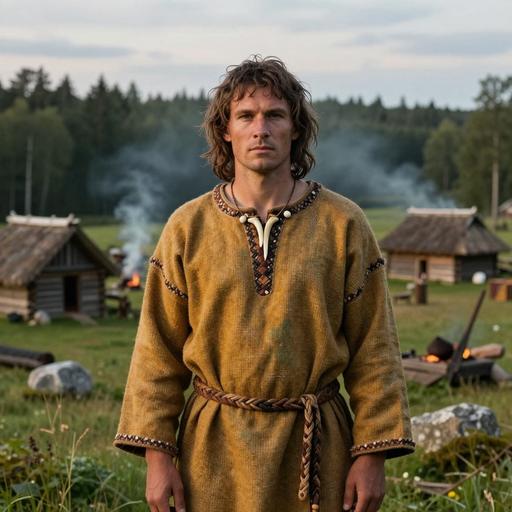
A man buried in Sweden in the Copper Age era

Download PDF creates a visual, rasterized copy. Use Print for selectable text and better assistive-technology support.

Loading Report

Preparing your ancestry journey

Preparing the available report content...

Your report will open automatically.

Skip to main content
Reference library / Sample profile

A man buried in Sweden in the Copper Age era

Explore the recorded context, genetic comparisons and research behind this reference sample.

SwedenLate Neolithic Sweden

A reference profile describes this sample. It does not establish a personal or family relationship.

AI portrait reconstruction for A man buried in Sweden in the Copper Age era
AI-generated artistic reconstruction, not a photograph of the individual.
Record

Sample details

Recorded details and available lineage markers.

Individual

Proto-Indo-European individual, Sweden

Sample ID: oll009

Date Range

1931 BCE - 1749 BCE

Cultural Period

Late Neolithic Sweden

Biological Sex

Male

mtDNA Haplogroup

H6a1b3

Y-DNA Haplogroup

I-DF29

Social Role

Farmer (AI estimate, era-typical)

Geography

Location

Where this individual was discovered

Country Sweden
Locality Olljso
Coordinates 56.0147, 14.0680
Chronology

Date range

When this individual lived in the broader context of human history

Proto-Indo-European individual, Sweden 1931 BCE - 1749 BCE
Context

Historical context

Background information associated with the reference record.

Region & Environment

Late Neolithic Sweden included both agricultural zones and forested regions, with wetlands and waterways shaping local subsistence choices. Seasonal hunting and fishing would have remained important complements to cultivation. Environmental conditions influenced where settlements could be sustained and how communities accessed timber and stone.

Historical Context

The period 2300–1700 BCE marks a Late Neolithic phase during which northern societies continued to reorganize material traditions and social connections. While the broader European context saw increasing use of new materials and technologies, in Sweden the archaeological record is mainly expressed through changes in tools, ceramics, and burial practices rather than written history.

Populations & Lifeways

Communities likely practiced mixed farming and foraging, with cultivation supported by local ecological conditions. Lifeways would have involved animal husbandry, plant processing, and craft work, along with seasonal activities that exploited forest and aquatic resources. Social organization is reconstructed from settlement distribution and mortuary patterns.

Archaeology & Material Culture

Late Neolithic material culture in Sweden typically includes distinctive pottery styles, stone tools, and evidence of household craft activities. Metal objects are not necessarily common across all contexts in this time span, but the era name “Copper Age” reflects a general chronological framework used by the site rather than a uniform metallurgical pattern. Assemblages vary by locality, indicating that communities were not identical across the region.

Culture & Society

Cultural identity is visible most clearly in recurring artifact and burial practices. Communities may have maintained local traditions while incorporating elements from wider regional interaction spheres. Differences in grave goods and deposition methods point to social distinctions and changing ritual priorities.

Legacy & Transition

As this phase ended, Sweden’s archaeological record increasingly reflects broader Bronze Age patterns in technology and exchange. The Late Neolithic thus functions as a formative stage—documenting how communities adjusted livelihoods, production practices, and cultural expression ahead of later developments.

Analysis

Genetic comparisons

These comparisons show genetic similarity, not identity or origin. The populations listed are those whose genomes show statistical alignment to this ancient individual.

Similarity reflects shared history, not shared identity. These are analytical comparisons, not claims about who this person was.

Modern Genetic Admixture

This analysis compares the DNA profile with present-day reference populations, showing statistical similarity to modern reference populations from different regions. The excavation site records where this individual was found, not a fixed modern genetic identity.

Europe 100.0%
Northwestern European 84.1%
English 41.1%
Finnish 30.4%
Scandinavian 8.0%
Northwestern European 4.6%
Southern European 15.9%
Iberian 7.9%
Balkan 6.0%
Sardinian 2.0%

Closest Modern Populations

These are the modern populations showing the closest statistical alignment to A man buried in Sweden in the Copper Age era, ranked by genetic distance. Lower distance values indicate closer statistical similarity. Cross-region similarity can reflect shared ancestry, population movement, continuity, or later admixture.

1
Orcadian
1.6509
2
Scottish
1.8551
3
English
2.1209
4
Dutch
2.1232
5
Irish
2.1736
6
Welsh
2.2508
7
English Cornwall
2.2904
8
Shetlandic
2.3205
9
Norwegian
2.3684
10
Danish
2.4078
Context

Related Samples

This individual exists within a broader network of ancient samples. No ancient genome stands alone.

Individual Culture/Period Date Location Action
Proto-Indo-European individual, Sweden Battle Axe Culture, Sweden 2622 BCE Bergsgraven, Sweden View
Proto-Indo-European individual, Sweden Battle Axe Culture, Sweden 2859 BCE Olljso, Sweden View
Nordic Bronze Age individual, Sweden Pitted Ware Culture, Sweden 3008 BCE Ajvide, Sweden View
North European Neolithic individual, Sweden Funnel Beaker Culture, Sweden 3096 BCE Rossberga, Sweden View
Proto-Indo-European individual, Sweden Late Neolithic Sweden 1931 BCE Olljso, Sweden View
North European Neolithic individual, Sweden Funnel Beaker Culture, Sweden 3331 BCE Rossberga, Sweden View
Proto-Indo-European individual, Sweden Battle Axe Culture, Sweden 2625 BCE Bergsgraven, Sweden View
Proto-Indo-European individual, Sweden Late Neolithic Sweden 1879 BCE Olljso, Sweden View
Indo-European individual, Poland Corded Ware Culture, Poland 2881 BCE Oblaczkowo, Poland View
Indo-European individual, Poland Corded Ware Culture, Poland 2866 BCE Oblaczkowo, Poland View
Proto-Indo-European individual, Estonia Corded Ware Culture, Estonia 2447 BCE Karlova, Estonia View
TRB individual, Sweden Funnel Beaker Culture, Sweden 3096 BCE Rössberga, Sweden View
Corded Ware individual, Sweden 2622 BCE Bergsgraven, Sweden View
Corded Ware individual, Sweden 2625 BCE Bergsgraven, Sweden View
Corded Ware individual, Estonia 2447 BCE Karlova, Estonia View
Nordic Mn individual, Sweden 3096 BCE Rossberga, Sweden View
Pitted Ware individual, Sweden 3008 BCE Ajvide, Sweden View
Megalithic individual, Sweden 2859 BCE Olljso, Sweden View
Megalithic individual, Sweden 1931 BCE Olljso, Sweden View
Megalithic individual, Sweden 1879 BCE Olljso, Sweden View
Corded Ware individual, Poland 2866 BCE Oblaczkowo, Poland View
Corded Ware individual, Poland 2881 BCE Oblaczkowo, Poland View
Nordic Mn individual, Sweden 3331 BCE Rossberga, Sweden View
Page 1
Individual Culture/Period Date Location Action
Proto-Indo-European individual, Sweden Late Neolithic Sweden 1931 BCE Olljso, Sweden View
Proto-Indo-European individual, Sweden Late Neolithic Sweden 1879 BCE Olljso, Sweden View
Page 1
Sources

References

Scientific publications and genetic data that inform this profile.

G25 Coordinates

These coordinates represent a position in genetic space, a tool for comparison, not a conclusion. You can use these to perform custom admixture analysis in G25 Studio.

oll009,0.12916944,0.12739844,0.05797902,0.0474784,0.040749,0.01878044,0.00100676,0.00074336,0.0065937,-0.00035334,-0.00859016,0.00821482,-0.0076582,-0.0093286,0.01740926,-0.00562322,-0.0148422,0.00039792,-0.00040098,-0.00122054,0.00686948,0.00249262,-0.00392074,0.00955066,-0.00288158
Continue in G25 Studio
Use code for 30% off • Expires Nov 16