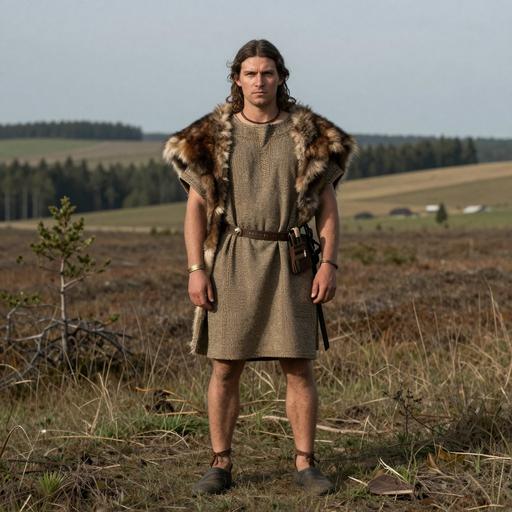
A man buried in Poland in the Bronze Age era

Download PDF creates a visual, rasterized copy. Use Print for selectable text and better assistive-technology support.

Loading Report

Preparing your ancestry journey

Preparing the available report content...

Your report will open automatically.

Skip to main content
Reference library / Sample profile

A man buried in Poland in the Bronze Age era

Explore the recorded context, genetic comparisons and research behind this reference sample.

PolandCorded Ware Culture, Poland

A reference profile describes this sample. It does not establish a personal or family relationship.

AI portrait reconstruction for A man buried in Poland in the Bronze Age era
AI-generated artistic reconstruction, not a photograph of the individual.
Record

Sample details

Recorded details and available lineage markers.

Individual

Indo-European individual, Poland

Sample ID: poz81

Date Range

2881 BCE - 2627 BCE

Cultural Period

Corded Ware Culture, Poland

Biological Sex

Male

mtDNA Haplogroup

U4b1b2

Y-DNA Haplogroup

R-CTS4385

Social Role

Farmer (AI estimate, era-typical)

Geography

Location

Where this individual was discovered

Country Poland
Locality Oblaczkowo
Coordinates 52.3000, 17.5500
Chronology

Date range

When this individual lived in the broader context of human history

Indo-European individual, Poland 2881 BCE - 2627 BCE
Context

Historical context

Background information associated with the reference record.

Overview

In Poland, the Corded Ware phase (c. 2900–2350 BCE) is recognized through a characteristic set of material signatures—most notably cord-impressed pottery and particular approaches to burial and deposition. It reflects changing social organization and broader connections across parts of northern and central Europe.

Region & Environment

Corded Ware sites in Poland span the lowlands and upland margins that supported mixed farming and pastoral activities. River valleys and workable soils would have favored settlement and cultivation, while forests and wetlands supplied additional resources for hunting, foraging, and grazing.

Historical Context

This period belongs to the late 3rd millennium BCE, when communities in much of Europe experienced growing regional interaction and increasingly visible differences in mortuary practice. In eastern and central Europe, Corded Ware is often discussed as part of wider cultural transformations rather than as a single, uniformly distributed movement.

Populations & Lifeways

Populations were largely rural and food-producing, with households relying on agriculture (cereals and domestic plants) complemented by animal husbandry. Evidence from settlement remains and associated features indicates repeated use of preferred locations and long-term occupation in some areas.

Archaeology & Material Culture

Material culture typically includes corded or impressed ceramic vessels, flint and stone tools, and recurring patterns of burial furniture. Specific artifact assemblages vary by locality, but the style of pottery and the organization of graves provide some of the clearest means of identifying Corded Ware contexts.

Culture & Society

Mortuary practice is central to interpretation. Burials and the placement of objects in graves can be read as expressing social roles and group affiliations, suggesting stable community identities and the importance of commemorative traditions.

Legacy & Transition

Corded Ware traditions eventually gave way to subsequent cultural horizons in the region, including the rise of Early Bronze Age groups. Across this transition, changes in ceramic style, burial practice, and assemblage composition point to shifting networks and evolving social practices.

Analysis

Genetic comparisons

These comparisons show genetic similarity, not identity or origin. The populations listed are those whose genomes show statistical alignment to this ancient individual.

Similarity reflects shared history, not shared identity. These are analytical comparisons, not claims about who this person was.

Modern Genetic Admixture

This analysis compares the DNA profile with present-day reference populations, showing statistical similarity to modern reference populations from different regions. The excavation site records where this individual was found, not a fixed modern genetic identity.

Europe 83.2%
Northwestern European 55.9%
English 35.8%
Finnish 10.7%
Scandinavian 9.4%
Eastern European 27.3%
Asia 13.4%
Central Asian, Northern Indian & Pakistani 13.4%
Pakistan 12.4%
Indian 1.0%
America 3.4%
America 3.4%
Native American 3.4%

Closest Modern Populations

These are the modern populations showing the closest statistical alignment to A man buried in Poland in the Bronze Age era, ranked by genetic distance. Lower distance values indicate closer statistical similarity. Cross-region similarity can reflect shared ancestry, population movement, continuity, or later admixture.

1
Tatar Mishar
5.3685
2
Moksha
5.5980
3
Mordovian
5.7315
4
Erzya
5.8389
5
Russian Kostroma
6.2221
6
Russian Krasnoborsky
6.3655
7
Finnish Central
6.7661
8
Finnish Southwest
6.7706
9
Moldovan O
6.8796
10
Russian Ryazan
6.9564
Context

Related Samples

This individual exists within a broader network of ancient samples. No ancient genome stands alone.

Individual Culture/Period Date Location Action
Proto-Indo-European individual, Sweden Battle Axe Culture, Sweden 2622 BCE Bergsgraven, Sweden View
Proto-Indo-European individual, Sweden Battle Axe Culture, Sweden 2859 BCE Olljso, Sweden View
Nordic Bronze Age individual, Sweden Pitted Ware Culture, Sweden 3008 BCE Ajvide, Sweden View
North European Neolithic individual, Sweden Funnel Beaker Culture, Sweden 3096 BCE Rossberga, Sweden View
Proto-Indo-European individual, Sweden Late Neolithic Sweden 1931 BCE Olljso, Sweden View
North European Neolithic individual, Sweden Funnel Beaker Culture, Sweden 3331 BCE Rossberga, Sweden View
Proto-Indo-European individual, Sweden Battle Axe Culture, Sweden 2625 BCE Bergsgraven, Sweden View
Proto-Indo-European individual, Sweden Late Neolithic Sweden 1879 BCE Olljso, Sweden View
Indo-European individual, Poland Corded Ware Culture, Poland 2881 BCE Oblaczkowo, Poland View
Indo-European individual, Poland Corded Ware Culture, Poland 2866 BCE Oblaczkowo, Poland View
Proto-Indo-European individual, Estonia Corded Ware Culture, Estonia 2447 BCE Karlova, Estonia View
TRB individual, Sweden Funnel Beaker Culture, Sweden 3096 BCE Rössberga, Sweden View
Corded Ware individual, Sweden 2622 BCE Bergsgraven, Sweden View
Corded Ware individual, Sweden 2625 BCE Bergsgraven, Sweden View
Corded Ware individual, Estonia 2447 BCE Karlova, Estonia View
Nordic Mn individual, Sweden 3096 BCE Rossberga, Sweden View
Pitted Ware individual, Sweden 3008 BCE Ajvide, Sweden View
Megalithic individual, Sweden 2859 BCE Olljso, Sweden View
Megalithic individual, Sweden 1931 BCE Olljso, Sweden View
Megalithic individual, Sweden 1879 BCE Olljso, Sweden View
Corded Ware individual, Poland 2866 BCE Oblaczkowo, Poland View
Corded Ware individual, Poland 2881 BCE Oblaczkowo, Poland View
Nordic Mn individual, Sweden 3331 BCE Rossberga, Sweden View
Page 1
Individual Culture/Period Date Location Action
Indo-European individual, Poland Corded Ware Culture, Poland 2600 BCE Pikutkowo, Poland View
Indo-European individual, Poland Corded Ware Culture, Poland 2571 BCE Pikutkowo, Poland View
Indo-European individual, Poland Corded Ware Culture, Poland 2881 BCE Oblaczkowo, Poland View
Indo-European individual, Poland Corded Ware Culture, Poland 2866 BCE Oblaczkowo, Poland View
Page 1
Sources

References

Scientific publications and genetic data that inform this profile.

G25 Coordinates

These coordinates represent a position in genetic space, a tool for comparison, not a conclusion. You can use these to perform custom admixture analysis in G25 Studio.

poz81,0.11929604,0.07734226,0.0432625,0.05208132,0.0050095,0.01890866,0.00702368,0.00815502,-0.00925212,-0.02092942,0.00114908,-0.00130442,0.00339848,-0.0076914,0.00394356,-0.00480814,-0.01228044,-0.00041414,-0.00564488,-0.00744492,0.00026922,0.00407724,-0.00665266,0.00848384,-0.00222069
Continue in G25 Studio
Use code for 30% off • Expires Nov 16