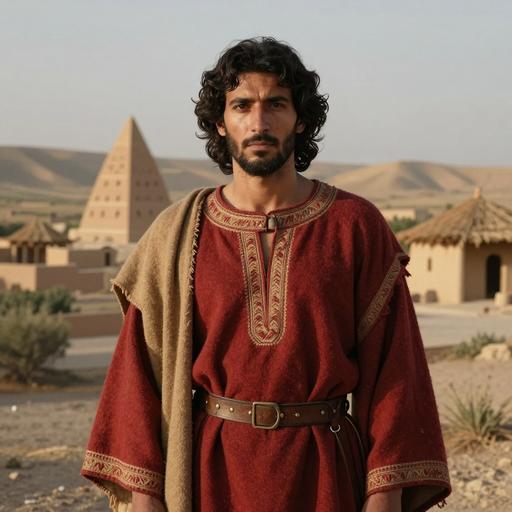
A man buried in Iran in the Iron Age era

Download PDF creates a visual, rasterized copy. Use Print for selectable text and better assistive-technology support.

Loading Report

Preparing your ancestry journey

Preparing the available report content...

Your report will open automatically.

Skip to main content
Reference library / Sample profile

A man buried in Iran in the Iron Age era

Explore the recorded context, genetic comparisons and research behind this reference sample.

IranIran Hasanlu IA

A reference profile describes this sample. It does not establish a personal or family relationship.

AI portrait reconstruction for A man buried in Iran in the Iron Age era
AI-generated artistic reconstruction, not a photograph of the individual.
Record

Sample details

Recorded details and available lineage markers.

Individual

Ancient Near Eastern Civilization individual, Iran

Sample ID: F38

Date Range

971 BCE - 828 BCE

Cultural Period

Iran Hasanlu IA

Biological Sex

Male

mtDNA Haplogroup

N1a3a*

Y-DNA Haplogroup

R-Y37377

Social Role

Farmer (AI estimate, era-typical)

Geography

Location

Where this individual was discovered

Country Iran
Locality Hasanlu
Coordinates 37.0050, 45.4590
Chronology

Date range

When this individual lived in the broader context of human history

Ancient Near Eastern Civilization individual, Iran 971 BCE - 828 BCE
Context

Historical context

Background information associated with the reference record.

Region & Environment

This horizon covers Iran’s western highlands and valleys, an environment where arable land is often concentrated near water sources and arable pockets. Seasonal climates and rugged terrain supported mixed subsistence, with farming complemented by herding and the use of local resources.

Historical Context

Between the second half of the second millennium BCE and the early first millennium BCE, the Near Eastern world saw the emergence and spread of Iron Age practices alongside older Bronze Age traditions. In western Iran, the period is associated with dynamic regional interaction—movement of goods, craftsmen, and ideas through networks that connected upland communities to wider centers.

Populations & Lifeways

Populations are expected to have lived in settled communities, sometimes with defensive considerations reflected in settlement organization. Daily lifeways involved agriculture and herding, craft production within households, and cooperative labor connected to storage and construction. Social differentiation is often suggested indirectly through differences in artifact types, access to metalwork, and building practices.

Archaeology & Material Culture

Archaeological signatures commonly associated with Iron Age sequences in this region include patterned ceramic assemblages, everyday stone tools, and—where preserved—metal artifacts. Differences in vessel shapes and manufacturing details can be used to distinguish phases and to indicate changing preferences or external influence. Durable architectural remains, when found, help clarify how people organized space for residence, storage, and defense.

Culture & Society

The Hasanlu Iron Age horizon reflects a society in which craft knowledge and material consumption were important markers of identity and connection. Communities likely maintained local traditions while adapting to broader technological trends, particularly in metal production and the organization of exchange. Social life would have been organized around household production, communal building tasks, and participation in regional interaction.

Legacy & Transition

As the Iron Age horizon developed, regional settlement and craft practices contributed to later historical periods across western Iran. The continuity of farming and household production, alongside changes in metal use and architectural organization, forms a bridge from earlier Bronze Age lifeways into subsequent phases of Iranian and Near Eastern history.

Analysis

Genetic comparisons

These comparisons show genetic similarity, not identity or origin. The populations listed are those whose genomes show statistical alignment to this ancient individual.

Similarity reflects shared history, not shared identity. These are analytical comparisons, not claims about who this person was.

Modern Genetic Admixture

This analysis compares the DNA profile with present-day reference populations, showing statistical similarity to modern reference populations from different regions. The excavation site records where this individual was found, not a fixed modern genetic identity.

Asia 83.6%
Northern West Asian 58.9%
Caucasian 28.0%
Mesopotamian 25.8%
Cypriot 3.3%
Anatolian 1.7%
Arab, Egyptian & Levantine 20.1%
Arabian 20.1%
Central Asian, Northern Indian & Pakistani 4.6%
Indian 4.6%
Europe 16.4%
Southern European 13.0%
Sardinian 8.8%
Italian 4.2%
Northwestern European 3.4%

Closest Modern Populations

These are the modern populations showing the closest statistical alignment to A man buried in Iran in the Iron Age era, ranked by genetic distance. Lower distance values indicate closer statistical similarity. Cross-region similarity can reflect shared ancestry, population movement, continuity, or later admixture.

1
Kurd USSR
1.8941
2
Kurd Zaza Turkey
1.9189
3
Ezid
1.9282
4
Kurd Sorani Iran Mukriyan
1.9573
5
Kurd Iraq
1.9914
6
Kurd Kurmanji Turkey
2.0504
7
Alevi Dersim
2.1606
8
Talysh Azerbaijan
2.3241
9
Kurd Syria
2.3882
10
Bukharian Jew
2.6686
Context

Related Samples

This individual exists within a broader network of ancient samples. No ancient genome stands alone.

Individual Culture/Period Date Location Action
Ancient Near Eastern Civilization individual, Iran The Iron Age in Hasanlu, Iran 971 BCE Hasanlu, Iran View
Ancient Near Eastern Civilization individual, Iran Neolithic Tepe Abdul Hosein, Iran 8250 BCE Tepe Abdul Hosein. Central Zagros, Iran View
Ancient Near Eastern Civilization individual, Iran Neolithic Tepe Abdul Hosein, Iran 8201 BCE Tepe Abdul Hosein. Central Zagros, Iran View
Ancient Near Eastern Civilization individual, Iran Neolithic Tepe Abdul Hosein, Iran 8202 BCE Tepe Abdul Hosein. Central Zagros, Iran View
Zagros Neolithic individual, Iran Neolithic Wezmeh Cave, Iran 7461 BCE Wezmeh Cave. Central Zagros, Iran View
Iran N individual, Iran 8250 BCE Tepe Abdul Hosein. Central Zagros, Iran View
Iran N individual, Iran 8202 BCE Tepe Abdul Hosein. Central Zagros, Iran View
Iran N individual, Iran 8201 BCE Tepe Abdul Hosein. Central Zagros, Iran View
Iran Ia individual, Iran 971 BCE Hasanlu, Iran View
Iran N individual, Iran 7461 BCE Wezmeh Cave. Central Zagros, Iran View
Page 1
Individual Culture/Period Date Location Action
Hasanlu IA individual, Iran The Iron Age in Hasanlu, Iran 761 BCE Hasanlu, Iran View
Hasanlu IA individual, Iran The Iron Age in Hasanlu, Iran 1046 BCE Hasanlu, Iran View
Hasanlu IA individual, Iran The Iron Age in Hasanlu, Iran 1011 BCE Hasanlu, Iran View
Hasanlu IA individual, Iran The Iron Age in Hasanlu, Iran 1111 BCE Hasanlu, Iran View
Hasanlu IA individual, Iran The Iron Age in Hasanlu, Iran 925 BCE Hasanlu, Iran View
Hasanlu IA individual, Iran The Iron Age in Hasanlu, Iran 1190 BCE Hasanlu, Iran View
Hasanlu LBA individual, Iran The Iron Age in Hasanlu, Iran 1377 BCE Hasanlu, Iran View
Hasanlu IA individual, Iran The Iron Age in Hasanlu, Iran 1115 BCE Hasanlu, Iran View
Hasanlu IA individual, Iran The Iron Age in Hasanlu, Iran 1011 BCE Hasanlu, Iran View
Hasanlu IA individual, Iran The Iron Age in Hasanlu, Iran 1200 BCE Hasanlu, Iran View
Hasanlu IA individual, Iran The Iron Age in Hasanlu, Iran 1192 BCE Hasanlu, Iran View
Hasanlu IA individual, Iran The Iron Age in Hasanlu, Iran 1262 BCE Hasanlu, Iran View
Hasanlu IA individual, Iran The Iron Age in Hasanlu, Iran 1369 BCE Hasanlu, Iran View
Hasanlu IA individual, Iran The Iron Age in Hasanlu, Iran 1012 BCE Hasanlu, Iran View
Hasanlu IA individual, Iran The Iron Age in Hasanlu, Iran 928 BCE Hasanlu, Iran View
Ancient Near Eastern Civilization individual, Iran The Iron Age in Hasanlu, Iran 902 BCE Hasanlu, Iran View
Hasanlu IA individual, Iran The Iron Age in Hasanlu, Iran 823 BCE Hasanlu, Iran View
Hasanlu IA individual, Iran The Iron Age in Hasanlu, Iran 805 BCE Hasanlu, Iran View
Hasanlu LBA-o individual, Iran The Iron Age in Hasanlu, Iran 1425 BCE Hasanlu, Iran View
Ancient Near Eastern Civilization individual, Iran The Iron Age in Hasanlu, Iran 971 BCE Hasanlu, Iran View
Page 1
Sources

References

Scientific publications and genetic data that inform this profile.

G25 Coordinates

These coordinates represent a position in genetic space, a tool for comparison, not a conclusion. You can use these to perform custom admixture analysis in G25 Studio.

F38,0.09550692,0.11519718,-0.06004624,-0.03987998,-0.03868144,-0.00566136,0.00587556,-0.00684748,-0.02697146,-0.01690894,0.00169844,-0.00056588,0.0029318,-0.00018248,0.00893968,0.01040696,0.00142488,0.00017138,0.00027482,0.00250604,0.0070462,0.00212068,0.00189248,-0.00444744,0.0005737
Continue in G25 Studio
Use code for 30% off • Expires Nov 16