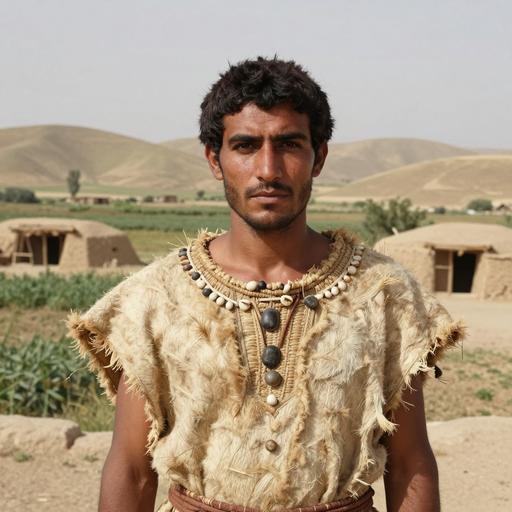
A man buried in Iran in the era

Download PDF creates a visual, rasterized copy. Use Print for selectable text and better assistive-technology support.

Loading Report

Preparing your ancestry journey

Preparing the available report content...

Your report will open automatically.

Skip to main content
Reference library / Sample profile

A man buried in Iran in the era

Explore the recorded context, genetic comparisons and research behind this reference sample.

IranNeolithic Iran

A reference profile describes this sample. It does not establish a personal or family relationship.

AI portrait reconstruction for A man buried in Iran in the  era
AI-generated artistic reconstruction, not a photograph of the individual.
Record

Sample details

Recorded details and available lineage markers.

Individual

Iran N individual, Iran

Sample ID: AH2

Date Range

8202 BCE - 7752 BCE

Cultural Period

Neolithic Iran

Biological Sex

Male

mtDNA Haplogroup

R2-a*

Y-DNA Haplogroup

J-M102

Social Role

Farmer (AI estimate, era-typical)

Geography

Location

Where this individual was discovered

Country Iran
Locality Tepe Abdul Hosein. Central Zagros

A location map is not available for this record.

Chronology

Date range

When this individual lived in the broader context of human history

Iran N individual, Iran 8202 BCE - 7752 BCE
Context

Historical context

Background information associated with the reference record.

Region & Environment

Neolithic Iran encompasses communities living across the Iranian plateau and nearby ecological zones where cultivable land and pasture could be accessed. Settlement locations were commonly influenced by local water availability and arable soils, with valleys and other resource-rich areas offering advantages for grain cultivation and animal husbandry.

Historical Context

This Neolithic phase reflects the wider shift toward economies centered on cultivation and animal management. Over time, these practices became more established, though their adoption and intensity varied regionally. Communities developed local traditions in ceramics and stone tool production that help distinguish archaeological phases.

Populations & Lifeways

Populations were largely sedentary or semi-sedentary, organizing daily work around planting, tending animals, and managing stored food. Household activities included processing crops, preparing meals, maintaining tools, and producing or repairing pottery and other domestic equipment.

Where conditions required, people also used the surrounding landscape for seasonal grazing and collecting resources beyond the immediate fields.

Archaeology & Material Culture

Neolithic archaeology in Iran is frequently identified through ceramic assemblages (cooking and storage vessels) and associated stone tool technologies. Ground-stone and cutting tools are often interpreted in relation to processing activities for plant foods and other household tasks.

Site stratigraphy and artifact styles support sequencing within the Neolithic, while patterns of settlement—such as repeated occupation of certain locales—indicate growing commitment to place-based lifeways.

Culture & Society

Social structure is primarily reconstructed from settlement organization and recurring artifact styles. Shared traditions in vessel forms and toolmaking suggest networks of learning within regions and, at times, broader interaction between communities.

The Neolithic period likely involved community coordination around resources such as water, arable land, and herding territories, even if large-scale political institutions are not evident across all regions.

Legacy & Transition

The Neolithic laid groundwork for later prehistoric transformations in Iran, including Chalcolithic developments and more complex economies. Continuities in domestic practices—especially ceramics and toolkits—help connect early farming communities to later changes in metallurgy and regional integration.

Analysis

Genetic comparisons

These comparisons show genetic similarity, not identity or origin. The populations listed are those whose genomes show statistical alignment to this ancient individual.

Similarity reflects shared history, not shared identity. These are analytical comparisons, not claims about who this person was.

Modern Genetic Admixture

This analysis compares the DNA profile with present-day reference populations, showing statistical similarity to modern reference populations from different regions. The excavation site records where this individual was found, not a fixed modern genetic identity.

Asia 96.0%
Central Asian, Northern Indian & Pakistani 94.3%
Pakistan 71.0%
Indian 23.3%
Northern West Asian 1.7%
Mesopotamian 1.7%
Africa 4.0%
West African 4.0%
Senegambian & Guinean 4.0%

Closest Modern Populations

These are the modern populations showing the closest statistical alignment to A man buried in Iran in the era, ranked by genetic distance. Lower distance values indicate closer statistical similarity. Cross-region similarity can reflect shared ancestry, population movement, continuity, or later admixture.

1
Iranian Persian Khorasan
5.4045
2
Parsi Pakistan
5.4786
3
Parsi India
5.5449
4
Iranian Mazandarani O
6.4269
5
Turkmen O
6.6581
6
Iranian Persian Shiraz
6.7757
7
Iranian Mazandarani
6.8307
8
Irani Zoroastrian India
6.8648
9
Iranian Central
6.9239
10
Iranian Persian Yazd
7.0775
Context

Related Samples

This individual exists within a broader network of ancient samples. No ancient genome stands alone.

Individual Culture/Period Date Location Action
Ancient Near Eastern Civilization individual, Iran The Iron Age in Hasanlu, Iran 971 BCE Hasanlu, Iran View
Ancient Near Eastern Civilization individual, Iran Neolithic Tepe Abdul Hosein, Iran 8250 BCE Tepe Abdul Hosein. Central Zagros, Iran View
Ancient Near Eastern Civilization individual, Iran Neolithic Tepe Abdul Hosein, Iran 8201 BCE Tepe Abdul Hosein. Central Zagros, Iran View
Ancient Near Eastern Civilization individual, Iran Neolithic Tepe Abdul Hosein, Iran 8202 BCE Tepe Abdul Hosein. Central Zagros, Iran View
Zagros Neolithic individual, Iran Neolithic Wezmeh Cave, Iran 7461 BCE Wezmeh Cave. Central Zagros, Iran View
Iran N individual, Iran 8250 BCE Tepe Abdul Hosein. Central Zagros, Iran View
Iran N individual, Iran 8202 BCE Tepe Abdul Hosein. Central Zagros, Iran View
Iran N individual, Iran 8201 BCE Tepe Abdul Hosein. Central Zagros, Iran View
Iran Ia individual, Iran 971 BCE Hasanlu, Iran View
Iran N individual, Iran 7461 BCE Wezmeh Cave. Central Zagros, Iran View
Page 1
Individual Culture/Period Date Location Action
Iran N individual, Iran 8250 BCE Tepe Abdul Hosein. Central Zagros, Iran View
Iran N individual, Iran 8202 BCE Tepe Abdul Hosein. Central Zagros, Iran View
Iran N individual, Iran 8201 BCE Tepe Abdul Hosein. Central Zagros, Iran View
Iran N individual, Iran 7461 BCE Wezmeh Cave. Central Zagros, Iran View
Page 1
Sources

References

Scientific publications and genetic data that inform this profile.

G25 Coordinates

These coordinates represent a position in genetic space, a tool for comparison, not a conclusion. You can use these to perform custom admixture analysis in G25 Studio.

AH2,0.08188524,0.06330816,-0.08080782,0.00252888,-0.0567205,0.00957014,0.00743824,-0.00077898,-0.03646728,-0.01513494,-0.00431488,0.0056872,-0.01465348,0.00487896,0.00683576,-0.01320252,0.01518516,-0.00419276,-0.0056462,0.01030914,0.01062074,-0.00054566,0.00655616,-0.00587104,-0.00583709
Continue in G25 Studio
Use code for 30% off • Expires Nov 16