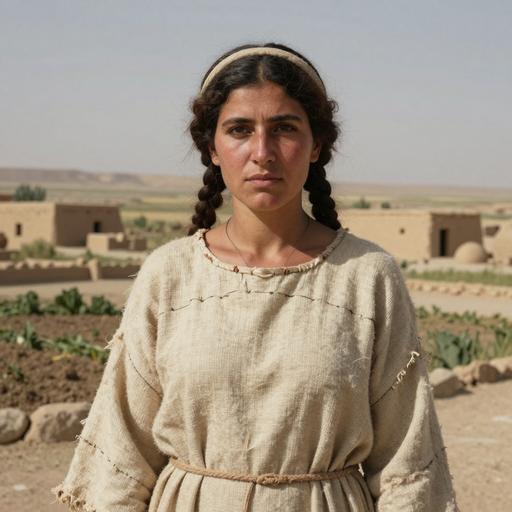
A woman buried in Iran in the Neolithic era

Download PDF creates a visual, rasterized copy. Use Print for selectable text and better assistive-technology support.

Loading Report

Preparing your ancestry journey

Preparing the available report content...

Your report will open automatically.

Skip to main content
Reference library / Sample profile

A woman buried in Iran in the Neolithic era

Explore the recorded context, genetic comparisons and research behind this reference sample.

IranIran TepeAbdulHosein N

A reference profile describes this sample. It does not establish a personal or family relationship.

AI portrait reconstruction for A woman buried in Iran in the Neolithic era
AI-generated artistic reconstruction, not a photograph of the individual.
Record

Sample details

Recorded details and available lineage markers.

Individual

Ancient Near Eastern Civilization individual, Iran

Sample ID: AH4

Date Range

8201 BCE - 7751 BCE

Cultural Period

Iran TepeAbdulHosein N

Biological Sex

Female

mtDNA Haplogroup

T2c2

Y-DNA Haplogroup

Not available

Social Role

Farmer (AI estimate, era-typical)

Geography

Location

Where this individual was discovered

Country Iran
Locality Tepe Abdul Hosein. Central Zagros
Coordinates 34.1883, 48.3689
Chronology

Date range

When this individual lived in the broader context of human history

Ancient Near Eastern Civilization individual, Iran 8201 BCE - 7751 BCE
Context

Historical context

Background information associated with the reference record.

Region & Environment

Tepe Abdul Hosein is located in Iran’s Zagros region, an area where mountain valleys and foothills offered corridors of arable land and seasonal grazing. The local environment supported early experimentation with agriculture and herding, drawing communities into more stable settlement patterns over time.

Historical Context

Dating to c. 8000–6000 BCE, this Neolithic phase falls within the broader establishment and spread of food-producing lifeways in the Near East. In western Iran, early village development is associated with the emergence of more sedentary routines, changing human relationships to local landscapes, and gradual expansion of agricultural practices.

Populations & Lifeways

The population is associated with the Abdul Hosein Culture and a Central Zagros Neolithic context (as given in the metadata). Lifeways likely included farming of domesticated plants and herding of domesticated animals, supplemented by hunting and gathering where environmental conditions allowed. As villages became more established, community organization would have shifted toward longer-term household planning, including storage of foods and the maintenance of built or reused settlement spaces.

Archaeology & Material Culture

Neolithic assemblages from this period commonly include ground-stone and flaked stone tools used for processing plant foods and working materials, along with pottery and other domestic equipment where present in local sequences. Ceramic traditions and toolkits are key for distinguishing Neolithic phases in the region, and variations can indicate changing daily practices, cooking technologies, and craft activities.

Culture & Society

As with many Neolithic societies, social organization would have been centered on households and community networks rather than complex state institutions. Over time, repeated rebuilding, shared craft know-how, and consistent domestic artifact patterns can point to stable norms of daily life. Material choices—such as tool forms and vessel styles—help archaeologists track how communities maintained continuity while adapting to new economic needs.

Legacy & Transition

This early Neolithic horizon contributes to understanding how farming settlements in the Zagros developed and persisted into later stages of the Neolithic. Subsequent transitions in the region would involve further changes in technology, settlement scale, and regional interactions as communities moved beyond the earliest food-producing phases.

Analysis

Genetic comparisons

These comparisons show genetic similarity, not identity or origin. The populations listed are those whose genomes show statistical alignment to this ancient individual.

Similarity reflects shared history, not shared identity. These are analytical comparisons, not claims about who this person was.

Modern Genetic Admixture

This analysis compares the DNA profile with present-day reference populations, showing statistical similarity to modern reference populations from different regions. The excavation site records where this individual was found, not a fixed modern genetic identity.

Asia 100.0%
Central Asian, Northern Indian & Pakistani 81.3%
Pakistan 55.1%
Indian 26.1%
Northern West Asian 18.7%
Mesopotamian 18.7%

Closest Modern Populations

These are the modern populations showing the closest statistical alignment to A woman buried in Iran in the Neolithic era, ranked by genetic distance. Lower distance values indicate closer statistical similarity. Cross-region similarity can reflect shared ancestry, population movement, continuity, or later admixture.

1
Iranian Persian Khorasan
5.5072
2
Parsi Pakistan
5.6735
3
Parsi India
5.7606
4
Iranian Mazandarani O
6.3032
5
Turkmen O
6.5413
6
Iranian Mazandarani
6.7248
7
Irani Zoroastrian India
6.7835
8
Iranian Persian Shiraz
6.8261
9
Iranian Central
6.8690
10
Azerbaijani Dagestan
6.9745
Context

Related Samples

This individual exists within a broader network of ancient samples. No ancient genome stands alone.

Individual Culture/Period Date Location Action
Ancient Near Eastern Civilization individual, Iran The Iron Age in Hasanlu, Iran 971 BCE Hasanlu, Iran View
Ancient Near Eastern Civilization individual, Iran Neolithic Tepe Abdul Hosein, Iran 8250 BCE Tepe Abdul Hosein. Central Zagros, Iran View
Ancient Near Eastern Civilization individual, Iran Neolithic Tepe Abdul Hosein, Iran 8201 BCE Tepe Abdul Hosein. Central Zagros, Iran View
Ancient Near Eastern Civilization individual, Iran Neolithic Tepe Abdul Hosein, Iran 8202 BCE Tepe Abdul Hosein. Central Zagros, Iran View
Zagros Neolithic individual, Iran Neolithic Wezmeh Cave, Iran 7461 BCE Wezmeh Cave. Central Zagros, Iran View
Iran N individual, Iran 8250 BCE Tepe Abdul Hosein. Central Zagros, Iran View
Iran N individual, Iran 8202 BCE Tepe Abdul Hosein. Central Zagros, Iran View
Iran N individual, Iran 8201 BCE Tepe Abdul Hosein. Central Zagros, Iran View
Iran Ia individual, Iran 971 BCE Hasanlu, Iran View
Iran N individual, Iran 7461 BCE Wezmeh Cave. Central Zagros, Iran View
Page 1
Individual Culture/Period Date Location Action
Ancient Near Eastern Civilization individual, Iran Neolithic Tepe Abdul Hosein, Iran 8250 BCE Tepe Abdul Hosein. Central Zagros, Iran View
Ancient Near Eastern Civilization individual, Iran Neolithic Tepe Abdul Hosein, Iran 8201 BCE Tepe Abdul Hosein. Central Zagros, Iran View
Ancient Near Eastern Civilization individual, Iran Neolithic Tepe Abdul Hosein, Iran 8202 BCE Tepe Abdul Hosein. Central Zagros, Iran View
Page 1
Sources

References

Scientific publications and genetic data that inform this profile.

G25 Coordinates

These coordinates represent a position in genetic space, a tool for comparison, not a conclusion. You can use these to perform custom admixture analysis in G25 Studio.

AH4,0.09087036,0.06437236,-0.08125444,0.00136548,-0.05709112,0.00914792,0.00814616,-0.00149152,-0.03690986,-0.0159831,-0.00430986,0.00571464,-0.01521946,0.00504408,0.00684856,-0.01350658,0.0154513,-0.00425648,-0.0059408,0.01068582,0.0107406,-0.0005359,0.00672666,-0.0060781,-0.00587421
Continue in G25 Studio
Use code for 30% off • Expires Nov 16