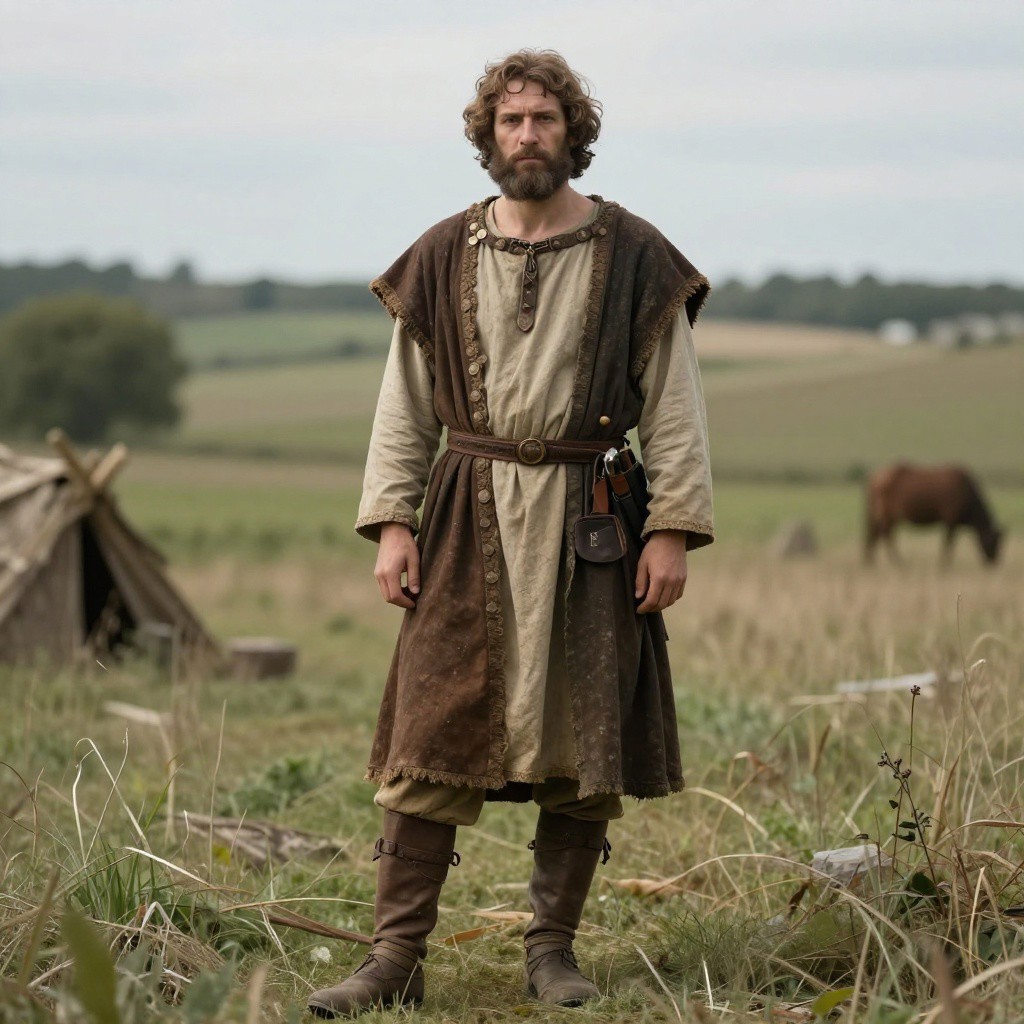
A man buried in Belgium in the era

Download PDF creates a visual, rasterized copy. Use Print for selectable text and better assistive-technology support.

Loading Report

Preparing your ancestry journey

Preparing the available report content...

Your report will open automatically.

Skip to main content
Reference library / Sample profile

A man buried in Belgium in the era

Explore the recorded context, genetic comparisons and research behind this reference sample.

BelgiumBelgium N

A reference profile describes this sample. It does not establish a personal or family relationship.

AI portrait reconstruction for A man buried in Belgium in the  era
AI-generated artistic reconstruction, not a photograph of the individual.
Record

Sample details

Recorded details and available lineage markers.

Individual

N individual, Belgium

Sample ID: I18068

Date Range

2956 BCE - 2860 BCE

Cultural Period

Belgium N

Biological Sex

Male

mtDNA Haplogroup

H7d

Y-DNA Haplogroup

F

Geography

Location

Where this individual was discovered

Country Belgium
Locality Pommeroeul (Wallonne Gewest, Henegouwen)
Coordinates 50.4608, 3.7117
Chronology

Date range

When this individual lived in the broader context of human history

N individual, Belgium 2956 BCE - 2860 BCE
Context

Historical context

Background information associated with the reference record.

Region & Environment

Belgium’s environments—river valleys, lowlands, and mixed terrestrial habitats—provided the ecological setting for long-term human occupation. Availability of arable land, freshwater resources, and travel corridors through water and overland routes shaped settlement choices.

Historical Context

Because “Belgium N” is presented here as a dataset-era label without an explicit, tightly bounded historical framing, it is best understood as a grouping used for organizing archaeological material rather than as a single, universally agreed historical moment. Any attempt to connect it to named political regimes or events would be speculative without tighter chronological controls.

Populations & Lifeways

In this kind of broad or transitional label, populations would have relied on local subsistence strategies appropriate to the wider region. Lifeways likely combined farming and/or herding with household craft and exchange, with settlement intensity varying by landscape productivity and social organization.

Archaeology & Material Culture

Material culture for a broad grouping is typically diverse and may include domestic debris, metal or stone items (depending on what is preserved and classified), and features indicating habitation and burial. Caution is required: without a narrower date range, artifacts may represent multiple phases or different cultural traditions coexisting or overlapping.

Culture & Society

Social organization would have ranged from household-level activities to community practices linked by shared traditions and exchange. In broad dataset groupings, identifiable patterns—such as recurring artifact types or burial organization—can suggest common practices, but they should not be used to infer precise political structures.

Legacy & Transition

When labels like “Belgium N” cover ambiguous or composite periods, their main value is organizational: they help track continuity and change across a longer arc of occupation. The transition to more precisely defined periods in the dataset often reflects improved chronological resolution, allowing clearer interpretation of cultural and social shifts.

Analysis

Genetic comparisons

These comparisons show genetic similarity, not identity or origin. The populations listed are those whose genomes show statistical alignment to this ancient individual.

Similarity reflects shared history, not shared identity. These are analytical comparisons, not claims about who this person was.

Modern Genetic Admixture

This analysis compares the DNA profile with present-day reference populations, showing statistical similarity to modern reference populations from different regions. The excavation site records where this individual was found, not a fixed modern genetic identity.

Europe 98.7%
Southern European 66.8%
Iberian 45.4%
Sardinian 21.4%
Northwestern European 31.9%
English 17.7%
Northwestern European 11.5%
Finnish 2.7%
Oceania 1.2%
Melanesian 1.2%
Papuan 1.2%

Closest Modern Populations

These are the modern populations showing the closest statistical alignment to A man buried in Belgium in the era, ranked by genetic distance. Lower distance values indicate closer statistical similarity. Cross-region similarity can reflect shared ancestry, population movement, continuity, or later admixture.

1
Spanish La Rioja
1.6373
2
Spanish Terres De L'ebre
1.8471
3
Spanish Cantabria
1.8508
4
Spanish Castello
1.8578
5
Spanish Aragon
1.8906
6
Spanish Pirineu
1.9164
7
Spanish Burgos
1.9710
8
Spanish Valencia
1.9777
9
Spanish Castilla La Mancha
2.0010
10
Spanish Navarra
2.1321
Context

Related Samples

This individual exists within a broader network of ancient samples. No ancient genome stands alone.

Individual Culture/Period Date Location Action
N individual, Belgium 3066 BCE Pommeroeul (Wallonne Gewest, Henegouwen), Belgium View
N individual, Belgium 2956 BCE Pommeroeul (Wallonne Gewest, Henegouwen), Belgium View
Roman individual, Belgium 3 BCE Tongeren-Beukenbergweg (Vlaams Gewest, Limburg), Belgium View
N individual, Belgium 3035 BCE Pommeroeul (Wallonne Gewest, Henegouwen), Belgium View
Page 1
Individual Culture/Period Date Location Action
N individual, Belgium 3383 BCE Trou Al'Wesse (Liège Province, Modave), Belgium View
N individual, Belgium 2977 BCE Grotte du Mont Falise (Wallonne Gewest, de Huy Arrondissement, Wanze), Belgium View
N individual, Belgium 3085 BCE Grotte du Mont Falise (Wallonne Gewest, de Huy Arrondissement, Wanze), Belgium View
N individual, Belgium 2974 BCE Abri Sandron (Wallonne Gewest, Luik, Huccorgne), Belgium View
N individual, Belgium 3066 BCE Pommeroeul (Wallonne Gewest, Henegouwen), Belgium View
N individual, Belgium 2956 BCE Pommeroeul (Wallonne Gewest, Henegouwen), Belgium View
N individual, Belgium 3035 BCE Pommeroeul (Wallonne Gewest, Henegouwen), Belgium View
N individual, Belgium 5408 BCE Grotte de la Faille du Burin (Wallonne Gewest, Namen), Belgium View
Page 1
Sources

References

Scientific publications and genetic data that inform this profile.

G25 Coordinates

These coordinates represent a position in genetic space, a tool for comparison, not a conclusion. You can use these to perform custom admixture analysis in G25 Studio.

I18068,0.12168968,0.14790704,0.04012508,-0.00571684,0.05035032,-0.00531192,-0.00068328,0.00121288,0.02404768,0.03974748,-0.00626908,0.0124748,-0.02154448,-0.01325016,0.00375536,-0.0035216,-0.00116844,-0.00010604,0.0004154,-0.003499,0.00311428,0.00237748,-0.0106208,-0.00497244,-7.332E-05
Continue in G25 Studio
Use code for 30% off • Expires Nov 16