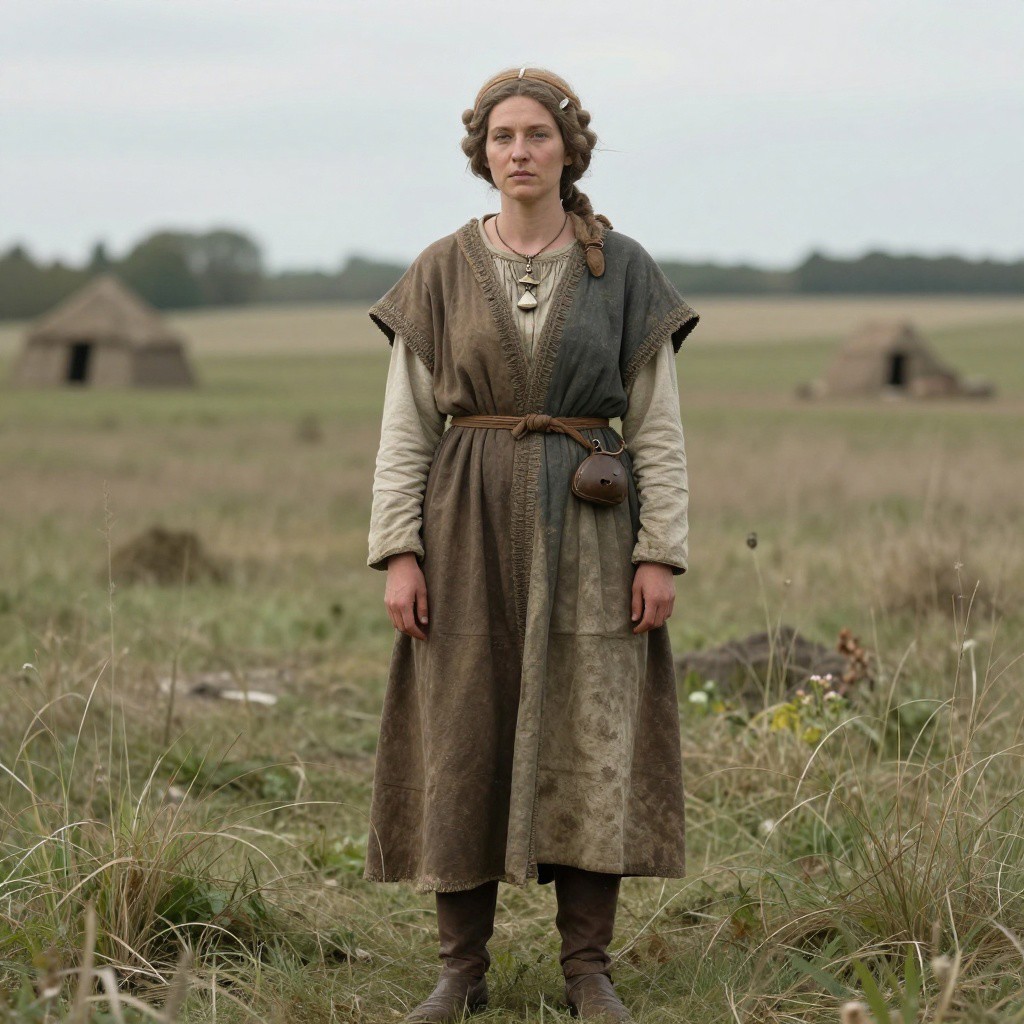
A woman buried in Netherlands in the era

Download PDF creates a visual, rasterized copy. Use Print for selectable text and better assistive-technology support.

Loading Report

Preparing your ancestry journey

Preparing the available report content...

Your report will open automatically.

Skip to main content
Reference library / Sample profile

A woman buried in Netherlands in the era

Explore the recorded context, genetic comparisons and research behind this reference sample.

NetherlandsLate Neolithic B Bell Beaker Culture, Netherlands

A reference profile describes this sample. It does not establish a personal or family relationship.

AI portrait reconstruction for A woman buried in Netherlands in the  era
AI-generated artistic reconstruction, not a photograph of the individual.
Record

Sample details

Recorded details and available lineage markers.

Individual

LNB Bell Beaker individual, Netherlands

Sample ID: I39210

Date Range

2066 BCE - 1834 BCE

Cultural Period

Late Neolithic B Bell Beaker Culture, Netherlands

Biological Sex

Female

mtDNA Haplogroup

H

Y-DNA Haplogroup

Not available

Geography

Location

Where this individual was discovered

Country Netherlands
Locality De-Tuithoorn (Noord-Holland, Medemblik)
Coordinates 52.7336, 5.0962
Chronology

Date range

When this individual lived in the broader context of human history

LNB Bell Beaker individual, Netherlands 2066 BCE - 1834 BCE
Context

Historical context

Background information associated with the reference record.

The Bell Beaker culture, which flourished during the Late Neolithic and Early Bronze Age around 2800–1800 BCE, is a significant prehistoric culture in Western Europe that is distinguished by its distinctive pottery. In the Netherlands, this era is marked by a range of cultural and technological developments as communities transitioned from Neolithic lifestyles to more complex societal structures.

Geographic and Temporal Context

The Bell Beaker culture spanned much of Western and Central Europe, but its presence in the Netherlands is particularly noteworthy due to the region’s strategic location and the diversity of archaeological sites. The timeline for the Bell Beaker culture in the Netherlands situates it primarily between 2400 and 1900 BCE, overlapping with the Late Neolithic B phase and even into the Early Bronze Age in some regions. The geographic setting includes the coastal regions, river valleys, and the sandy soils of the interior, each offering distinct resources and influences.

Pottery and Material Culture

The hallmark of the Bell Beaker culture is its characteristic pottery. The bell-shaped beakers themselves, often decorated with incised lines and patterns, possibly served both practical and ceremonial purposes. These artifacts are frequently unearthed in burial sites, suggesting their significance in rituals associated with death and the afterlife. Additionally, the presence of pottery in domestic settings highlights its role in daily life.

Apart from pottery, this culture is also known for its use of metalwork, particularly copper tools and weapons, which marked a technological advance over the previous Neolithic cultures. The advent of metalworking signifies increased interaction with distant regions, such as the British Isles and Iberia, where Bell Beaker communities also thrived. Stone tools continued to be used, although they became more specialized and refined.

Social Organization and Economy

The Bell Beaker communities in the Netherlands showcased complex social structures. Evidence suggests a society that was both stratified and mobile, with elite classes likely involved in long-distance trade networks connecting various European regions. These interactions facilitated the exchange not only of goods but also of ideas and cultural practices.

Economically, the Bell Beaker people were primarily agrarian, supplemented by hunting and gathering. Settlements tended to be small-scale and consisted of semi-permanent dwellings. The introduction of the plough and other agricultural tools during this period indicates improvements in farming techniques. Domesticated animals such as cattle, sheep, and goats were integral to their subsistence strategies, providing dairy products, meat, and secondary products like wool.

Burial Practices and Symbolism

Burial practices give significant insight into the Bell Beaker culture’s social and religious ideologies. Graves often contain beakers and other goods, indicating the deceased’s status and the community’s belief in an afterlife. In the Netherlands, these graves may be found in flat cemeteries or under small mounds, sometimes in association with megalithic structures such as passage graves, which predate the Beaker culture but may have been reused or revered by them.

Cultural Interactions and Legacy

The Bell Beaker culture is often viewed as a catalyst for cultural synthesis across Europe, attributable to its extensive trade networks and migratory patterns. In the Netherlands, this era is characterized by a fusion of indigenous traditions with the incoming Bell Beaker influences, evident in the archeological record through a blend of pottery styles and burial customs.

The legacy of the Bell Beaker culture in the Netherlands is profound, laying foundational elements for subsequent Bronze Age societies. The innovations and cultural practices introduced during this era had lasting impacts on the social and technological landscape of the region, serving as a precursor to later developments in prehistoric Europe.

In summary, the Late Neolithic B Bell Beaker culture in the Netherlands represents a pivotal period of cultural transformation, marked by unique artifacts, evolving social structures, and widespread interactions. Its study provides crucial insights into the complex tapestry of prehistoric Europe, highlighting the region’s role as a dynamic hub of cultural exchange and innovation.

Analysis

Genetic comparisons

These comparisons show genetic similarity, not identity or origin. The populations listed are those whose genomes show statistical alignment to this ancient individual.

Similarity reflects shared history, not shared identity. These are analytical comparisons, not claims about who this person was.

Modern Genetic Admixture

This analysis compares the DNA profile with present-day reference populations, showing statistical similarity to modern reference populations from different regions. The excavation site records where this individual was found, not a fixed modern genetic identity.

Europe 90.1%
Northwestern European 58.8%
English 38.1%
Scandinavian 10.4%
Northwestern European 7.0%
Finnish 3.3%
Eastern European 16.2%
Southern European 15.1%
Iberian 13.7%
Balkan 1.4%
Asia 9.9%
Central Asian, Northern Indian & Pakistani 9.9%
Pakistan 5.3%
Indian 4.6%

Closest Modern Populations

These are the modern populations showing the closest statistical alignment to A woman buried in Netherlands in the era, ranked by genetic distance. Lower distance values indicate closer statistical similarity. Cross-region similarity can reflect shared ancestry, population movement, continuity, or later admixture.

1
Afrikaner
2.6817
2
German
2.8734
3
Dutch
2.9422
4
German Erlangen
3.0345
5
French Seine Maritime
3.0899
6
Scottish
3.1532
7
French Brittany
3.1568
8
Orcadian
3.1628
9
Welsh
3.1873
10
Shetlandic
3.1920
Context

Related Samples

This individual exists within a broader network of ancient samples. No ancient genome stands alone.

Individual Culture/Period Date Location Action
Baltrum MN individual, Germany 3749 BCE Baltrum (Lower Saxony, Aurich), Germany View
EN Late Mesolithic Swifterbant-o individual, Netherlands 4802 BCE Het Klooster (Utrecht, Nieuwegein), Netherlands View
EN Late Mesolithic Swifterbant individual, Netherlands 4867 BCE Het Klooster (Utrecht, Nieuwegein), Netherlands View
EN Late Mesolithic Swifterbant individual, Netherlands 4916 BCE Het Klooster (Utrecht, Nieuwegein), Netherlands View
LNA Corded Ware Vlaardingen individual, Netherlands 2875 BCE Molenaarsgraaf (Zuid-Holland, Molenlanden), Netherlands View
Mesolithic Swifterbant individual, Netherlands 5799 BCE Polderweg (Zuid-Holland, Hardinxveld-Giessendam), Netherlands View
N individual, Belgium 3383 BCE Trou Al'Wesse (Liège Province, Modave), Belgium View
N individual, Belgium 2977 BCE Grotte du Mont Falise (Wallonne Gewest, de Huy Arrondissement, Wanze), Belgium View
LN individual, Belgium 2946 BCE Abri Sandron (Wallonne Gewest, Luik, Huccorgne), Belgium View
LN individual, Belgium 2664 BCE Abri Sandron (Wallonne Gewest, Luik, Huccorgne), Belgium View
LN individual, Belgium 2898 BCE Grotte du Mont Falise (Wallonne Gewest, de Huy Arrondissement, Wanze), Belgium View
N individual, Belgium 3085 BCE Grotte du Mont Falise (Wallonne Gewest, de Huy Arrondissement, Wanze), Belgium View
N-o individual, Belgium 3085 BCE Grotte du Mont Falise (Wallonne Gewest, de Huy Arrondissement, Wanze), Belgium View
N individual, Belgium 2974 BCE Abri Sandron (Wallonne Gewest, Luik, Huccorgne), Belgium View
LN individual, Belgium 2988 BCE Abri Sandron (Wallonne Gewest, Luik, Huccorgne), Belgium View
N individual, Belgium 2974 BCE Abri Sandron (Wallonne Gewest, Luik, Huccorgne), Belgium View
LN individual, Belgium 2940 BCE Abri Sandron (Wallonne Gewest, Luik, Huccorgne), Belgium View
LN individual, Belgium 2877 BCE Abri Sandron (Wallonne Gewest, Luik, Huccorgne), Belgium View
EN Late Mesolithic Swifterbant individual, Netherlands 4974 BCE Het Klooster (Utrecht, Nieuwegein), Netherlands View
EN Late Mesolithic individual, Netherlands 4266 BCE Zoelen de Beldert (Gelderland, Zoelen), Netherlands View
EN Late Mesolithic individual, Netherlands 4285 BCE Zoelen de Beldert (Gelderland, Zoelen), Netherlands View
LNA Corded Ware Vlaardingen individual, Netherlands 2585 BCE Sijbekarspel de Veken (Noord-Holland, Medemblik), Netherlands View
MN individual, Netherlands 3814 BCE Tiel-Medel (Gelderland), Netherlands View
MN Hazendonk individual, Netherlands 3553 BCE Schipluiden-Harnaschpolder (Zuid-Holland, Schipluiden), Netherlands View
EN LN Swifterbant individual, Netherlands 4578 BCE Angeren Via 2170 (Gelderland, Angeren), Netherlands View
MN Hazendonk individual, Netherlands 508 BCE Schipluiden-Harnaschpolder (Zuid-Holland, Schipluiden), Netherlands View
MN Hazendonk individual, Netherlands 3554 BCE Schipluiden-Harnaschpolder (Zuid-Holland, Schipluiden), Netherlands View
Late Mesolithic individual, Netherlands 5538 BCE Polderweg (Zuid-Holland, Hardinxveld-Giessendam), Netherlands View
LNB Bell Beaker individual, Netherlands 2066 BCE De-Tuithoorn (Noord-Holland, Medemblik), Netherlands View
LN EBA Bell Beaker individual, Netherlands 1987 BCE De-Tuithoorn (Noord-Holland, Medemblik), Netherlands View
N individual, Belgium 5408 BCE Grotte de la Faille du Burin (Wallonne Gewest, Namen), Belgium View
LN individual, Belgium 2603 BCE Grotte Rousseau (Lustin), Belgium View
LN individual, Belgium 2688 BCE Weris II (Spy), Belgium View
Mesolithic individual, Belgium 12542 BCE Calamin Forge (Wallonne Gewest, Luik), Belgium View
Spiekeroog Mesolithic individual, Germany 5567 BCE Spiekeroog (Lower Saxony, Wittmund, East Frisian Islands), Germany View
EMN Swifterbant individual, Netherlands 4216 BCE Swifterbant S2 (Flevoland, Dronten, Swifterbant), Netherlands View
Page 1
Individual Culture/Period Date Location Action
Western European Neolithic individual, Netherlands Late Neolithic B Bell Beaker Culture, Netherlands 2500 BCE Zuid-Holland. Ottoland-Kromme Elleboog, Netherlands View
LNB Bell Beaker individual, Netherlands 2066 BCE De-Tuithoorn (Noord-Holland, Medemblik), Netherlands View
Page 1
Sources

References

Scientific publications and genetic data that inform this profile.

G25 Coordinates

These coordinates represent a position in genetic space, a tool for comparison, not a conclusion. You can use these to perform custom admixture analysis in G25 Studio.

I39210,0.12995392,0.12498008,0.0438012,0.04603286,0.02553206,0.01860862,0.00332738,0.00219296,-0.00010998,-0.0020522,-0.00353622,0.00752388,-0.00740272,-0.0106015,0.01125332,0.00234232,-0.00161118,0.00132168,-0.00184354,-0.00110624,0.00557762,0.00396976,-0.0011384,0.00762374,0.00116304
Continue in G25 Studio
Use code for 30% off • Expires Nov 16