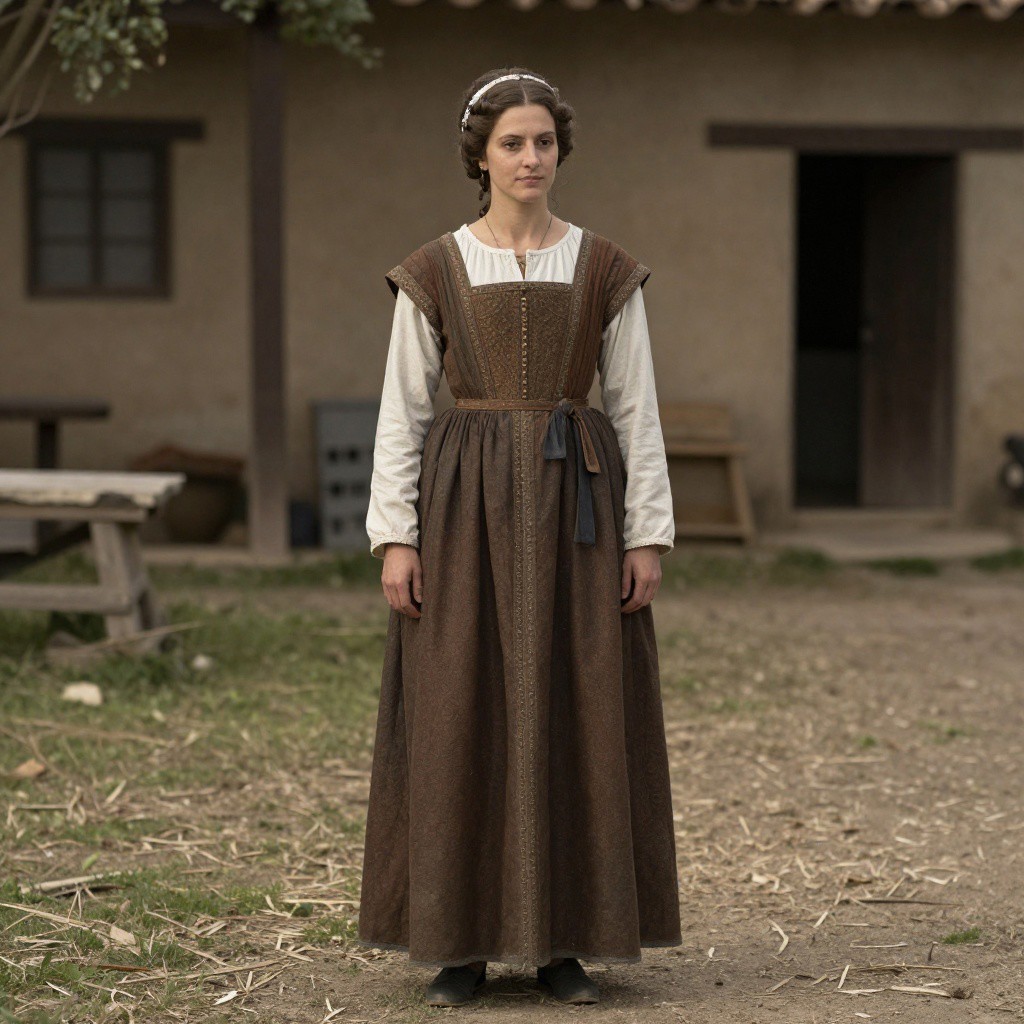
A woman buried in Portugal in the era

Download PDF creates a visual, rasterized copy. Use Print for selectable text and better assistive-technology support.

Loading Report

Preparing your ancestry journey

Preparing the available report content...

Your report will open automatically.

Skip to main content
Reference library / Sample profile

A woman buried in Portugal in the era

Explore the recorded context, genetic comparisons and research behind this reference sample.

PortugalPortugal Reconquista

A reference profile describes this sample. It does not establish a personal or family relationship.

AI portrait reconstruction for A woman buried in Portugal in the  era
AI-generated artistic reconstruction, not a photograph of the individual.
Record

Sample details

Recorded details and available lineage markers.

Individual

Reconquista individual, Portugal

Sample ID: LP123_16

Date Range

1076 CE - 1424 CE

Cultural Period

Portugal Reconquista

Biological Sex

Female

mtDNA Haplogroup

Not available

Y-DNA Haplogroup

Not available

Geography

Location

Where this individual was discovered

Country Portugal
Locality Guarda - Prazo (Freixo de Numão) (Chota)
Coordinates 41.0690, -7.2430
Chronology

Date range

When this individual lived in the broader context of human history

Reconquista individual, Portugal 1076 CE - 1424 CE
Context

Historical context

Background information associated with the reference record.

Region & Environment

The period centers on the territory of present-day Portugal, spanning coastal landscapes, river valleys, and interior uplands. Roman-era towns persisted in some places, while many areas remained organized around agriculture and pastoral use of nearby lands. The Atlantic climate and Mediterranean-influenced zones supported mixed farming and viticulture, while defensive settlement patterns became increasingly important in frontier regions.

Historical Context

The Reconquista in Iberia involved prolonged conflict between Christian kingdoms and Muslim polities, along with campaigns, tribute arrangements, and diplomatic changes. In Portugal, the process accelerated in the 12th and early 13th centuries as Christian authorities extended control over contested districts and incorporated them into expanding territorial structures. Even where conquest occurred, governance typically required ongoing military presence, legal reorganization, and population management.

Populations & Lifeways

Communities included local rural populations who farmed and herded, alongside soldiers and urban residents connected to garrisons, trade, and craft production. Frontier conditions encouraged movement, the founding or strengthening of fortified sites, and the integration of diverse groups under new or revised authorities. Daily life generally remained grounded in subsistence agriculture, but with increased emphasis on defense and regulation in towns.

Archaeology & Material Culture

Archaeological evidence for this era often relies on settlement stratigraphy around walled towns, fortifications, and ecclesiastical or administrative installations. Material culture can include domestic ceramics, metalwork associated with everyday use and military gear, and building materials reflecting the reuse and modification of earlier structures. Evidence for craft and exchange may be visible in locally made wares and imported goods, though the overall record varies by site and preservation.

Culture & Society

As control shifted, Christian institutions and legal frameworks became more prominent in many areas, including church organization and town regulations. Society was structured by the interaction of landlords, local communities, clergy, and military elites. Cultural life would have blended inherited Iberian traditions with influences introduced or strengthened through new administrative centers, while contact and coexistence dynamics likely varied from district to district.

Legacy & Transition

By the mid-13th century, Portuguese territories were increasingly integrated into more stable political arrangements. The frontier’s movement helped solidify urban networks and rural obligations that shaped later medieval development. Material traces—especially in fortifications, churches, and town layouts—form a bridge between the later Iberian Islamic-influenced landscape and the emerging medieval Christian order.

Analysis

Genetic comparisons

These comparisons show genetic similarity, not identity or origin. The populations listed are those whose genomes show statistical alignment to this ancient individual.

Similarity reflects shared history, not shared identity. These are analytical comparisons, not claims about who this person was.

Modern Genetic Admixture

This analysis compares the DNA profile with present-day reference populations, showing statistical similarity to modern reference populations from different regions. The excavation site records where this individual was found, not a fixed modern genetic identity.

Europe 92.7%
Southern European 85.2%
Iberian 37.7%
Balkan 31.2%
Sardinian 16.3%
Northwestern European 7.5%
Northwestern European 6.6%
Scandinavian 0.8%
Africa 7.3%
West African 4.2%
Ghanaian, Liberian, Sierra Leonean 3.7%
Senegambian & Guinean 0.5%
North African 3.2%
North African 3.2%

Closest Modern Populations

These are the modern populations showing the closest statistical alignment to A woman buried in Portugal in the era, ranked by genetic distance. Lower distance values indicate closer statistical similarity. Cross-region similarity can reflect shared ancestry, population movement, continuity, or later admixture.

1
Spanish Mallorca
1.7159
2
Spanish Girona
1.7481
3
Spanish Camp De Tarragona
1.7553
4
Spanish Baleares
1.8181
5
Spanish Peri Barcelona
1.8341
6
Spanish Pirineu
1.8655
7
Spanish Castello
1.8898
8
Spanish Penedes
1.9272
9
Spanish Valencia
1.9311
10
Spanish Cataluna
1.9448
Context

Related Samples

This individual exists within a broader network of ancient samples. No ancient genome stands alone.

Individual Culture/Period Date Location Action
Early Medieval individual, Portugal 484 CE Castro de Avelãs - Torre Velha, Portugal View
Kingdom Of Portugal individual, Portugal 1184 CE Santarém - Rua dos Barcos (Oeste e Vale do Tejo), Portugal View
Early Medieval individual, Portugal 370 CE Idanha-a-Velha - Espírito Santo (Idanha-a-Nova), Portugal View
Early Medieval individual, Portugal 576 CE Castro de Avelãs - Torre Velha, Portugal View
Kingdom Of Portugal individual, Portugal 1184 CE Santarém - Rua dos Barcos (Oeste e Vale do Tejo), Portugal View
Islamic individual, Portugal 676 CE Santarém - Islamic Necropolis (Oeste e Vale do Tejo), Portugal View
Islamic individual, Portugal 970 CE Loulé - Hospital da Misericordia, Portugal View
N individual, Portugal 3277 BCE Leiria - Cova das Lapas (Largo das Catacumbas), Portugal View
Islamic individual, Portugal 1184 CE Loulé - Quinta da Boavista, Portugal View
Kingdom Of Portugal individual, Portugal 1184 CE Santarém - Rua dos Barcos (Oeste e Vale do Tejo), Portugal View
Roman individual, Portugal 239 CE Idanha-a-Velha - Espírito Santo Muralha (Centro Region, Castelo Branco District, Idanha-a-Nova Municipality, Idanha-a-Velha Village), Portugal View
Islamic individual, Portugal 970 CE Loulé - Hospital da Misericordia, Portugal View
Islamic individual, Portugal 1192 CE Loulé - Quinta da Boavista, Portugal View
Islamic individual, Portugal 970 CE Loulé - Quinta da Boavista, Portugal View
N individual, Portugal 3277 BCE Leiria - Cova das Lapas (Largo das Catacumbas), Portugal View
Kingdom Of Portugal individual, Portugal 1184 CE Santarém - Rua dos Barcos (Oeste e Vale do Tejo), Portugal View
Kingdom Of Portugal individual, Portugal 1092 CE Santarém - Rua dos Barcos (Oeste e Vale do Tejo), Portugal View
Reconquista individual, Portugal 984 CE Castro de Avelãs - Torre Velha, Portugal View
Kingdom Of Portugal individual, Portugal 1192 CE Santarém - Rua dos Barcos (Oeste e Vale do Tejo), Portugal View
Reconquista individual, Portugal 1092 CE Castro de Avelãs - Torre Velha, Portugal View
Early Medieval individual, Portugal 586 CE Castro de Avelãs - Torre Velha, Portugal View
Reconquista individual, Portugal 770 CE Guarda - Prazo (Freixo de Numão) (Chota), Portugal View
Reconquista individual, Portugal 776 CE Guarda - Prazo (Freixo de Numão) (Chota), Portugal View
Reconquista individual, Portugal 1076 CE Guarda - Prazo (Freixo de Numão) (Chota), Portugal View
Early Medieval individual, Portugal 576 CE Guarda - Prazo (Freixo de Numão) (Chota), Portugal View
N individual, Portugal 3277 BCE Leiria - Cova das Lapas (Largo das Catacumbas), Portugal View
Islamic individual, Portugal 676 CE Santarém - Islamic Necropolis (Oeste e Vale do Tejo), Portugal View
Roman individual, Portugal 226 CE Idanha-a-Velha - Porta Sul (Idanha-a-Nova), Portugal View
Roman individual, Portugal 239 CE Idanha-a-Velha - Porta Sul (Idanha-a-Nova), Portugal View
Roman individual, Portugal 226 CE Idanha-a-Velha - Porta Norte (Idanha-a-Nova), Portugal View
N individual, Portugal 3277 BCE Leiria - Cova das Lapas (Largo das Catacumbas), Portugal View
Portugal C individual, Portugal 3277 BCE Leiria - Cova das Lapas (Largo das Catacumbas), Portugal View
N individual, Portugal 3277 BCE Leiria - Cova das Lapas (Largo das Catacumbas), Portugal View
Roman individual, Portugal 239 CE Idanha-a-Velha - Porta Norte (Idanha-a-Nova), Portugal View
Page 1
Individual Culture/Period Date Location Action
Reconquista individual, Portugal 984 CE Castro de Avelãs - Torre Velha, Portugal View
Reconquista individual, Portugal 1092 CE Castro de Avelãs - Torre Velha, Portugal View
Reconquista individual, Portugal 770 CE Guarda - Prazo (Freixo de Numão) (Chota), Portugal View
Reconquista individual, Portugal 776 CE Guarda - Prazo (Freixo de Numão) (Chota), Portugal View
Reconquista individual, Portugal 1076 CE Guarda - Prazo (Freixo de Numão) (Chota), Portugal View
Page 1
Sources

References

Scientific publications and genetic data that inform this profile.

G25 Coordinates

These coordinates represent a position in genetic space, a tool for comparison, not a conclusion. You can use these to perform custom admixture analysis in G25 Studio.

LP123_16,0.1133636,0.14107942,0.03859132,0.00459212,0.04600744,0.00220672,0.00017768,0.00699238,0.01816998,0.0303633,-0.00563486,0.0105982,-0.01164534,-0.01104536,0.0005999,0.00199446,0.00345276,0.00032972,-0.00079894,-0.00134414,0.0027146,0.00397272,-0.00526852,-0.00460138,0.00119309
Continue in G25 Studio
Use code for 30% off • Expires Nov 16