Menu
Store
Blog
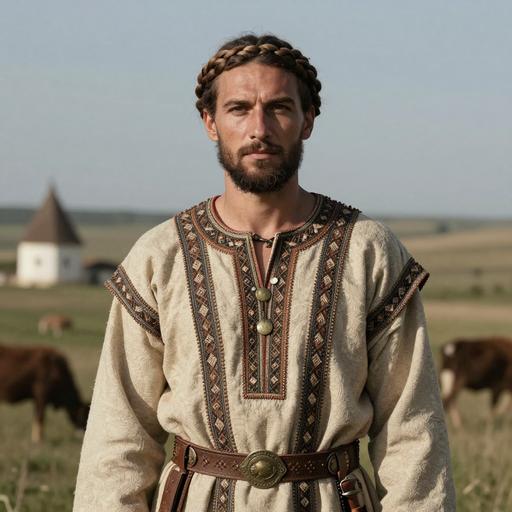
Portrait reconstruction of A1824
Ancient Individual

A man buried in Hungary in the Late Antiquity era

A1824
600 CE - 650 CE
Male
Early Avar Period 1 South Transdanubia, Hungary
Hungary
Scroll to begin
Chapter I

Identity

The biological and cultural markers that define this ancient individual

Sample ID

A1824

Date Range

600 CE - 650 CE

Biological Sex

Male

mtDNA Haplogroup

K1a17a

Y-DNA Haplogroup

R1a1a1b1a2a

Cultural Period

Early Avar Period 1 South Transdanubia, Hungary

Chapter II

Place

Where this individual was discovered

Country Hungary
Locality South Transdanubia. Kölked -Feketekapu
Coordinates 45.9487, 18.7046
Chapter III

Time

When this individual lived in the broader context of human history

A1824 600 CE - 650 CE
Chapter IV

Story

The narrative of this ancient life

The Early Avar Period in South Transdanubia, Hungary, marks a fascinating chapter in the region's history, characterized by the arrival and establishment of the Avars—nomadic people of Eurasian origin. This era, approximately spanning the late 6th to early 7th centuries, is pivotal for understanding the transformation of the Carpathian Basin's cultural and socio-political landscape.

Historical Background

The Avars were originally from Central Asia and are believed to have consisted of a diverse mixture of Turkic, Mongolic, and other steppe peoples. Their rise in Eastern Europe began around the 560s when they migrated westward, escaping conflicts and seeking fertile lands and new opportunities. They quickly established the Avar Khaganate, which extended its influence over large areas of Central and Eastern Europe, including modern-day Hungary.

Settlement Patterns

In South Transdanubia, the Avars settled in the rich fertile plains and river valleys. The region's geography served both their agricultural pursuits and traditional nomadic lifestyle. Settlements from this period reveal a combination of pit houses and surface dwellings. Archaeological findings include large, fortified centers that functioned as economic and military hubs.

Social and Political Structure

The Avar society was hierarchical, headed by a Khagan, who wielded supreme political and military authority. Beneath the Khagan were various noble classes, often consisting of influential clan leaders who managed local affairs and led military contingents. The system was tribal, with each clan retaining a degree of autonomy, thereby ensuring a decentralized governance model.

Economic Life

Economically, the Avars were both pastoralists and agriculturalists. They utilized the fertile Transdanubian lands for cultivating crops like barley, wheat, and millet while continuing to herd cattle, horses, and sheep on the expansive grasslands. Trade also played a crucial role, with the Avars engaging with neighboring Byzantine and Slavic entities. Artifacts such as weaponry, jewelry, and Byzantine coins recovered from burial sites highlight a thriving trade network.

Material Culture and Artifacts

The material culture of the Early Avar Period is rich and indicative of their nomadic roots blended with influences from conquered territories. Burial sites are particularly revealing, with grave goods that include finely crafted weapons, riding equipment, and ornamental gold and silver items. The Avars are renowned for their metalwork, particularly in producing belt buckles and horse gear, often adorned with intricate animal motifs and geometric designs.

Religion and Beliefs

The religious life of the Early Avars remains somewhat enigmatic due to a lack of written records. However, archaeological evidence points to a form of shamanism being prevalent, characterized by burial rites and grave offerings intended for use in the afterlife. The presence of Christian artifacts in some burials suggests interaction with, and gradual conversion by, neighboring Christian communities.

Interaction with Other Cultures

Intercultural interaction was significant during this period, with the Avars exerting influence over and assimilating elements from the Slavic populations in the region. They also engaged in frequent conflict and trade with the Byzantine Empire, which greatly impacted the Avar culture. Over time, the Avars adopted some Romanized customs, evident in their craftsmanship and burial practices.

Legacy

The Early Avar Period in South Transdanubia left a lasting legacy in the region, contributing to the ethnogenesis of several groups, including the Magyars. The period is emblematic of the dynamic cultural exchanges that characterized the Eurasian steppe, underlining the complex socio-political transformations in early medieval Europe.

In summary, the Early Avar Period in South Transdanubia was a time of great change and cultural fusion brought about by these formidable nomads. Their legacy is intertwined with the subsequent historical developments in the region, shaping the medieval history of Hungary and its surrounding areas.

Chapter V

Genetics

The genetic ancestry of this ancient individual

Ancient Genetic Admixture

This analysis compares the DNA profile of A1824 with ancient reference populations, showing the genetic composition in terms of prehistoric ancestral groups.

Neolithic Farmers 36.4%
Ancient Asians 29.5%
European Hunter-Gatherers 20.1%
Western Steppe Pastoralists 14.0%

Modern Genetic Admixture

This analysis compares the DNA profile with present-day reference populations, showing what percentage of genetic makeup resembles modern populations from different regions.

Asia 72.3%
Northern West Asian 46.0%
Caucasian 33.2%
Mesopotamian 11.0%
Anatolian 0.9%
Cypriot 0.8%
Central Asian, Northern Indian & Pakistani 10.5%
Central Asian 9.0%
Pakistan 1.5%
Northern Asian 6.9%
Siberian 6.9%
Chinese & Southeast Asian 4.3%
Chinese 3.9%
Japanese & Korean 4.1%
Japanese 4.1%
Arab, Egyptian & Levantine 0.5%
Arabian 0.5%
Europe 24.2%
Southern European 16.3%
Balkan 10.7%
Italian 5.0%
Sardinian 0.6%
Northwestern European 7.9%
Finnish 5.8%
Northwestern European 2.1%
Africa 3.4%
North African 3.2%
North African 3.2%

Closest Modern Populations

These are the modern populations showing the closest statistical alignment to A man buried in Hungary in the Late Antiquity era, ranked by genetic distance. Lower distance values indicate closer statistical similarity.

1
Turkmen Iran
3.7271
2
Turkmen
4.0441
3
Turkmen Uzbekistan
4.8145
4
Tatar Crimean Steppe
6.3407
5
Tajik Tajikistan Ayni
6.4109
6
Tajik Tajikistan Hisor
6.6259
7
Tatar Lipka
6.9470
8
Turkish Antalya
7.6466
9
Turkish Giresun
7.7117
10
Turkish Balikesir
8.1272
Chapter VI

Context

Other ancient individuals connected to this sample

Sources

References

Scientific publications and genetic data

Scientific Publication

Ancient genomes reveal origin and rapid trans-Eurasian migration of 7th century Avar elites

Authors Gnecchi-Ruscone GA, Szécsényi-Nagy A, Koncz I
Abstract

The Avars settled the Carpathian Basin in 567/68 CE, establishing an empire lasting over 200 years. Who they were and where they came from is highly debated. Contemporaries have disagreed about whether they were, as they claimed, the direct successors of the Mongolian Steppe Rouran empire that was destroyed by the Turks in ∼550 CE. Here, we analyze new genome-wide data from 66 pre-Avar and Avar-period Carpathian Basin individuals, including the 8 richest Avar-period burials and further elite sites from Avar's empire core region. Our results provide support for a rapid long-distance trans-Eurasian migration of Avar-period elites. These individuals carried Northeast Asian ancestry matching the profile of preceding Mongolian Steppe populations, particularly a genome available from the Rouran period. Some of the later elite individuals carried an additional non-local ancestry component broadly matching the steppe, which could point to a later migration or reflect greater genetic diversity within the initial migrant population.

G25 Coordinates

The G25 coordinates for sample A1824 can be used for detailed admixture analysis in our G25 Studio tool.

A1824,0.09112738,-0.01812996,0.0048261,-0.01213372,-0.03070946,-0.00742282,0.00911822,0.0028668,-0.02469352,-0.0089267,-0.00648172,0.0054514,-0.0074688,0.00055274,0.0038845,-0.0059182,-0.00692482,-0.00011146,0.00080338,0.00083856,-0.00274572,-0.00087424,-0.00129838,0.00132374,0.00110673
Analyze in G25 Studio
Use code for 40% off Expires Feb 27