Menu
Store
Blog
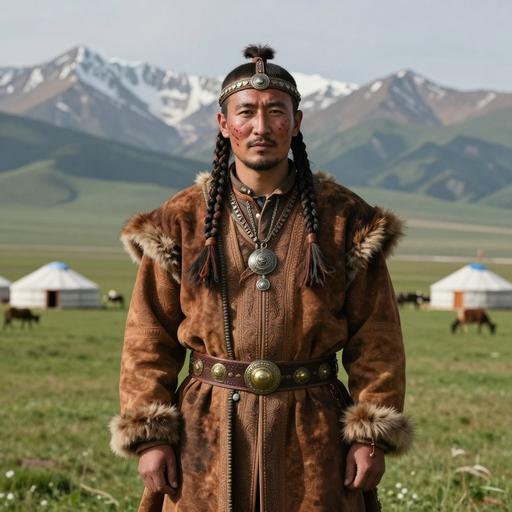
Portrait reconstruction of DA23
Ancient Individual

A man buried in Kazakhstan in the Middle Ages era

DA23
1036 CE - 1206 CE
Male
Kipchak Period 2, Kazakhstan
Kazakhstan
Scroll to begin
Chapter I

Identity

The biological and cultural markers that define this ancient individual

Sample ID

DA23

Date Range

1036 CE - 1206 CE

Biological Sex

Male

mtDNA Haplogroup

F1b1b

Y-DNA Haplogroup

C-F8513

Cultural Period

Kipchak Period 2, Kazakhstan

Chapter II

Place

Where this individual was discovered

Country Kazakhstan
Locality Tian Shan. Central Steppe
Coordinates 52.6925, 62.6472
Chapter III

Time

When this individual lived in the broader context of human history

DA23 1036 CE - 1206 CE
Chapter IV

Story

The narrative of this ancient life

The Kipchak Period 2 in Kazakhstan represents a fascinating era deeply entrenched in the broader historical tapestry of the Turkic nomadic cultures. This period, which spans approximately from the 11th to the 13th centuries, embodies the complex dynamics of nomadic life on the Eurasian steppes and the intersection of various political, cultural, and economic influences.

Geographic and Historical Context

The Kipchak Confederation, known for its dominant presence on the vast steppes of Central Asia, including present-day Kazakhstan, arose after the decline of the Khazar Khaganate and before the Mongol invasions. The Kipchak people, originally part of the broader Turkic migrations, established themselves as a formidable power, exerting influence over vast territories stretching from the Ural Mountains and the Volga River in the west to the Irtysh River in the east.

Social Structure and Nomadic Lifestyle

The social organization of the Kipchaks was typical of nomadic societies, characterized by tribal affiliations and a hierarchical structure led by tribal chieftains. Clan loyalties and kinship played a crucial role in maintaining social cohesion and in the administration of justice. The nomadic lifestyle of the Kipchaks fostered a highly mobile society adept in horseback riding, herding, and warfare.

Horses were central to Kipchak life, serving not only as a means of transportation but also as an indicator of wealth and status. The Kipchaks were expert horsemen and archers, skills that were essential for both their survival and dominance in the region. Yurts (portable, circular tents) were the primary dwelling of the Kipchaks, facilitating their nomadic existence across the steppes.

Economy and Trade

Economically, the Kipchaks relied heavily on animal husbandry, with sheep, cattle, and horses being the mainstay of their sustenance. The surplus of animal products, such as meat, hides, and wool, facilitated trade with neighboring sedentary civilizations. The Kipchaks engaged in extensive trade networks, bartering with the regions of Kievan Rus, Persia, and the Byzantine Empire, among others. Their trade activities not only brought material goods but also facilitated cultural exchanges.

Political Alliances and Conflicts

The Kipchak period was marked by shifting alliances and conflicts, both internally among different tribes and externally with other states and empires. The Kipchaks were occasionally in conflict with Kievan Rus and later formed part of the Cuman-Kipchak confederation that wielded significant power in Eastern Europe. Their conflicts and eventual alliances with surrounding powers were strategic, often dictated by the need to protect trade routes or to secure favorable terms for their nomadic lifestyle.

Cultural Practices and Beliefs

Culturally, the Kipchaks carried on the rich oral traditions of the Turkic peoples, with epic poetry, folklore, and music playing a significant role in their society. Shamanistic beliefs were prevalent, with spiritual leaders (shamans) guiding tribal members through rites and rituals intended to appease natural spirits and ensure the tribe's well-being.

The Kipchaks had intricate artistic expressions, particularly in decorative arts and metallurgy. They were skilled in crafting weaponry, jewelry, and other items that reflected both their aesthetic values and practical needs.

Linguistic and Ethnic Diversity

The Kipchak language, part of the Kipchak branch of the Turkic language family, acted as a lingua franca across their territories, facilitating communication among diverse tribes and peoples. Linguistic influences from Persian and Slavic languages also began to permeate due to extensive trade and interaction.

Influence and Legacy

The Kipchak period in Kazakhstan holds significant historical importance. Their influence extended into the formation of various successor states and played a crucial role in the ethnic and cultural evolution of the region. As predecessors to later groups such as the Kazakhs, the Kipchaks contributed to the mosaic of Central Asian history through their traditions, interactions, and adaptations to the ever-shifting political landscape.

Overall, the Kipchak Period 2 in Kazakhstan represents an era of remarkable adaptation, resilience, and cultural exchange, reflecting the intricate tapestry of nomadic life on the Eurasian steppes.

Chapter V

Genetics

The genetic ancestry of this ancient individual

Ancient Genetic Admixture

This analysis compares the DNA profile of DA23 with ancient reference populations, showing the genetic composition in terms of prehistoric ancestral groups.

Ancient Asians 60.7%
European Hunter-Gatherers 16.2%
Western Steppe Pastoralists 13.5%
Neolithic Farmers 9.6%

Modern Genetic Admixture

This analysis compares the DNA profile with present-day reference populations, showing what percentage of genetic makeup resembles modern populations from different regions.

Asia 83.1%
Central Asian, Northern Indian & Pakistani 43.9%
Central Asian 39.0%
Pakistan 4.9%
Northern Asian 28.9%
Siberian 26.2%
Mongolian 2.7%
Japanese & Korean 6.9%
Japanese 6.9%
Chinese & Southeast Asian 2.7%
Tibetan 2.7%
Northern West Asian 0.7%
Caucasian 0.7%
Europe 15.3%
Northwestern European 12.4%
Northwestern European 4.5%
Finnish 4.2%
Scandinavian 3.7%
Southern European 2.8%
Balkan 2.8%
America 1.5%
America 1.5%
Native American 1.5%

Closest Modern Populations

These are the modern populations showing the closest statistical alignment to A man buried in Kazakhstan in the Middle Ages era, ranked by genetic distance. Lower distance values indicate closer statistical similarity.

1
Altaian Kizhi O
3.0431
2
Tubalar
3.7201
3
Altaian
9.7530
4
Altaian Kizhi
10.6609
5
Tu
24.9649
Chapter VI

Context

Other ancient individuals connected to this sample

Sources

References

Scientific publications and genetic data

Scientific Publication

137 ancient human genomes from across the Eurasian steppes

Authors Damgaard PB, Marchi N, Rasmussen S
Abstract

For thousands of years the Eurasian steppes have been a centre of human migrations and cultural change. Here we sequence the genomes of 137 ancient humans (about 1× average coverage), covering a period of 4,000 years, to understand the population history of the Eurasian steppes after the Bronze Age migrations. We find that the genetics of the Scythian groups that dominated the Eurasian steppes throughout the Iron Age were highly structured, with diverse origins comprising Late Bronze Age herders, European farmers and southern Siberian hunter-gatherers. Later, Scythians admixed with the eastern steppe nomads who formed the Xiongnu confederations, and moved westward in about the second or third century BC, forming the Hun traditions in the fourth-fifth century AD, and carrying with them plague that was basal to the Justinian plague. These nomads were further admixed with East Asian groups during several short-term khanates in the Medieval period. These historical events transformed the Eurasian steppes from being inhabited by Indo-European speakers of largely West Eurasian ancestry to the mostly Turkic-speaking groups of the present day, who are primarily of East Asian ancestry.

G25 Coordinates

The G25 coordinates for sample DA23 can be used for detailed admixture analysis in our G25 Studio tool.

DA23,0.07106602,-0.20038022,0.05854094,0.01374496,-0.05686626,-0.01286368,0.00785876,0.01461752,-0.00568248,-0.00469278,-0.01046714,-0.00250852,0.00352932,-0.00393614,0.00063852,0.00165992,-0.00469992,-0.00416678,0.00337606,0.0112186,-0.02176448,0.00530256,-0.00679004,-0.00066174,0.0006732
Analyze in G25 Studio
Use code for 40% off Expires Feb 26