Menu
Store
Blog
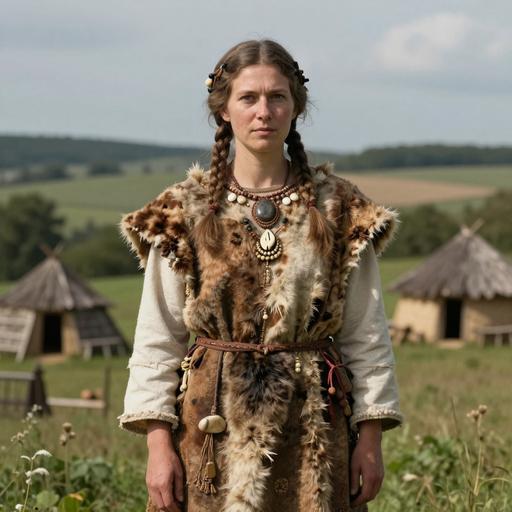
Portrait reconstruction of I0171
Ancient Individual

A woman buried in Germany in the Late Neolithic era

I0171
2288 BCE - 2039 BCE
Female
Late Neolithic Benzigerode-Heimburg, Germany
Germany
Scroll to begin
Chapter I

Identity

The biological and cultural markers that define this ancient individual

Sample ID

I0171

Date Range

2288 BCE - 2039 BCE

Biological Sex

Female

mtDNA Haplogroup

U5a1a2a

Cultural Period

Late Neolithic Benzigerode-Heimburg, Germany

Chapter II

Place

Where this individual was discovered

Country Germany
Locality Benzingerode-Heimburg
Coordinates 51.8200, 10.9100
Chapter III

Time

When this individual lived in the broader context of human history

I0171 2288 BCE - 2039 BCE
Chapter IV

Story

The narrative of this ancient life

The Late Neolithic period in Benzigerode-Heimburg, located in what is now Germany, is a fascinating era that marks significant developments in prehistoric European culture. This period, occurring roughly between 3000 to 2000 BCE, is characterized by advancements in agricultural practices, societal structures, material culture, and interregional interactions. Here, we will explore various aspects of the Late Neolithic in Benzigerode-Heimburg.

Geographic and Environmental Context

Benzigerode-Heimburg is situated in central Germany, a region characterized by its rolling hills, fertile plains, and access to waterways. The landscape during the Late Neolithic provided abundant resources for early agriculturalists, including arable land for crop cultivation and forests rich in game and timber. The climate was relatively temperate, which further facilitated the development of agrarian lifestyles.

Subsistence and Economy

The economy during the Late Neolithic in this region was predominantly based on agriculture. Communities cultivated emmer wheat, barley, and legumes, alongside the domestication of animals such as cattle, sheep, goats, and pigs. This mixed farming economy not only ensured a stable food supply but also supported population growth and the expansion of settlements.

Hunting and gathering still played a role, with communities exploiting wild resources like deer, fish, nuts, and berries. The combination of agriculture and foraging allowed for a more varied diet and showcased the adaptability of these communities to their environment.

Settlement Patterns and Architecture

Settlements in Benzigerode-Heimburg during the Late Neolithic were typically small, but they began to show more permanent and structured forms of habitation. Villages often consisted of longhouses built using timber and wattle-and-daub techniques, reflecting a communal lifestyle and shared resources.

There is evidence to suggest the emergence of larger, possibly fortified settlements, hinting at developments in social organization and possibly the need for defense against rival groups or to protect resources. Settlements were strategically located to maximize access to resources and trade routes.

Social Structure and Organization

The social structure during this period likely became more complex and stratified compared to earlier times. Evidence from burial sites suggests distinctions in status, as indicated by varying grave goods and the construction of megalithic tombs for certain individuals. This stratification might have been based on wealth, lineage, or achievements within the community.

Kinship and communal activities played a central role, with extended families living and working together. Shared responsibilities in agriculture and craft production fostered a cooperative society, although there might have been emerging leaders who coordinated larger scale endeavors such as trade or communal building projects.

Material Culture and Technology

The material culture of the Late Neolithic in Benzigerode-Heimburg saw significant advancements. Pottery became more sophisticated, with improved techniques in decoration and firing, leading to finer and more varied ceramic products. Stone tools remained prevalent, but their forms evolved to include specialized implements for agriculture and craft production.

The period also saw advances in textile production, with evidence of weaving and the use of looms. This indicates a growing complexity in daily life and increased time allocated to tasks beyond subsistence.

Trade and Interaction

Trade networks expanded during the Late Neolithic, as evidenced by the presence of non-local materials such as flint, amber, and certain types of pottery found in settlements. These trade routes facilitated the exchange of goods, ideas, and technologies, thus fostering cultural interaction and shared innovations among different communities across Europe.

Religion and Rituals

Ritual and religious practices played an essential role in Late Neolithic society. The construction of megalithic structures like dolmens and stone circles indicate an evolved spiritual life possibly connected to ancestor worship, astronomical events, or territorial markers. These structures often required considerable communal effort, reflecting their significance in the cultural and religious fabric of the society.

In conclusion, the Late Neolithic era in Benzigerode-Heimburg represents a period of significant transition and advancement. The communities here witnessed the solidification of agricultural practices, the development of more complex social structures, and increased interaction within and beyond their region. This era laid the foundational aspects of civilization that would influence the trajectory of European history in subsequent millennia.

Chapter V

Genetics

The genetic ancestry of this ancient individual

Ancient Genetic Admixture

This analysis compares the DNA profile of I0171 with ancient reference populations, showing the genetic composition in terms of prehistoric ancestral groups.

Western Steppe Pastoralists 40.3%
European Hunter-Gatherers 33.5%
Neolithic Farmers 23.2%
Ancient Asians 3.0%

Modern Genetic Admixture

This analysis compares the DNA profile with present-day reference populations, showing what percentage of genetic makeup resembles modern populations from different regions.

Europe 83.9%
Northwestern European 78.6%
English 45.2%
Scandinavian 17.2%
Finnish 10.0%
Northwestern European 6.2%
Eastern European 4.3%
Southern European 1.0%
Balkan 1.0%
Asia 13.9%
Central Asian, Northern Indian & Pakistani 9.1%
Pakistan 9.1%
Northern West Asian 4.8%
Mesopotamian 3.1%
Anatolian 1.8%
Africa 1.6%
West African 1.1%
Nigerian 1.1%
America 0.6%
America 0.6%
Native American 0.6%

Closest Modern Populations

These are the modern populations showing the closest statistical alignment to A woman buried in Germany in the Late Neolithic era, ranked by genetic distance. Lower distance values indicate closer statistical similarity.

1
Afrikaner
4.4078
2
Irish
4.4314
3
Orcadian
4.4344
4
Scottish
4.4705
5
Shetlandic
4.6587
6
Dutch
4.6906
7
Norwegian
4.7909
8
Icelandic
4.7910
9
English
4.8470
10
Welsh
4.9348
Chapter VI

Context

Other ancient individuals connected to this sample

Sources

References

Scientific publications and genetic data

Scientific Publication

Genome-wide patterns of selection in 230 ancient Eurasians

Authors Mathieson I, Lazaridis I, Rohland N
Abstract

Ancient DNA makes it possible to observe natural selection directly by analysing samples from populations before, during and after adaptation events. Here we report a genome-wide scan for selection using ancient DNA, capitalizing on the largest ancient DNA data set yet assembled: 230 West Eurasians who lived between 6500 and 300 bc, including 163 with newly reported data. The new samples include, to our knowledge, the first genome-wide ancient DNA from Anatolian Neolithic farmers, whose genetic material we obtained by extracting from petrous bones, and who we show were members of the population that was the source of Europe's first farmers. We also report a transect of the steppe region in Samara between 5600 and 300 bc, which allows us to identify admixture into the steppe from at least two external sources. We detect selection at loci associated with diet, pigmentation and immunity, and two independent episodes of selection on height.

G25 Coordinates

The G25 coordinates for sample I0171 can be used for detailed admixture analysis in our G25 Studio tool.

I0171,0.12368756,0.11173248,0.03911212,0.05431726,0.01709818,0.0190905,0.00578192,0.00645892,-0.0031331,-0.00607718,-0.0037265,0.00689016,-0.00697846,-0.01272732,0.02809466,-0.00112772,-0.01690986,-0.00040006,0.00079918,-0.00298738,0.0025041,0.00080946,-0.0046651,0.007121,-0.00517971
Analyze in G25 Studio
Use code for 40% off Expires Feb 26