Menu
Store
Blog
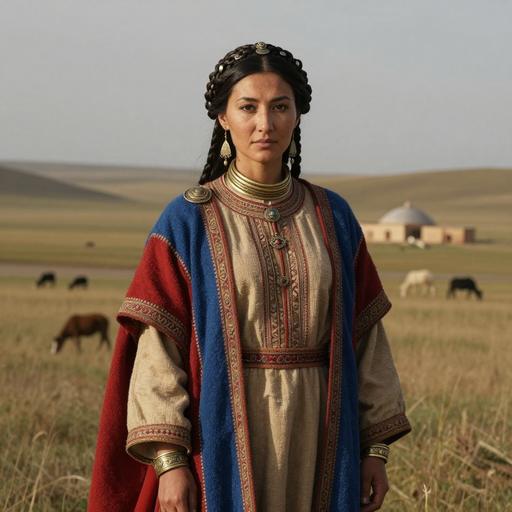
Portrait reconstruction of I11523
Ancient Individual

A woman buried in Kazakhstan in the Iron Age era

I11523
769 BCE - 236 BCE
Female
Sarmatian Culture in Kazakhstan
Kazakhstan
Scroll to begin
Chapter I

Identity

The biological and cultural markers that define this ancient individual

Sample ID

I11523

Date Range

769 BCE - 236 BCE

Biological Sex

Female

mtDNA Haplogroup

U5a1

Cultural Period

Sarmatian Culture in Kazakhstan

Chapter II

Place

Where this individual was discovered

Country Kazakhstan
Locality Tengiz. Caspian steppe
Coordinates 46.0397, 53.4422
Chapter III

Time

When this individual lived in the broader context of human history

I11523 769 BCE - 236 BCE
Chapter IV

Story

The narrative of this ancient life

The Sarmatians were a confederation of nomadic tribes, primarily of Iranian origin, who occupied a vast region of the Eurasian steppe from the 5th century BC until the 4th century AD. By exploring the Sarmatian culture in what is today Kazakhstan, we can uncover a fascinating facet of these ancient peoples and their role in the historical dynamics of the Eurasian nomadic world.

Geographic and Historical Context

Kazakhstan, with its expansive steppes and diverse landscapes, served as a critical region for the Sarmatians due to its strategic location connecting East and West. It was part of the Eurasian Steppe Belt, which extended from Eastern Europe to Mongolia. This geographic placement allowed for cultural transmission and facilitated the movement of nomadic groups across significant distances. The Sarmatians in Kazakhstan occupied parts of the Caspian steppe and surrounding areas, where they interacted with neighboring tribes and empires, including the Scythians, Huns, and later the Goths and Romans.

Society and Political Structure

Sarmatian society was organized in a hierarchical structure typical of nomadic cultures, with a strong emphasis on kinship and clan affiliations. Warrior aristocracy dominated the social order, with leaders emerging from the elite warrior class. The Sarmatian tribes were known for their confederate system, wherein different tribes maintained autonomy but united under a common cause or threat.

Economy and Lifestyle

The Sarmatians were primarily pastoralists, raising cattle, horses, sheep, and goats, which were central to their economy and way of life. The semi-nomadic lifestyle involved seasonal migrations to optimize grazing conditions and pasture availability. Horses were particularly significant, not only as a source of mobility but also as a symbol of status and wealth, integral to Sarmatian identity and warfare.

Culture and Spirituality

The Sarmatian culture was rich in artistry and craftsmanship. Their metalwork, especially in gold and bronze, often depicted animals and mythical creatures, highlighting their spiritual and symbolic significance. Among vessels and adornments, intricate designs reflect a complex symbolic language relating to their beliefs and social status.

The spiritual beliefs of the Sarmatians were polytheistic, deeply connected to nature, and likely included the worship of a pantheon of deities associated with natural elements and war. Burial practices provide insight into their spiritual worldview, with elaborate kurgans (burial mounds) constructed for the elite, often containing weapons, horse trappings, and ornaments to accompany the deceased into the afterlife.

Military Prowess

The Sarmatians were renowned warriors, with a distinct equestrian culture that influenced military tactics across the steppe and beyond. They excelled in heavy cavalry, a strategic evolution from their Scythian predecessors, and were among the first to use scale armor for both horse and rider. This prowess in mounted warfare allowed them to exert influence over large territories and engage in conflicts with powers such as Rome, with some Sarmatian tribes integrating into Roman military ranks as auxiliary forces.

Art and Metalwork

Sarmatian art is characterized by ornate design and symbolism, often employing motifs of animals and mythical creatures. Their metalwork includes jewelry, weaponry, and everyday items that reflect both artistic finesse and cultural values. The prevalence of animal motifs in their art links them to the broader Scytho-Siberian Arts symmetrical style.

Influence and Legacy

The influence of Sarmatian culture extended beyond their time and territory, contributing to the cultural and genetic mosaic of the populations across the Eurasian steppe. Their interactions with contemporary peoples facilitated a cultural exchange that enriched the development of subsequent nomadic and sedentary cultures in the region.

By the 4th century AD, the decline of the Sarmatians was hastened by the migrations and invasions of other tribes, most notably the Huns. Nevertheless, Sarmatian contributions to the cultural and historical tapestry of Eurasia are undeniable, with echoes of their influence persisting in the archaeological record and historical narratives of the region.

In summary, the Sarmatian culture in Kazakhstan represents a vital chapter in the history of Eurasian nomadic cultures, marked by their adept martial skills, distinctive art and spiritual beliefs, and strategic role as mediators in the vast expanse of the Eurasian steppe.

Chapter V

Genetics

The genetic ancestry of this ancient individual

Ancient Genetic Admixture

This analysis compares the DNA profile of I11523 with ancient reference populations, showing the genetic composition in terms of prehistoric ancestral groups.

Western Steppe Pastoralists 32.6%
European Hunter-Gatherers 29.4%
Neolithic Farmers 20.1%
Ancient Asians 15.8%
Ancient Native Americans 2.1%

Modern Genetic Admixture

This analysis compares the DNA profile with present-day reference populations, showing what percentage of genetic makeup resembles modern populations from different regions.

Europe 61.7%
Northwestern European 31.3%
English 21.2%
Scandinavian 7.6%
Finnish 2.0%
Eastern European 30.4%
Asia 36.4%
Central Asian, Northern Indian & Pakistani 25.2%
Pakistan 25.2%
Northern West Asian 9.3%
Caucasian 9.3%
Chinese & Southeast Asian 1.5%
Chinese 1.2%
Africa 1.9%
West African 1.1%
Senegambian & Guinean 1.1%
North African 0.8%
Egyptian 0.8%

Closest Modern Populations

These are the modern populations showing the closest statistical alignment to A woman buried in Kazakhstan in the Iron Age era, ranked by genetic distance. Lower distance values indicate closer statistical similarity.

1
Tatar Mishar
5.7805
2
Tatar Kazan
7.2314
3
Moksha
7.3217
4
Mordovian
7.3373
5
Erzya
7.4360
6
Russian Krasnoborsky
7.7624
7
Komi A
7.7756
8
Russian Kostroma
7.8857
9
Finnish Central
8.0639
10
Finnish Southwest
8.1346
Chapter VI

Context

Other ancient individuals connected to this sample

Sources

References

Scientific publications and genetic data

Scientific Publication

137 ancient human genomes from across the Eurasian steppes

Authors Damgaard PB, Marchi N, Rasmussen S
Abstract

For thousands of years the Eurasian steppes have been a centre of human migrations and cultural change. Here we sequence the genomes of 137 ancient humans (about 1× average coverage), covering a period of 4,000 years, to understand the population history of the Eurasian steppes after the Bronze Age migrations. We find that the genetics of the Scythian groups that dominated the Eurasian steppes throughout the Iron Age were highly structured, with diverse origins comprising Late Bronze Age herders, European farmers and southern Siberian hunter-gatherers. Later, Scythians admixed with the eastern steppe nomads who formed the Xiongnu confederations, and moved westward in about the second or third century BC, forming the Hun traditions in the fourth-fifth century AD, and carrying with them plague that was basal to the Justinian plague. These nomads were further admixed with East Asian groups during several short-term khanates in the Medieval period. These historical events transformed the Eurasian steppes from being inhabited by Indo-European speakers of largely West Eurasian ancestry to the mostly Turkic-speaking groups of the present day, who are primarily of East Asian ancestry.

G25 Coordinates

The G25 coordinates for sample I11523 can be used for detailed admixture analysis in our G25 Studio tool.

I11523,0.1121757,0.0664597,0.03617756,0.05493492,-0.00116732,0.02087228,0.0025876,0.00668692,-0.00509328,-0.01583442,0.00193882,-0.00238628,-0.00121238,-0.01267702,0.00983766,-0.00356106,-0.01692944,7.876E-05,-0.00757974,-0.01114834,0.00089388,0.00307004,-0.0077243,0.01063922,-0.00012
Analyze in G25 Studio
Use code for 40% off Expires Feb 26