Menu
Store
Blog
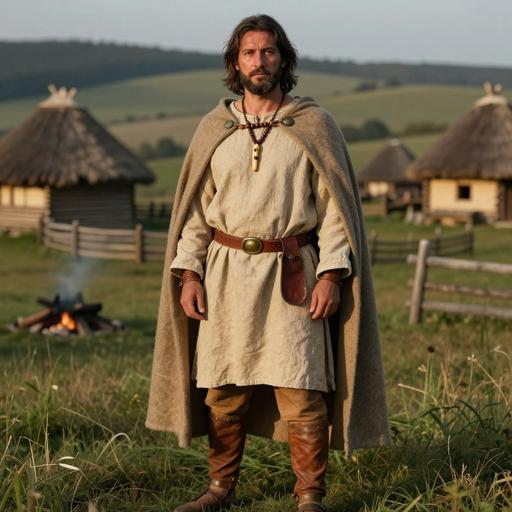
Portrait reconstruction of I5037
Ancient Individual

A man buried in Czech Republic in the Early Bronze Age era

I5037
2300 BCE - 2000 BCE
Male
Early Bronze Age Proto-Unetice Culture, Czech Republic
Czech Republic
Scroll to begin
Chapter I

Identity

The biological and cultural markers that define this ancient individual

Sample ID

I5037

Date Range

2300 BCE - 2000 BCE

Biological Sex

Male

mtDNA Haplogroup

K1a-a

Y-DNA Haplogroup

R-M417

Cultural Period

Early Bronze Age Proto-Unetice Culture, Czech Republic

Chapter II

Place

Where this individual was discovered

Country Czech Republic
Locality Moravská Nová Ves
Coordinates 48.8019, 17.0233
Chapter III

Time

When this individual lived in the broader context of human history

I5037 2300 BCE - 2000 BCE
Chapter IV

Story

The narrative of this ancient life

The Proto-Unetice culture, a precursor to the more well-known Unetice culture, defines the Early Bronze Age period in the region now known as the Czech Republic, along with parts of Central Europe. This era, roughly dated between around 2300 BCE and 1800 BCE, represents a significant transitional phase from late Neolithic societies to more advanced Bronze Age civilizations.

Geographic and Archaeological Context

The territory associated with the Proto-Unetice culture includes the modern Czech Republic, with archaeological sites spread across regions like Bohemia and Moravia. This culture also touched areas of present-day eastern Germany, Poland, and Austria, highlighting its broad influence. The landscape consisted of river valleys and fertile plains, conducive to settlement and agriculture.

Material Culture and Technology

  • Metallurgy: The Proto-Unetice people were among the forerunners in metalworking technology, particularly bronze. They utilized tin and copper to create bronze tools, weapons, and ornaments. This period marked the beginning stages of sophisticated metallurgy, laying down the technological groundwork for subsequent periods.
  • Pottery: The pottery of Proto-Unetice is characterized by high-quality craftsmanship, often with intricate decorations and burnished surfaces. Common forms included beakers and various storage vessels.
  • Settlements and Architecture: Settlements tended to be small, consisting of simple dwellings made from organic materials like wood and clay. These settlements were generally located near water sources, which facilitated agriculture and trade.

Economy and Society

  • Agriculture and Subsistence: The Proto-Unetice culture practiced mixed farming, growing cereals like wheat and barley and domesticating animals such as cattle, pigs, and sheep. This combination supported a stable subsistence economy.
  • Trade and Exchange: The culture engaged in wide-ranging trade networks, facilitated by the desire for raw materials essential to bronze production. Evidence suggests exchanges with groups across Europe, dealing in items ranging from metals and amber to shells and pottery.
  • Social Structure: Although less is known about specific social hierarchies, the presence of richly furnished graves suggests emerging social stratification. Burial practices often included goods like weapons, ornaments, and pottery, indicating a culture that valued status and prestige.

Burial Practices and Religion

Proto-Unetice burial customs are significant markers of their cultural identity. Graves typically included multiple burials in barrows or flat cemeteries, with the deceased often laid on their sides in a crouched position. Grave goods varied but commonly included items like tools, weapons, and pottery—indicative of beliefs related to the afterlife and status.

Cultural Legacy

While the Proto-Unetice culture laid foundational developments in metallurgy and trade, its most lasting impact may be its role as a precursor to the Unetice culture, which succeeded and expanded upon its advancements. The Unetice culture is credited with spreading the innovations of the early Bronze Age more broadly across Europe.

Conclusion

As a transitional period bridging the late Neolithic and developed Bronze Age societies, the Proto-Unetice culture played a pivotal role in shaping the social, economic, and technological landscape of Early Bronze Age Europe. Its advancements in metallurgy, its evolving social structures, and its role in expansive trade networks underscore its significance in the prehistoric record.

Chapter V

Genetics

The genetic ancestry of this ancient individual

Ancient Genetic Admixture

This analysis compares the DNA profile of I5037 with ancient reference populations, showing the genetic composition in terms of prehistoric ancestral groups.

Western Steppe Pastoralists 36.9%
European Hunter-Gatherers 31.6%
Neolithic Farmers 31.5%

Modern Genetic Admixture

This analysis compares the DNA profile with present-day reference populations, showing what percentage of genetic makeup resembles modern populations from different regions.

Europe 71.3%
Northwestern European 57.7%
Northwestern European 29.5%
Scandinavian 24.6%
Finnish 3.5%
Eastern European 7.9%
Southern European 5.7%
Iberian 5.7%
Africa 20.7%
North African 20.7%
North African 20.7%
Asia 5.0%
Central Asian, Northern Indian & Pakistani 3.1%
Pakistan 3.1%
Chinese & Southeast Asian 1.9%
Chinese 1.9%
Oceania 3.0%
Melanesian 3.0%
Papuan 3.0%

Closest Modern Populations

These are the modern populations showing the closest statistical alignment to A man buried in Czech Republic in the Early Bronze Age era, ranked by genetic distance. Lower distance values indicate closer statistical similarity.

1
Moldovan O
4.5638
2
Hungarian
4.5691
3
Afrikaner
4.5945
4
German Hamburg
4.6858
5
Czech
4.7199
6
Ukrainian Zakarpattia
4.7737
7
German Erlangen
4.8646
8
Austrian
4.9652
9
Croatian
5.0367
10
German East
5.0401
Chapter VI

Context

Other ancient individuals connected to this sample

Sources

References

Scientific publications and genetic data

Scientific Publication

The Beaker phenomenon and the genomic transformation of northwest Europe

Authors Olalde I, Brace S, Allentoft ME
Abstract

From around 2750 to 2500 bc, Bell Beaker pottery became widespread across western and central Europe, before it disappeared between 2200 and 1800 bc. The forces that propelled its expansion are a matter of long-standing debate, and there is support for both cultural diffusion and migration having a role in this process. Here we present genome-wide data from 400 Neolithic, Copper Age and Bronze Age Europeans, including 226 individuals associated with Beaker-complex artefacts. We detected limited genetic affinity between Beaker-complex-associated individuals from Iberia and central Europe, and thus exclude migration as an important mechanism of spread between these two regions. However, migration had a key role in the further dissemination of the Beaker complex. We document this phenomenon most clearly in Britain, where the spread of the Beaker complex introduced high levels of steppe-related ancestry and was associated with the replacement of approximately 90% of Britain's gene pool within a few hundred years, continuing the east-to-west expansion that had brought steppe-related ancestry into central and northern Europe over the previous centuries.

G25 Coordinates

The G25 coordinates for sample I5037 can be used for detailed admixture analysis in our G25 Studio tool.

I5037,0.11242824,0.11244348,0.04236664,0.0462042,0.01887326,0.02292064,0.00733602,0.00584294,-0.00868326,-0.02279354,-0.00386996,0.00228096,0.00193012,-0.00032976,0.00938662,0.00133786,-0.00328762,0.00099106,0.0011554,-0.0009582,0.0035216,0.00081926,0.0011886,0.00978534,0.00018727
Analyze in G25 Studio
Use code for 40% off Expires Feb 27