Menu
Store
Blog
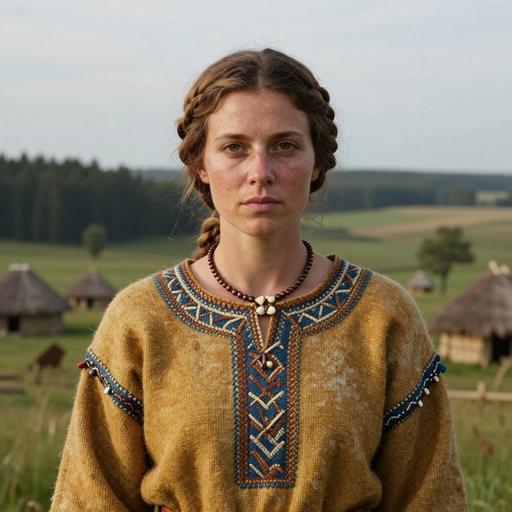
Portrait reconstruction of I6579
Ancient Individual

A woman buried in Poland in the Early Bronze Age era

I6579
2340 BCE - 2042 BCE
Female
Early Bronze Age Poland
Poland
Scroll to begin
Chapter I

Identity

The biological and cultural markers that define this ancient individual

Sample ID

I6579

Date Range

2340 BCE - 2042 BCE

Biological Sex

Female

mtDNA Haplogroup

K1a4a1g

Cultural Period

Early Bronze Age Poland

Chapter II

Place

Where this individual was discovered

Country Poland
Locality Iwiny
Coordinates 51.0400, 17.0700
Chapter III

Time

When this individual lived in the broader context of human history

I6579 2340 BCE - 2042 BCE
Chapter IV

Story

The narrative of this ancient life

The Early Bronze Age in Poland, roughly spanning from 2300 to 1600 BCE, marks a significant period of transition and cultural development, characterized by the emergence of Indo-European influences and the establishment of complex societal structures. This period continued the transformations initiated during the late Neolithic, with notable advancements in metallurgy, settlement patterns, and cultural exchange.

Cultural and Societal Structure

During the Early Bronze Age, Poland was inhabited by several distinct archaeological cultures, most prominently the Unetice (or Únětice) culture, which extended into parts of what is now Germany and the Czech Republic. This culture is recognized for its advancements in bronze metallurgy, which dramatically altered societal dynamics. The introduction of bronze tools and weapons facilitated more efficient agriculture and combat, giving rise to social stratification and the formation of hierarchical communities.

The Unetice culture is known for its tumulus, or burial mound, complexes, which provide critical insights into the beliefs and societal organization of the time. These burial practices indicate a society with developed spiritual beliefs and a recognition of social status, as evidenced by the goods interred with the dead, such as ornamental jewelry, weapons, and pottery.

Settlements and Architecture

Settlements during this period were typically situated in fertile river valleys, conducive to agriculture and trade. These communities were often fortified with wooden palisades or earthworks, reflecting a growing need for defense and territorial control. Houses were usually constructed using timber, with thatched roofs, and organized in clusters that suggest cooperative living and resource-sharing.

Settlements were often strategically located to facilitate trade, which played an essential role in cultural exchange and the dissemination of technological innovations. This trade network extended across the continent, connecting the Polish territories with other burgeoning cultures in Europe.

Economy and Subsistence

The economy during the Early Bronze Age was predominantly agrarian, with communities engaged in agriculture, animal husbandry, and metallurgy. The introduction of the plow enabled more efficient farming, leading to surpluses that supported population growth and specialization of labor.

Metallurgical expertise became a cornerstone of Early Bronze Age societies. The production and trade of bronze goods—a mixture of copper and tin, metals that were not locally abundant—underscore the extensive trade networks in place. This period saw the development of new tools and weaponry, such as swords and axes, which were both functional and symbols of prestige.

Indo-European Influence

The Indo-European influence during the Early Bronze Age in Poland is apparent in linguistic, cultural, and genetic traces observed through archaeological and anthropological studies. This influence is part of a broader migratory movement and cultural diffusion that affected much of Europe during this time.

Language and mythological concepts disseminated through these Indo-European migrations began to take hold, blending with existing local traditions. This era witnessed the gradual evolution of societal norms and practices that would lay the groundwork for future cultural identities in the region.

Art and Symbolism

Artistic expression during the Early Bronze Age in Poland primarily manifested through pottery, jewelry, and funerary artifacts. Pottery from this period was often decorated with intricate geometric patterns and served both practical and ceremonial purposes. Metalwork, particularly in the form of decorative pins, bracelets, and necklaces, highlights the craftsmanship and aesthetic values of the time.

Funerary rites involving rich grave goods reflect a society that placed significant emphasis on the afterlife, with symbolism often revolving around notions of power, status, and spiritual beliefs.

Conclusion

The Early Bronze Age in Poland represents a critical juncture in the development of European prehistoric societies. This period was marked by the fusion of indigenous and Indo-European elements, driving technological, social, and cultural transformations. The archaeological record from this era provides valuable insights into the emergence of complex societies that would continue to evolve throughout the Bronze Age and beyond, laying the foundations for historical cultures in Poland and Central Europe.

Chapter V

Genetics

The genetic ancestry of this ancient individual

Ancient Genetic Admixture

This analysis compares the DNA profile of I6579 with ancient reference populations, showing the genetic composition in terms of prehistoric ancestral groups.

Western Steppe Pastoralists 48.8%
European Hunter-Gatherers 32.0%
Neolithic Farmers 15.8%
Ancient Asians 3.5%

Modern Genetic Admixture

This analysis compares the DNA profile with present-day reference populations, showing what percentage of genetic makeup resembles modern populations from different regions.

Europe 100.0%
Northwestern European 68.3%
English 24.8%
Northwestern European 17.5%
Finnish 13.1%
Scandinavian 12.9%
Eastern European 26.5%
Southern European 5.2%
Balkan 4.7%
Iberian 0.5%

Closest Modern Populations

These are the modern populations showing the closest statistical alignment to A woman buried in Poland in the Early Bronze Age era, ranked by genetic distance. Lower distance values indicate closer statistical similarity.

1
Polish Kashubian
2.9965
2
Finnish Southwest
3.1214
3
Swedish
3.1644
4
Estonian
3.3538
5
Polish
3.4821
6
Russian Kursk
3.6653
7
Finnish Central
3.7061
8
Russian Kaluga
3.7123
9
Ukrainian Dnipro
3.7193
10
Ingrian
3.7245
Chapter VI

Context

Other ancient individuals connected to this sample

Sources

References

Scientific publications and genetic data

Scientific Publication

The Beaker phenomenon and the genomic transformation of northwest Europe

Authors Olalde I, Brace S, Allentoft ME
Abstract

From around 2750 to 2500 bc, Bell Beaker pottery became widespread across western and central Europe, before it disappeared between 2200 and 1800 bc. The forces that propelled its expansion are a matter of long-standing debate, and there is support for both cultural diffusion and migration having a role in this process. Here we present genome-wide data from 400 Neolithic, Copper Age and Bronze Age Europeans, including 226 individuals associated with Beaker-complex artefacts. We detected limited genetic affinity between Beaker-complex-associated individuals from Iberia and central Europe, and thus exclude migration as an important mechanism of spread between these two regions. However, migration had a key role in the further dissemination of the Beaker complex. We document this phenomenon most clearly in Britain, where the spread of the Beaker complex introduced high levels of steppe-related ancestry and was associated with the replacement of approximately 90% of Britain's gene pool within a few hundred years, continuing the east-to-west expansion that had brought steppe-related ancestry into central and northern Europe over the previous centuries.

G25 Coordinates

The G25 coordinates for sample I6579 can be used for detailed admixture analysis in our G25 Studio tool.

I6579,0.13326476,0.11743426,0.08040904,0.06998544,0.03926046,0.02928994,0.00629336,0.0131884,0.00147394,-0.02258252,-0.00186554,-0.0026636,0.0081974,0.00476652,0.0052626,-0.00059092,-0.00513966,-0.00065282,0.00199372,0.00111708,0.00436542,-0.00133958,-0.00238892,0.00918878,0.00185152
Analyze in G25 Studio
Use code for 40% off Expires Feb 26