Menu
Store
Blog
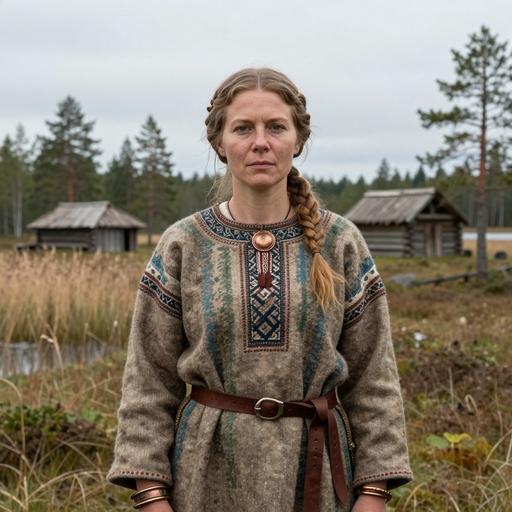
Portrait reconstruction of JK1967
Ancient Individual

An individual buried in Finland in the Bronze Age era

JK1967
300 CE - 800 CE
Not known
Levanluhta Site, Finland
Finland
Scroll to begin
Chapter I

Identity

The biological and cultural markers that define this ancient individual

Sample ID

JK1967

Date Range

300 CE - 800 CE

Biological Sex

Not known

mtDNA Haplogroup

U5b1b1a4

Cultural Period

Levanluhta Site, Finland

Chapter II

Place

Where this individual was discovered

Country Finland
Locality Isokyro. Levanluhta
Coordinates 62.9487, 22.4101
Chapter III

Time

When this individual lived in the broader context of human history

JK1967 300 CE - 800 CE
Chapter IV

Story

The narrative of this ancient life

The Levanluhta site, located in present-day Finland, provides a fascinating window into the lives and practices of people during the Nordic Bronze Age, a period spanning approximately from 1700 to 500 BCE in the Nordic region. This era in Finland is somewhat unique compared to other parts of Scandinavia, owing to its geographical positioning and distinct cultural interactions.

Geographic and Archaeological Context

The Levanluhta site is situated in western Finland, characterized by its wetland environment. It's a notable archaeological location primarily because it serves as a burial site. Wetlands, bogs, or lakes were often used in ancient Nordic societies for ritualistic purposes, including human sacrifices and burials, because of their mystical connotations as liminal spaces between life and death.

Cultural Attributes

Settlement and Society

During the Nordic Bronze Age, Finland's society was organized primarily into small communities or clans, often related by familial ties. These communities were typically self-sufficient, relying on a mix of farming, hunting, and fishing. The landscape necessitated a semi-nomadic lifestyle in some areas, with settlements located near water sources for sustenance and transportation.

Material Culture

The material culture of the region around the Levanluhta site reflects a blend of local and external influences, particularly from Scandinavian and Baltic interactions. While bronze was a significant material in Scandinavia during this time, in Finland, bronze artifacts were less common. Instead, stone and organic materials were more frequently used, reflecting the limited access to metal trade networks.

Artifacts: Items such as stone tools, pottery, and wooden implements have been discovered. Ornamentation, when present, often included amber and bone, with designs reflecting symbolic meanings or social statuses.

Burial Practices and Spiritual Life

Levanluhta particularly provides insights into the spiritual and ritual practices of the period. The site is renowned for its use as a burial place, where numerous human remains have been discovered submerged in waterlogged conditions. This method of burial might indicate beliefs associated with water as a purifying element or a means to connect with the spiritual realm.

Rituals: Burials in wetlands may have had ritualistic purposes, possibly related to ancestor worship or appeasement of deities. The presence of animal remains and ritual deposits could suggest offerings to gods or spirits.

Art and Symbolism

Art from this era in Finland includes simplistic geometric designs and depictions of animals, which may have been imbued with spiritual significance. Rock carvings and patterns found on pottery reflect the cultural exchange between Finnish groups and neighboring cultures. Symbolic motifs often found in bronze work from more southern Nordic regions are less prevalent in Finland, underlining the area's divergent cultural evolution.

Economy and Trade

The Bronze Age in this region saw minimal large-scale trade; however, the exchange of goods such as furs, timber, and amber occurred. Trade routes connected Finnish communities with Baltic and Scandinavian partners, fostering a gradual exchange of ideas and materials. The presence of bronze artifacts, although limited, indicates occasional trade interactions with more metal-rich neighboring regions.

Climate and Environmental Impact

The climate during the Nordic Bronze Age in Finland was cooler and wetter than the present day, which influenced the predominantly subsistence-based lifestyle. The abundance of natural resources like forests and water bodies played a crucial role in daily life, providing materials for tools, housing, and food.

Conclusion

The Levanluhta site offers valuable insights into the Nordic Bronze Age specific to Finland, illustrating a society that, while connected to broader Nordic cultural dynamics, maintained unique regional characteristics. The use of wetlands for burials highlights distinctive spiritual beliefs and practices, while the region's material culture reflects a reliance on natural resources coupled with influences garnered through limited but significant trade and contact with neighboring peoples.

Chapter V

Genetics

The genetic ancestry of this ancient individual

Ancient Genetic Admixture

This analysis compares the DNA profile of JK1967 with ancient reference populations, showing the genetic composition in terms of prehistoric ancestral groups.

Ancient Asians 61.3%
Western Steppe Pastoralists 16.8%
Neolithic Farmers 15.0%
Ancient Native Americans 3.8%
Ancient Africans 3.0%

Modern Genetic Admixture

This analysis compares the DNA profile with present-day reference populations, showing what percentage of genetic makeup resembles modern populations from different regions.

Europe 45.3%
Northwestern European 43.3%
Finnish 43.3%
Southern European 2.0%
Sardinian 2.0%
America 21.5%
America 21.5%
Native American 21.5%
Asia 16.6%
Northern Asian 15.5%
Mongolian 10.2%
Siberian 5.3%
Central Asian, Northern Indian & Pakistani 1.1%
Indian 1.1%
Africa 9.7%
North African 7.7%
North African 7.7%
West African 2.0%
Nigerian 2.0%
Oceania 6.9%
Melanesian 6.9%
Papuan 6.9%

Closest Modern Populations

These are the modern populations showing the closest statistical alignment to An individual buried in Finland in the Bronze Age era, ranked by genetic distance. Lower distance values indicate closer statistical similarity.

1
Bashkir
8.9017
2
Khanty O1
9.1915
3
Tatar Crimean Steppe
9.7838
4
Besermyan
9.8761
5
Udmurt
9.9061
6
Tatar Lipka
10.0784
7
Chuvash
10.9684
8
Tatar Siberian
10.9853
9
Tatar Kazan
10.9868
10
Saami
11.2291
Chapter VI

Context

Other ancient individuals connected to this sample

Sources

References

Scientific publications and genetic data

Scientific Publication

Ancient Fennoscandian genomes reveal origin and spread of Siberian ancestry in Europe

Authors Lamnidis TC, Majander K, Jeong C
Abstract

European population history has been shaped by migrations of people, and their subsequent admixture. Recently, ancient DNA has brought new insights into European migration events linked to the advent of agriculture, and possibly to the spread of Indo-European languages. However, little is known about the ancient population history of north-eastern Europe, in particular about populations speaking Uralic languages, such as Finns and Saami. Here we analyse ancient genomic data from 11 individuals from Finland and north-western Russia. We show that the genetic makeup of northern Europe was shaped by migrations from Siberia that began at least 3500 years ago. This Siberian ancestry was subsequently admixed into many modern populations in the region, particularly into populations speaking Uralic languages today. Additionally, we show that ancestors of modern Saami inhabited a larger territory during the Iron Age, which adds to the historical and linguistic information about the population history of Finland.

G25 Coordinates

The G25 coordinates for sample JK1967 can be used for detailed admixture analysis in our G25 Studio tool.

JK1967,0.06725244,-0.05782704,0.06672728,0.0354492,-0.0166187,-0.00814476,-0.0304939,-0.03375344,0.01162164,-0.0081362,0.02171286,-0.0044402,0.00792406,-0.02566576,-0.015087,-0.01070706,0.0004325,-3.82E-05,-0.00951872,-0.01136486,-0.00071716,0.01148058,-0.0075328,-0.00473508,-0.00379565
Analyze in G25 Studio
Use code for 40% off Expires Feb 27