Menu
Store
Blog
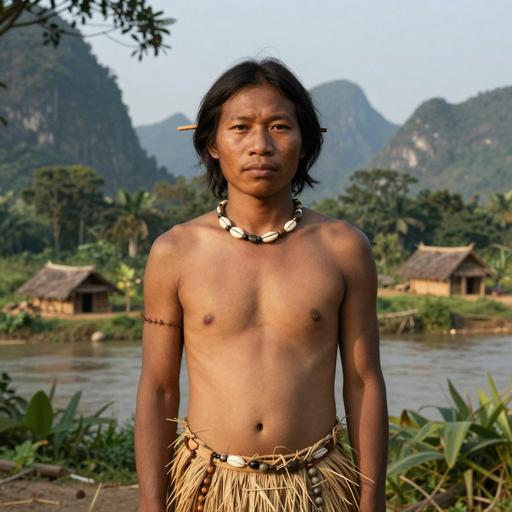
Portrait reconstruction of La368
Ancient Individual

A man buried in Laos in the Mesolithic era

La368
6012 BCE - 5837 BCE
Male
The Hoabinhian Culture
Laos
Scroll to begin
Chapter I

Identity

The biological and cultural markers that define this ancient individual

Sample ID

La368

Date Range

6012 BCE - 5837 BCE

Biological Sex

Male

mtDNA Haplogroup

M5

Y-DNA Haplogroup

C-K150

Cultural Period

The Hoabinhian Culture

Chapter II

Place

Where this individual was discovered

Country Laos
Locality Northern Bolikhamsay. Pha Faen
Chapter III

Time

When this individual lived in the broader context of human history

La368 6012 BCE - 5837 BCE
Chapter IV

Story

The narrative of this ancient life

The Hoabinhian culture is an archaeological tradition that emerged in Southeast Asia, particularly in regions like Laos, Vietnam, Thailand, and Malaysia. It is characterized by its distinct stone tools and is considered one of the earliest cultural phases in this region, dating roughly from 10,000 to 3,000 BCE, though some sites may be older. The culture is named after the Hoabinh province in northern Vietnam, where evidence of this prehistoric society was first discovered.

Key Characteristics

Tools and Technology

The hallmark of the Hoabinhian culture is its unique stone tool industry. The most distinctive tool associated with this culture is the \sumatralith," a type of stone tool made from pebbles and cobbles. These tools display a bifacial or multi-facial flaking technique that is not common in other contemporary cultures. The tools are often crudely shaped, primarily for use in chopping, cutting, and processing food or materials. They also include simple flaked tools, grinding stones, and edge-ground axes.

Subsistence and Economy

The Hoabinhian people were predominantly hunter-gatherers, relying on a mix of hunting, fishing, and foraging for subsistence. The environment of Southeast Asia provided a rich and diverse array of resources, from riverine and coastal fish to forest game and plant materials. The dietary remains found at Hoabinhian sites suggest a varied diet, incorporating terrestrial and aquatic resources.

The exploitation of shellfish is well-documented in Hoabinhian sites, indicating a thorough use of available resources. It's likely that Hoabinhian groups were semi-nomadic, moving periodically to exploit seasonal resources or possibly settle for extended periods at rich resource sites.

Settlement Patterns

Hoabinhian sites are often caves or rock shelters, which provided natural protection. Open-air sites have been discovered as well, typically located near rivers or other water sources. These sites show evidence of repeated occupation, suggesting that groups returned regularly, perhaps following a seasonal cycle.

Social Structure and Organization

While detailed information about the social organization of the Hoabinhian people is limited due to the lack of written records, it is generally assumed that they lived in small, egalitarian groups. The mobility patterns, as well as the nature of the resources they exploited, suggest a society organized around small family or kin groups.

Cultural and Historical Significance

Impact and Influence

The Hoabinhian culture represents a foundational period in Southeast Asian prehistory. It provides insights into the adaptation strategies of early human populations in tropical environments. The widespread distribution of Hoabinhian artifacts across Southeast Asia suggests a broad cultural tradition, perhaps facilitated by seasonal migrations or exchanges between groups.

This culture sets the stage for the subsequent development of more complex societies in the region, such as those associated with the Neolithic Revolution, which saw the introduction of agriculture and sedentism. The knowledge of local flora and fauna, as well as the techniques for exploiting them, developed during the Hoabinhian period likely informed later agricultural practices.

Anthropological and Archaeological Research

Archaeological investigations of Hoabinhian sites have greatly contributed to the understanding of prehistoric Southeast Asia. The study of these sites has offered comprehensive insights into the technological and economic adaptations of early humans in tropical forest environments. These studies are crucial for understanding broader human evolutionary and migratory processes, particularly in the context of the spread of Homo sapiens across Asia.

Researchers continue to explore Hoabinhian sites using modern techniques such as radiocarbon dating, paleoethnobotany, and zooarchaeology to develop more nuanced pictures of these prehistoric communities.

In conclusion, the Hoabinhian culture is a cornerstone of Southeast Asian prehistoric archaeology, providing vital insights into the lifestyle, technological innovation, and environmental interactions of early human populations in this region. Its study helps bridge the gap between the Paleolithic and Neolithic periods, illustrating the gradual shifts in human subsistence and social organization that laid the groundwork for more complex societies."

Chapter V

Genetics

The genetic ancestry of this ancient individual

Ancient Genetic Admixture

This analysis compares the DNA profile of La368 with ancient reference populations, showing the genetic composition in terms of prehistoric ancestral groups.

Ancient Asians 61.7%
Neolithic Farmers 16.7%
Ancient Oceanians 13.2%
Ancient Africans 5.8%
Western Steppe Pastoralists 2.6%

Modern Genetic Admixture

This analysis compares the DNA profile with present-day reference populations, showing what percentage of genetic makeup resembles modern populations from different regions.

Asia 79.8%
Central Asian, Northern Indian & Pakistani 45.5%
Indian 45.5%
Chinese & Southeast Asian 22.9%
Indonesian Khmer Thai Myanma 10.2%
Vietnamese 7.0%
Tibetan 3.1%
Chinese 2.7%
Japanese & Korean 7.0%
Japanese 7.0%
Northern Asian 4.3%
Mongolian 4.3%
Oceania 13.7%
Melanesian 13.7%
Papuan 13.7%
Africa 6.6%
Northern East African 2.9%
Eastern African 2.9%
West African 2.3%
Senegambian & Guinean 2.0%
African Hunter-Gatherer 0.8%
Congolese & Southern East African 0.5%
South East African 0.5%

Closest Modern Populations

These are the modern populations showing the closest statistical alignment to A man buried in Laos in the Mesolithic era, ranked by genetic distance. Lower distance values indicate closer statistical similarity.

1
Onge
9.3363
2
Jarawa
9.4414
3
Newar
9.9828
4
Nyishi
10.1977
5
Tharu O2
10.3197
6
Brahmin Manipuri
10.4675
7
Nepali Indo Aryan O1
10.7007
8
Damai
10.9223
9
Nepali Indo Aryan D
11.5069
10
Tharu
12.2332
Chapter VI

Context

Other ancient individuals connected to this sample

Sources

References

Scientific publications and genetic data

Scientific Publication

The prehistoric peopling of Southeast Asia

Authors McColl H, Racimo F, Vinner L
Abstract

The human occupation history of Southeast Asia (SEA) remains heavily debated. Current evidence suggests that SEA was occupied by Hòabìnhian hunter-gatherers until ~4000 years ago, when farming economies developed and expanded, restricting foraging groups to remote habitats. Some argue that agricultural development was indigenous; others favor the "two-layer" hypothesis that posits a southward expansion of farmers giving rise to present-day Southeast Asian genetic diversity. By sequencing 26 ancient human genomes (25 from SEA, 1 Japanese Jōmon), we show that neither interpretation fits the complexity of Southeast Asian history: Both Hòabìnhian hunter-gatherers and East Asian farmers contributed to current Southeast Asian diversity, with further migrations affecting island SEA and Vietnam. Our results help resolve one of the long-standing controversies in Southeast Asian prehistory.

G25 Coordinates

The G25 coordinates for sample La368 can be used for detailed admixture analysis in our G25 Studio tool.

La368,-0.01966798,-0.2171745,-0.1086797,0.0767639,-0.00855962,-0.01437984,0.01319718,0.00198668,0.02401702,0.02286608,-0.02782768,-0.00686842,0.00307128,0.00263386,-0.00658304,-0.00728364,0.00398328,-0.0023697,-0.00023684,7.156E-05,0.00125408,0.00890348,0.00117814,0.0036715,0.00752506
Analyze in G25 Studio
Use code for 40% off Expires Feb 27