Menu
Store
Blog
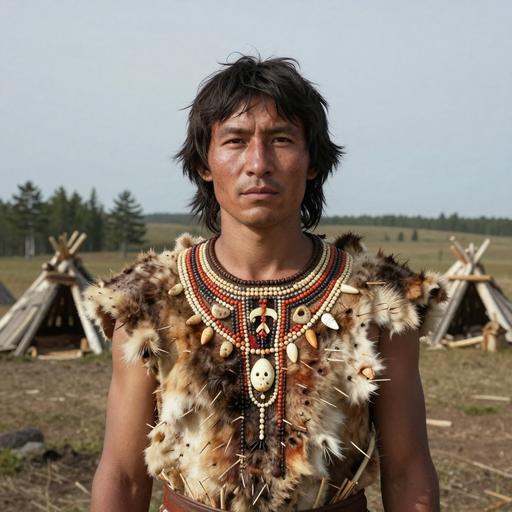
Portrait reconstruction of Sunghir1
Ancient Individual

A man buried in Russia in the Pleistocene era

Sunghir1
32326 BCE - 30080 BCE
Male
Sunghir 1 Site, Russia
Russia
Scroll to begin
Chapter I

Identity

The biological and cultural markers that define this ancient individual

Sample ID

Sunghir1

Date Range

32326 BCE - 30080 BCE

Biological Sex

Male

mtDNA Haplogroup

U8c

Y-DNA Haplogroup

C-V3177

Cultural Period

Sunghir 1 Site, Russia

Chapter II

Place

Where this individual was discovered

Country Russia
Locality Sunghir
Coordinates 56.1761, 40.5025
Chapter III

Time

When this individual lived in the broader context of human history

Sunghir1 32326 BCE - 30080 BCE
Chapter IV

Story

The narrative of this ancient life

The Sunghir site, located near Vladimir, Russia, is one of the most significant and well-preserved archaeological sites from the European Upper Paleolithic era. This site provides invaluable insights into the lives, culture, and societal structures of Upper Paleolithic hunter-gatherers, approximately dating to between 34,000 and 28,000 years ago.

Overview of the Upper Paleolithic Era

The Upper Paleolithic period, spanning approximately from 50,000 to 10,000 years ago, marks the final phase of the Stone Age. It was a time of significant cultural, technological, and social developments among Homo sapiens. This era saw the proliferation of sophisticated stone tools, the development of art and symbolic behavior, and the establishment of complex social structures.

Location and Discovery

Sunghir is situated about 200 kilometers northeast of Moscow, on the western edge of what is now known as the Russian Plain. Discovered in the mid-20th century, the site has been extensively excavated, resulting in remarkable findings that have made it one of the most informative sites for understanding the European Upper Paleolithic.

Archaeological Finds

The site is renowned for its rich assemblage of archaeological materials, which include:

  • Burial Sites: Several burials were uncovered, the most notable being those of Sunghir 1, Sunghir 2, and Sunghir 3. Sunghir 1, an adult male, was found interred with an extensive array of grave goods, including thousands of ivory beads, mammoth ivory bracelets, a lance made from straightened mammoth tusk, and other adornments. The presence of these elaborate grave goods suggests the existence of ritual practices and social stratification.

  • Artistic Elements: The discovery of personal ornaments, such as beads and pendants made from animal teeth and ivory, as well as ochre, indicates the inhabitants' aesthetic sensibilities and possibly symbolic or ceremonial functions.

  • Tools and Technology: Lithic analysis from the site indicates advanced stone tool technology, including blades, scrapers, and burins, reflecting the sophistication in tool-making techniques and the ingenious adaptations required for survival in the harsh climates of the period.

Cultural and Social Implications

The lavishness and intricacy of the grave goods at Sunghir suggest a complex society with developed cultural practices. The differential treatment in burials indicates social differentiation, possibly pointing to leadership roles or hierarchical structures. This challenges earlier notions that prehistoric societies were uniformly egalitarian.

The presence of symbolic items, such as jewelry and ochre, denotes a developed sense of identity and possibly spiritual beliefs. The site's artifacts reflect a society engaging in long-distance trade or cultural exchange, as some materials were not locally sourced.

Physical Anthropology

The human remains at Sunghir have provided significant data for physical anthropologists. The skeletal remains show signs of robust health despite the harsh environment, with evidence pointing to a diverse diet that included a variety of plant and animal resources. Detailed study of these remains also contributes to understanding the genetic and evolutionary history of European populations.

Environmental Context

The Sunghir site was occupied during a period of fluctuating climate conditions associated with the Pleistocene epoch. The ability of these hunter-gatherer groups to adapt to such changing environments demonstrates their resilience and resourcefulness. Faunal remains found at the site include large Ice Age mammals such as mammoths, reindeer, and horses, which were crucial both as food sources and materials for tool and ornament production.

Conclusion

Overall, the Sunghir site encompasses a remarkable archaeological record that offers a window into the lives of Upper Paleolithic humans. It reveals a society rich in culture, art, and social complexity. The findings from Sunghir continue to provoke questions and inspire research about the nature of human societies, their development, and their intricate web of social relations during the Upper Paleolithic era.

Chapter V

Genetics

The genetic ancestry of this ancient individual

Ancient Genetic Admixture

This analysis compares the DNA profile of Sunghir1 with ancient reference populations, showing the genetic composition in terms of prehistoric ancestral groups.

Western Steppe Pastoralists 29.6%
Neolithic Farmers 29.1%
Ancient Asians 24.6%
European Hunter-Gatherers 7.7%
Ancient Africans 6.3%
Ancient Oceanians 2.8%

Modern Genetic Admixture

This analysis compares the DNA profile with present-day reference populations, showing what percentage of genetic makeup resembles modern populations from different regions.

Europe 58.5%
Northwestern European 32.5%
Northwestern European 14.0%
Scandinavian 14.0%
Finnish 4.5%
Eastern European 15.1%
Southern European 10.9%
Iberian 8.5%
Sardinian 2.4%
Asia 24.6%
Central Asian, Northern Indian & Pakistani 18.1%
Indian 18.1%
Chinese & Southeast Asian 4.8%
Indonesian Khmer Thai Myanma 4.8%
Japanese & Korean 1.7%
Japanese 1.7%
Africa 8.7%
Northern East African 4.7%
Ethiopian 4.0%
Eastern African 0.7%
African Hunter-Gatherer 2.5%
North African 1.5%
Egyptian 1.5%
Oceania 6.5%
Melanesian 6.5%
Papuan 6.5%
America 1.7%
America 1.7%
Native American 1.7%

Closest Modern Populations

These are the modern populations showing the closest statistical alignment to A man buried in Russia in the Pleistocene era, ranked by genetic distance. Lower distance values indicate closer statistical similarity.

1
Roma Bilbao
10.1197
2
Roma Granada
10.2471
3
Tatar Lipka
10.3598
4
Tatar Kazan
10.5432
5
Roma Porto
10.6478
6
Roma Balkans
10.7837
7
Tajik Tajikistan Ayni
10.8739
8
Tajik Tajikistan Hisor
10.9610
9
Roma Madrid
10.9692
10
Tatar Mishar
11.0933
Chapter VI

Context

Other ancient individuals connected to this sample

Sources

References

Scientific publications and genetic data

Scientific Publication

Ancient genomes show social and reproductive behavior of early Upper Paleolithic foragers

Authors Sikora M, Seguin-Orlando A, Sousa VC
Abstract

Present-day hunter-gatherers (HGs) live in multilevel social groups essential to sustain a population structure characterized by limited levels of within-band relatedness and inbreeding. When these wider social networks evolved among HGs is unknown. To investigate whether the contemporary HG strategy was already present in the Upper Paleolithic, we used complete genome sequences from Sunghir, a site dated to ~34,000 years before the present, containing multiple anatomically modern human individuals. We show that individuals at Sunghir derive from a population of small effective size, with limited kinship and levels of inbreeding similar to HG populations. Our findings suggest that Upper Paleolithic social organization was similar to that of living HGs, with limited relatedness within residential groups embedded in a larger mating network.

G25 Coordinates

The G25 coordinates for sample Sunghir1 can be used for detailed admixture analysis in our G25 Studio tool.

Sunghir1,0.04630008,0.01491986,0.00096946,0.05517962,0.01828626,-0.00334986,-0.00719464,9.596E-05,0.02468228,-0.00294528,-0.01105864,0.00158542,2.494E-05,0.0010849,0.00519772,-0.00348452,-0.00113166,-0.00140222,0.00121774,-0.00030494,0.0041465,0.00309612,-0.00189152,0.00309914,0.00145442
Analyze in G25 Studio
Use code for 40% off Expires Feb 27