Menu
Store
Blog
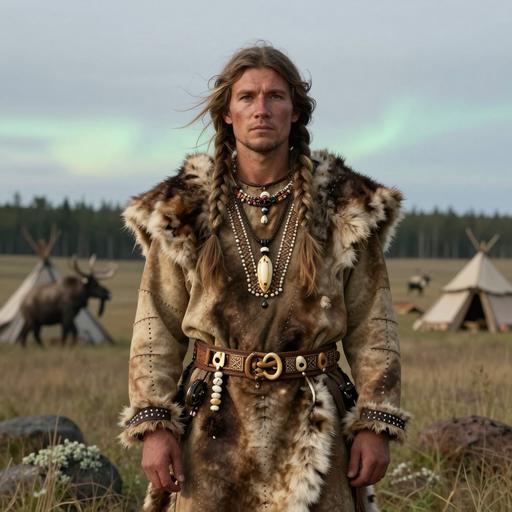
Portrait reconstruction of Sunghir4
Ancient Individual

A man buried in Russia in the Pleistocene era

Sunghir4
32898 BCE - 31771 BCE
Male
Sunghir 4 Site, Russia
Russia
Scroll to begin
Chapter I

Identity

The biological and cultural markers that define this ancient individual

Sample ID

Sunghir4

Date Range

32898 BCE - 31771 BCE

Biological Sex

Male

mtDNA Haplogroup

U2

Y-DNA Haplogroup

C-CTS10356

Cultural Period

Sunghir 4 Site, Russia

Chapter II

Place

Where this individual was discovered

Country Russia
Locality Sunghir
Coordinates 56.1761, 40.5025
Chapter III

Time

When this individual lived in the broader context of human history

Sunghir4 32898 BCE - 31771 BCE
Chapter IV

Story

The narrative of this ancient life

The Sunghir site, located near Vladimir city in Russia, is one of the most significant archaeological sites from the European Upper Paleolithic era, dated to around 34,000 to 28,000 years ago. This time period corresponds to the latter part of the Upper Paleolithic, a time characterized by the flourishing of modern Homo sapiens across Europe. The Sunghir site is particularly noteworthy for its well-preserved burials and the sophisticated artifacts and remains that provide deep insights into the culture and life of Paleolithic humans.

Geography and Environment

The Sunghir site is situated in an area that was part of the European Plain, a broad expanse that would have been dominated by a tundra or steppe-like environment during the Upper Paleolithic. This region offered a habitat rich in large game animals, which was crucial for the sustenance of the hunter-gatherer societies of the time.

Archaeological Significance

Sunghir is celebrated primarily for its astonishing funerary discoveries. The site includes several burials, the most famous being that of an adult male (Sunghir 1) and two children (Sunghir 2 and 3). These burials are marked by their elaborate nature, indicating complex social structures and belief systems.

Sunghir 4

The Sunghir 4 site refers to specific burial contexts within the broader archaeological discovery of Sunghir, although the fourth burial has not been extensively detailed as being distinct in the primary literature from Sunghir 1, 2, and 3, it is collectively assumed to be part of the cultural context of the site. Each of these burials provides invaluable insights into the mortuary practices and symbolic behaviors of Upper Paleolithic humans.

Burial Practices and Grave Goods

The burials at Sunghir are characterized by an extraordinary array of grave goods. These include:

  • Ivory Beads and Pendants: Thousands of intricately crafted beads and pendants, made from mammoth ivory, were found decorating the clothing of the deceased. The sheer number and craftsmanship illustrate the high value placed on adornment, possibly indicating status or clan affiliation.

  • Spears and Tools: Some burials contained long mammoth ivory spears, and other tools, which may have served both practical and ceremonial purposes.

  • Red Ochre: The bodies were sprinkled with red ochre, a common practice in Paleolithic burials, which may symbolize life, death, or rebirth.

Social Structure and Cultural Implications

The level of detail and the resources expended in these burials suggest a stratified society with social differentiation. The placement of children in such richly endowed graves points to the possibility of inherited status or the existence of social roles even among younger community members.

Art and Symbolism

Items discovered in Sunghir reflect a high degree of artistic skill and symbolic thought. The engraving and decoration of objects demonstrate not only aesthetic concerns but also possible spiritual or clan meanings. These embellishments reveal a complex culture capable of abstract thought and social rituals.

Genetics and Physical Anthropology

The skeletal remains at Sunghir have been instrumental in understanding the genetics and physical anthropology of Paleolithic populations. DNA analyses show that these individuals were part of the early modern human populations in Europe, with connections to other Upper Paleolithic groups.

Conclusion

The Sunghir site offers a rare glimpse into the intricate social, ideological, and economic aspects of Upper Paleolithic life. The artistry and care evident in the burials indicate a community that valued not only survival but also social identity, symbolism, and relationships with the broader environment. Sunghir remains an essential touchstone in the study of prehistoric human societies, helping to illuminate the complex mosaic of early human culture in Europe.

Chapter V

Genetics

The genetic ancestry of this ancient individual

Ancient Genetic Admixture

This analysis compares the DNA profile of Sunghir4 with ancient reference populations, showing the genetic composition in terms of prehistoric ancestral groups.

Western Steppe Pastoralists 30.2%
Neolithic Farmers 28.5%
Ancient Asians 18.7%
European Hunter-Gatherers 7.5%
Ancient Africans 6.7%
Ancient Oceanians 5.5%
Ancient Native Americans 2.9%

Modern Genetic Admixture

This analysis compares the DNA profile with present-day reference populations, showing what percentage of genetic makeup resembles modern populations from different regions.

Europe 52.8%
Northwestern European 20.0%
Northwestern European 7.2%
Scandinavian 7.0%
Finnish 5.8%
Eastern European 18.7%
Southern European 14.0%
Iberian 12.9%
Sardinian 1.1%
Asia 25.5%
Central Asian, Northern Indian & Pakistani 18.1%
Indian 18.1%
Arab, Egyptian & Levantine 4.2%
Arabian 4.2%
Northern Asian 1.6%
Siberian 1.6%
Chinese & Southeast Asian 1.6%
Indonesian Khmer Thai Myanma 1.3%
Africa 12.8%
Northern East African 5.1%
Ethiopian 5.1%
North African 3.2%
Egyptian 3.2%
West African 2.5%
Senegambian & Guinean 2.5%
African Hunter-Gatherer 1.9%
Oceania 6.1%
Melanesian 6.1%
Papuan 6.1%
America 2.9%
America 2.9%
Native American 2.9%

Closest Modern Populations

These are the modern populations showing the closest statistical alignment to A man buried in Russia in the Pleistocene era, ranked by genetic distance. Lower distance values indicate closer statistical similarity.

1
Roma Granada
9.5580
2
Roma Bilbao
9.6704
3
Roma Porto
10.1016
4
Roma Balkans
10.3251
5
Roma Madrid
10.3853
6
Roma Barcelona
11.2248
7
Cochin Jew A
11.7678
8
Tajik Tajikistan Ayni
11.7931
9
Tajik Tajikistan Hisor
11.9034
10
Turkish Antalya
12.1623
Chapter VI

Context

Other ancient individuals connected to this sample

Sources

References

Scientific publications and genetic data

Scientific Publication

Ancient genomes show social and reproductive behavior of early Upper Paleolithic foragers

Authors Sikora M, Seguin-Orlando A, Sousa VC
Abstract

Present-day hunter-gatherers (HGs) live in multilevel social groups essential to sustain a population structure characterized by limited levels of within-band relatedness and inbreeding. When these wider social networks evolved among HGs is unknown. To investigate whether the contemporary HG strategy was already present in the Upper Paleolithic, we used complete genome sequences from Sunghir, a site dated to ~34,000 years before the present, containing multiple anatomically modern human individuals. We show that individuals at Sunghir derive from a population of small effective size, with limited kinship and levels of inbreeding similar to HG populations. Our findings suggest that Upper Paleolithic social organization was similar to that of living HGs, with limited relatedness within residential groups embedded in a larger mating network.

G25 Coordinates

The G25 coordinates for sample Sunghir4 can be used for detailed admixture analysis in our G25 Studio tool.

Sunghir4,0.03034538,0.03009772,-0.00724424,0.05076168,0.0147355,-0.01014822,-0.00869536,0.00357002,0.0294503,0.0021155,-0.00372294,-0.00059352,-0.00216972,0.0008178,0.0035404,-0.0039189,0.0022033,-0.0003811,0.00338338,-0.00101006,0.00236596,-0.00015148,-0.0029637,0.00398556,0.00153696
Analyze in G25 Studio
Use code for 40% off Expires Feb 27