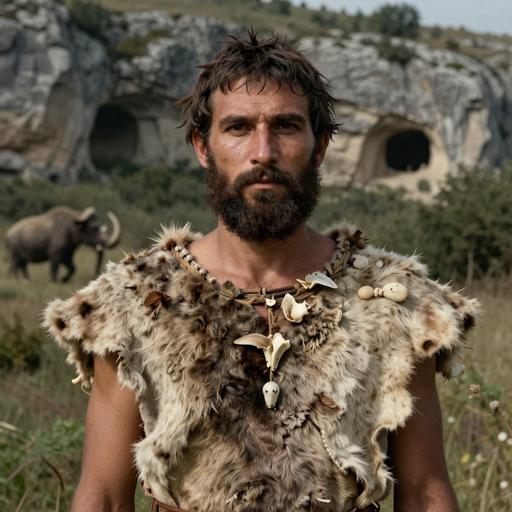
BB7-240 - A man buried in Bulgaria in the Pleistocene era

Download PDF creates a visual, rasterized copy. Use Print for selectable text and better assistive-technology support.

Menu
Currency
Main
Store
Blog

Loading Report

Preparing your ancestry journey

Connecting to ancient matches...

Preparing your report

Skip to main content
Portrait reconstruction of A man buried in Bulgaria in the Pleistocene era
Ancient Individual

A man buried in Bulgaria in the Pleistocene era

A man buried in Bulgaria during the Late Pleistocene Bacho Kiro Cave, Bulgaria

A fragment of the ancient world, preserved across millennia in strands of DNA.

BB7-240
44169 BCE - 42652 BCE
Male
Bulgaria
Scroll to begin
Chapter I

Identity

The biological and cultural markers that define this ancient individual

Sample ID

BB7-240

Date Range

44169 BCE - 42652 BCE

Cultural Period

Late Pleistocene Bacho Kiro Cave, Bulgaria

Biological Sex

Male

mtDNA Haplogroup

Not available

Y-DNA Haplogroup

Not available

Social Role

Hunter (AI estimate, era-typical)

Chapter II

Place

Where this individual was discovered

Country Bulgaria
Locality Balkan Mountains. Bacho Kiro Cave
Coordinates 42.9480, 24.4302
Chapter III

Time

When this individual lived in the broader context of human history

BB7-240 44169 BCE - 42652 BCE
Chapter IV

Story

The narrative of this ancient life

Region & Environment

Bacho Kiro Cave is located in Bulgaria within a temperate-to-mountainous setting influenced by Late Pleistocene climate variability. Caves such as this provided sheltered spaces during periods when temperatures and precipitation likely fluctuated significantly.

Historical Context

In the interval represented by 45,000–38,000 BCE, human populations in Europe were undergoing technological and behavioral transformations associated with the Initial Upper Paleolithic. These centuries fall within broader phases of Upper Paleolithic expansion and intensification, often linked to early modern human populations.

Populations & Lifeways

People occupying Bacho Kiro would have used the cave as a strategic shelter and activity space. Lifeways were likely based on hunting and gathering, with repeated visits that could include tool production, food processing, and maintenance of daily equipment.

Archaeology & Material Culture

The culture label “Bacho Kiro” and the complex “Initial Upper Paleolithic” indicate an archaeological horizon characterized by Upper Paleolithic technologies. Cave assemblages in such contexts typically include stone tools produced through controlled knapping techniques and other material indicators of organized tasks, though the supplied data does not list specific artifact types.

Culture & Society

Evidence from caves can reflect socially learned practices—such as shared approaches to making stone tools and using particular areas for repeated activities. Although detailed social organization cannot be reconstructed from the provided information alone, the structured nature of Upper Paleolithic toolkits is consistent with coordinated behavior.

Legacy & Transition

Bacho Kiro Cave belongs to a transitional Late Pleistocene period preceding later Upper Paleolithic developments. Over time, archaeological sequences in the region show shifts in technology and site use that track changing climatic conditions and human adaptation.

Chapter V

Genetics

These comparisons show genetic similarity, not identity or origin. The populations listed are those whose genomes show statistical alignment to this ancient individual.

Similarity reflects shared history, not shared identity. These are analytical comparisons, not claims about who this person was.

Modern Genetic Admixture

This analysis compares the DNA profile with present-day reference populations, showing statistical similarity to modern reference populations from different regions. The excavation site records where this individual was found, not a fixed modern genetic identity.

Asia 66.2%
Central Asian, Northern Indian & Pakistani 44.9%
Indian 44.9%
Japanese & Korean 10.1%
Japanese 10.1%
Chinese & Southeast Asian 10.0%
Indonesian Khmer Thai Myanma 4.0%
Tibetan 3.3%
Chinese 2.7%
Northern Asian 1.1%
Siberian 1.1%
Africa 17.1%
Northern East African 6.5%
Ethiopian 5.1%
Eastern African 1.4%
West African 5.8%
Senegambian & Guinean 5.8%
African Hunter-Gatherer 3.9%
Congolese & Southern East African 0.5%
South East African 0.5%
Oceania 8.5%
Melanesian 8.5%
Papuan 8.5%
Europe 7.9%
Northwestern European 4.7%
Finnish 2.7%
Scandinavian 2.0%
Eastern European 2.4%
Southern European 0.7%
Iberian 0.7%

Closest Modern Populations

These are the modern populations showing the closest statistical alignment to A man buried in Bulgaria in the Pleistocene era, ranked by genetic distance. Lower distance values indicate closer statistical similarity. Cross-region similarity can reflect shared ancestry, population movement, continuity, or later admixture.

1
Bahun O
13.9814
2
Nepali Indo Aryan C
14.0908
3
Rajput Mondal
14.1786
4
Rajput Garhwal
14.2548
5
Bengali Bangladesh Southeast
14.4578
6
Rohingya
14.6908
7
Bengali Bangladesh Sylhet
14.7772
8
Nepali Indo Aryan B
14.9309
9
Damai
15.0705
10
Nepali Indo Aryan D
15.1478
Context

Related Samples

This individual exists within a broader network of ancient samples. No ancient genome stands alone.

Sample ID Culture/Period Date Location Action
F6-620 Late Pleistocene Bacho Kiro Cave, Bulgaria 41976 BCE Balkan Mountains. Bacho Kiro Cave, Bulgaria View
AA7-738 Late Pleistocene Bacho Kiro Cave, Bulgaria 41976 BCE Balkan Mountains. Bacho Kiro Cave, Bulgaria View
BB7-240 Late Pleistocene Bacho Kiro Cave, Bulgaria 44169 BCE Balkan Mountains. Bacho Kiro Cave, Bulgaria View
CC7-2289 Late Pleistocene Bacho Kiro Cave, Bulgaria 42446 BCE Balkan Mountains. Bacho Kiro Cave, Bulgaria View
CC7-335 Late Pleistocene Bacho Kiro Cave, Bulgaria 43975 BCE Balkan Mountains. Bacho Kiro Cave, Bulgaria View
BK-1653 Late Pleistocene Bacho Kiro Cave, Bulgaria 33333 BCE Balkan Mountains. Bacho Kiro Cave, Bulgaria View
Sample ID Culture/Period Date Location Action
F6-620 Late Pleistocene Bacho Kiro Cave, Bulgaria 41976 BCE Balkan Mountains. Bacho Kiro Cave, Bulgaria View
AA7-738 Late Pleistocene Bacho Kiro Cave, Bulgaria 41976 BCE Balkan Mountains. Bacho Kiro Cave, Bulgaria View
BB7-240 Late Pleistocene Bacho Kiro Cave, Bulgaria 44169 BCE Balkan Mountains. Bacho Kiro Cave, Bulgaria View
CC7-2289 Late Pleistocene Bacho Kiro Cave, Bulgaria 42446 BCE Balkan Mountains. Bacho Kiro Cave, Bulgaria View
CC7-335 Late Pleistocene Bacho Kiro Cave, Bulgaria 43975 BCE Balkan Mountains. Bacho Kiro Cave, Bulgaria View
BK-1653 Late Pleistocene Bacho Kiro Cave, Bulgaria 33333 BCE Balkan Mountains. Bacho Kiro Cave, Bulgaria View
Sources

References

Scientific publications and genetic data that inform this profile.

Scientific Publication

Initial Upper Palaeolithic humans in Europe had recent Neanderthal ancestry

Authors Hajdinjak M, Mafessoni F, Skov L, Vernot B, Hübner A et al.
Abstract

Modern humans appeared in Europe by at least 45,000 years ago1-5, but the extent of their interactions with Neanderthals, who disappeared by about 40,000 years ago6, and their relationship to the broader expansion of modern humans outside Africa are poorly understood. Here we present genome-wide data from three individuals dated to between 45,930 and 42,580 years ago from Bacho Kiro Cave, Bulgaria1,2. They are the earliest Late Pleistocene modern humans known to have been recovered in Europe so far, and were found in association with an Initial Upper Palaeolithic artefact assemblage. Unlike two previously studied individuals of similar ages from Romania7 and Siberia8 who did not contribute detectably to later populations, these individuals are more closely related to present-day and ancient populations in East Asia and the Americas than to later west Eurasian populations. This indicates that they belonged to a modern human migration into Europe that was not previously known from the genetic record, and provides evidence that there was at least some continuity between the earliest modern humans in Europe and later people in Eurasia. Moreover, we find that all three individuals had Neanderthal ancestors a few generations back in their family history, confirming that the first European modern humans mixed with Neanderthals and suggesting that such mixing could have been common.

G25 Coordinates

These coordinates represent a position in genetic space, a tool for comparison, not a conclusion. You can use these to perform custom admixture analysis in G25 Studio.

BB7-240,-0.05710842,-0.1122732,-0.09307856,0.06283898,0.00567032,-0.00062494,-0.00269604,0.00835416,0.03688852,-0.00788232,0.0100371,-0.00032474,-0.00080802,-0.00199192,-0.00296216,-0.01165318,0.00042606,-0.00173742,-0.00020896,-0.00606154,0.0017603,-0.00067232,-0.00953642,0.00061642,-0.00431536
Continue in G25 Studio
Use code for 30% off Expires Aug 04