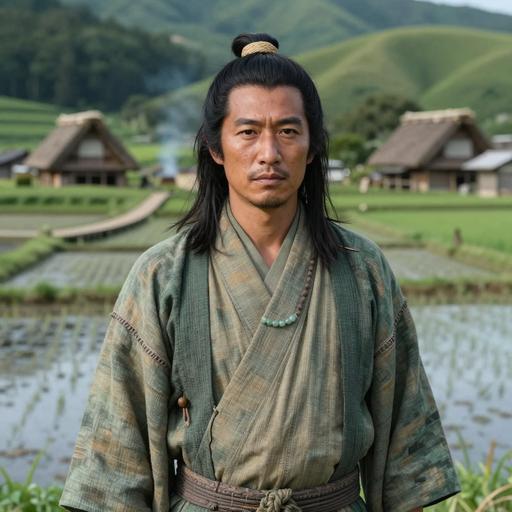
The Yayoi Period, which spans from approximately 300 BCE to 300 CE, represents a critical era in the history of Japan, marking a transition from the Jomon Period and leading into the subsequent Kofun Period. This era witnessed the introduction of rice agriculture, significant technological and social innovations, and substantial cultural changes in the Japanese archipelago, primarily influenced by interactions with the Korean Peninsula and China.
Agricultural and Technological Advancements:
The Yayoi Period is particularly noted for its agricultural revolution, with the adoption of wet-rice cultivation playing a central role. This transformation was facilitated by migrants from the Korean Peninsula who introduced advanced farming techniques and new crop varieties. The resulting agricultural surplus supported larger population densities and the formation of more complex societal structures.
The period also saw advancements in tools and technology. Yayoi people utilized iron and bronze implements, which were crucial for farming and warfare. Bronze was used primarily for ceremonial objects, such as bells (known as dōtaku), mirrors, and weapons, while iron tools became integral in agriculture and daily life. These metal-working skills likely arrived through cultural diffusion from neighboring regions.
Social and Political Structures:
As a result of increased agricultural productivity and technological innovation, Yayoi society became more stratified compared to the Jomon Period. There is evidence of emerging social hierarchies and the development of regional political entities resembling chiefdoms. These were often led by powerful clan leaders who wielded significant influence and controlled considerable resources. Settlements in the Yayoi Period varied from small villages to larger, semi-fortified communities.
Trade and exchange networks expanded during this period, both within the islands and with continental Asia. Yayoi communities obtained metallic resources and other exotic goods through these connections, which facilitated the rise of local elites.
Cultural Characteristics:
Culturally, the Yayoi Period is distinguished by its pottery, which evolved from the cord-marked styles of the Jomon to more refined, wheel-made forms. Yayoi pottery often consisted of simple, functional shapes, adorned with minimal decoration. This transition signifies a shift towards practicality, possibly driven by the demands of agricultural life.
The Yayoi people practiced animistic and shamanistic religious beliefs, venerating natural elements and forces. Evidence of ritual practices has been uncovered, including remains of ceremonial structures, offerings, and burials. These suggest the presence of complex spiritual beliefs and a focus on community-centric rituals.
Regional Variations and Influences:
There were regional variations in Yayoi culture throughout Japan, suggesting a degree of local adaptation and innovation. For example, northern regions retained more Jomon cultural traits, while southern areas, closer to Korea, exhibit stronger continental influences.
The impact of continental neighbors on the Yayoi culture is evident in diverse aspects, ranging from agricultural practices to metallurgy. Interaction with China, particularly during the Han dynasty, brought increased cultural exchange and influence, opening pathways for the transfer of technology, goods, and ideas.
End of the Yayoi Period:
The Yayoi Period eventually transitioned into the Kofun Period around 300 CE. This shift is marked by the appearance of large burial mounds (kofun) and further political unification under increasingly powerful regional powers. The foundation for later Japanese state formation processes can be traced back to the social developments of the Yayoi era.
The Yayoi Period was thus a transformative era that laid the technological, agricultural, and social groundwork for the future of Japan, embodying a significant cultural amalgamation that combined the indigenous and imported practices to forge a new direction in Japanese history.