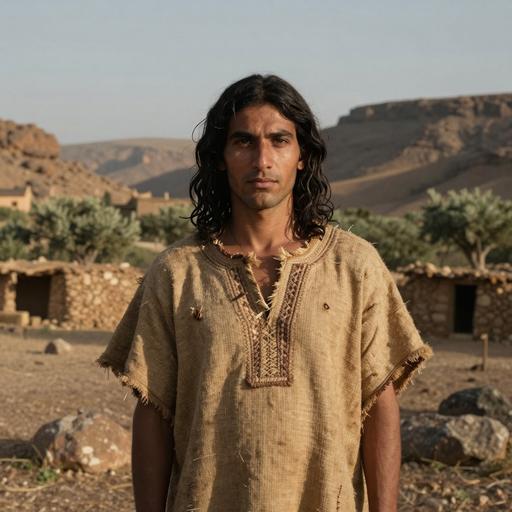
A man buried in Morocco in the Early Neolithic era

Download PDF creates a visual, rasterized copy. Use Print for selectable text and better assistive-technology support.

Loading Report

Preparing your ancestry journey

Preparing the available report content...

Your report will open automatically.

Skip to main content
Reference library / Sample profile

A man buried in Morocco in the Early Neolithic era

Explore the recorded context, genetic comparisons and research behind this reference sample.

MoroccoMorocco EN

A reference profile describes this sample. It does not establish a personal or family relationship.

AI portrait reconstruction for A man buried in Morocco in the Early Neolithic era
AI-generated artistic reconstruction, not a photograph of the individual.
Record

Sample details

Recorded details and available lineage markers.

Individual

Berber individual, Morocco

Sample ID: IAM.4.plus.5

Date Range

5211 BCE - 5010 BCE

Cultural Period

Morocco EN

Biological Sex

Male

mtDNA Haplogroup

U6a1b6

Y-DNA Haplogroup

E-L19

Social Role

Gatherer (AI estimate, era-typical)

Geography

Location

Where this individual was discovered

Country Morocco
Locality Ifri n'Amr or Moussa
Coordinates 33.8841, -5.9326
Chronology

Date range

When this individual lived in the broader context of human history

Berber individual, Morocco 5211 BCE - 5010 BCE
Context

Historical context

Background information associated with the reference record.

Morocco’s Early Neolithic (c. 8000–5600 BCE) is part of a wider Mediterranean-era transition in which food-producing lifeways increasingly complemented earlier hunting and gathering traditions.

Region & Environment

The relevant setting is the Atlantic-facing and Mediterranean-influenced coastal and interior landscape of Morocco, where rainfall and coastal productivity supported seasonal mobility and settlement. Ecological variation—from coastal zones to more inland environments—encouraged flexible strategies in resource use.

Historical Context

This interval follows the late Pleistocene and spans the emergence and consolidation of Neolithic practices in North Africa. The Moroccan record is often characterized by transitional phases, reflecting interaction among local populations and the gradual uptake of farming-related technologies.

Populations & Lifeways

Communities likely lived in settlements that varied in permanence, combining cultivation and animal husbandry with continued exploitation of wild resources. Early herding and farming would have required new skills in plant processing, animal management, and storage, while some older subsistence practices likely persisted.

Archaeology & Material Culture

Early Neolithic assemblages in Morocco are typically discussed through lithic technologies and ceramic production, as well as the broader toolkits associated with food processing. Material culture commonly shows continuities with earlier North African traditions while also incorporating features associated with Neolithic lifeways.

Culture & Society

Social life in this period can be approached through evidence of craft practices and household consumption patterns rather than written institutions. The adoption of pottery and new subsistence routines would have supported changes in cooking, storage, and diet—processes that typically reorganize everyday social rhythms.

Legacy & Transition

By the mid-to-late Neolithic, Moroccan societies continued to develop regionally recognizable practices in pottery and subsistence. The Early Neolithic thus serves as a key background for later phases, documenting how food production and material innovations became locally embedded over time.

Analysis

Genetic comparisons

These comparisons show genetic similarity, not identity or origin. The populations listed are those whose genomes show statistical alignment to this ancient individual.

Similarity reflects shared history, not shared identity. These are analytical comparisons, not claims about who this person was.

Modern Genetic Admixture

This analysis compares the DNA profile with present-day reference populations, showing statistical similarity to modern reference populations from different regions. The excavation site records where this individual was found, not a fixed modern genetic identity.

Africa 93.7%
North African 56.2%
North African 56.2%
Northern East African 21.3%
Ethiopian 21.3%
West African 16.3%
Senegambian & Guinean 16.3%
Oceania 4.0%
Melanesian 4.0%
Papuan 4.0%
Asia 2.3%
Chinese & Southeast Asian 2.3%
Chinese 2.3%

Closest Modern Populations

These are the modern populations showing the closest statistical alignment to A man buried in Morocco in the Early Neolithic era, ranked by genetic distance. Lower distance values indicate closer statistical similarity. Cross-region similarity can reflect shared ancestry, population movement, continuity, or later admixture.

1
Eritrean
6.1183
2
Ethiopian Tigray
6.3023
3
Saho Eritrean
6.4620
4
Ethiopian Afar
6.7409
5
Ethiopian Amhara
7.1046
6
Ethiopian Agaw
7.1791
7
Ethiopian Jew
7.9083
8
Baggara Arab Chad A
8.1203
9
Sudan Arab Kababish
9.8121
10
Moroccan South
9.8613
Context

Related Samples

This individual exists within a broader network of ancient samples. No ancient genome stands alone.

Individual Culture/Period Date Location Action
Berber individual, Morocco Early Neolithic Era in Morocco 4348 BCE Ifri n'Amr or Moussa, Morocco View
Berber individual, Morocco Epipalaeolithic-Neolithic Transition in Morocco 5007 BCE Ifri n'Amr or Moussa, Morocco View
Berber individual, Morocco Epipalaeolithic-Neolithic Transition in Morocco 5211 BCE Ifri n'Amr or Moussa, Morocco View
Berber individual, Morocco Epipalaeolithic-Neolithic Transition in Morocco 5367 BCE Ifri n'Amr or Moussa, Morocco View
Berber individual, Morocco Epipalaeolithic-Neolithic Transition in Morocco 5297 BCE Ifri n'Amr or Moussa, Morocco View
Berber individual, Morocco Late Neolithic Era in Morocco 3800 BCE Kelif el Boroud, Morocco View
Berber individual, Morocco Late Neolithic Era in Morocco 3779 BCE Kelif el Boroud, Morocco View
Berber individual, Morocco Late Neolithic Era in Morocco 8400 BCE , Morocco View
Western European Neolithic individual, Spain Early Neolithic Spain 5100 BCE El Toro, Spain View
Western European Neolithic individual, Spain Early Neolithic Spain 5036 BCE El Toro, Spain View
North Africa N individual, Morocco 5211 BCE Ifri n'Amr or Moussa, Morocco View
North Africa N individual, Morocco 3779 BCE Kelif el Boroud, Morocco View
Iberia N individual, Morocco 8400 BCE , Morocco View
North Africa N individual, Morocco 5367 BCE Ifri n'Amr or Moussa, Morocco View
North Africa N individual, Morocco 5297 BCE Ifri n'Amr or Moussa, Morocco View
North Africa N individual, Morocco 5007 BCE Ifri n'Amr or Moussa, Morocco View
North Africa N individual, Morocco 3800 BCE Kelif el Boroud, Morocco View
Iberia En individual, Spain 5036 BCE El Toro, Spain View
Iberia En individual, Spain 5100 BCE El Toro, Spain View
Page 1
Individual Culture/Period Date Location Action
Berber individual, Morocco Epipalaeolithic-Neolithic Transition in Morocco 5007 BCE Ifri n'Amr or Moussa, Morocco View
Berber individual, Morocco Epipalaeolithic-Neolithic Transition in Morocco 5211 BCE Ifri n'Amr or Moussa, Morocco View
Berber individual, Morocco Epipalaeolithic-Neolithic Transition in Morocco 5367 BCE Ifri n'Amr or Moussa, Morocco View
Berber individual, Morocco Epipalaeolithic-Neolithic Transition in Morocco 5297 BCE Ifri n'Amr or Moussa, Morocco View
Page 1
Sources

References

Scientific publications and genetic data that inform this profile.

G25 Coordinates

These coordinates represent a position in genetic space, a tool for comparison, not a conclusion. You can use these to perform custom admixture analysis in G25 Studio.

IAM.4.plus.5,-0.18456116,0.09405786,-0.0270374,-0.06427978,0.00929972,-0.04356788,-0.02707856,-0.00394584,0.0893294,-0.02989106,-0.00149436,-0.00785148,0.01223768,-0.0028674,0.01960726,-0.00894426,0.01357374,-0.00946182,-0.01215758,0.00206704,-0.00275344,-0.01167066,0.00897704,-0.00186012,-0.00126115
Continue in G25 Studio
Use code for 30% off • Expires Nov 16