
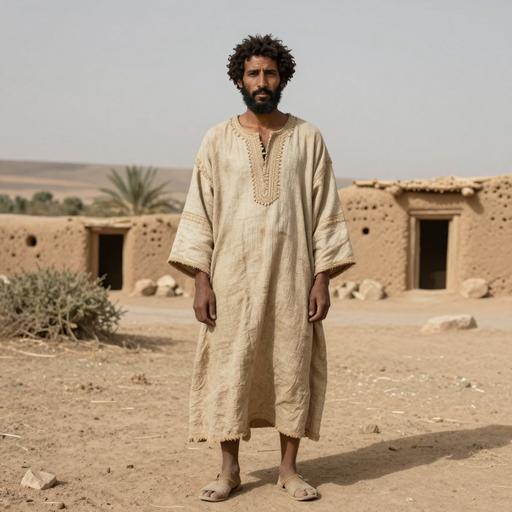
A man buried in Morocco in the Late Neolithic era

Download PDF creates a visual, rasterized copy. Use Print for selectable text and better assistive-technology support.

Loading Report

Preparing your ancestry journey

Preparing the available report content...

Your report will open automatically.

Skip to main content
Reference library / Sample profile

A man buried in Morocco in the Late Neolithic era

Explore the recorded context, genetic comparisons and research behind this reference sample.

MoroccoMorocco LN

A reference profile describes this sample. It does not establish a personal or family relationship.

AI portrait reconstruction for A man buried in Morocco in the Late Neolithic era
AI-generated artistic reconstruction, not a photograph of the individual.
Record

Sample details

Recorded details and available lineage markers.

Individual

Berber individual, Morocco

Sample ID: KEB.6

Date Range

3800 BCE - 3600 BCE

Cultural Period

Morocco LN

Biological Sex

Male

mtDNA Haplogroup

K1a4a1*

Y-DNA Haplogroup

T-L208

Social Role

Farmer (AI estimate, era-typical)

Geography

Location

Where this individual was discovered

Country Morocco
Locality Kelif el Boroud
Coordinates 33.8129, -6.8115
Chronology

Date range

When this individual lived in the broader context of human history

Berber individual, Morocco 3800 BCE - 3600 BCE
Context

Historical context

Background information associated with the reference record.

This era introduces the Late Neolithic of Morocco, a period of intensified settlement and everyday craft activity before later Bronze Age developments.

Region & Environment

Morocco spans Mediterranean-influenced coasts, Atlantic shores, and interior ranges and plateaus. Communities lived in close relationship with coastal resources, river valleys, and arable zones where rain-fed cultivation and pastoral strategies were possible.

Historical Context

Between roughly 3500 and 2500 BCE, farming and herding livelihoods were already established in many parts of North Africa. In Morocco, this Late Neolithic phase follows earlier Neolithic occupations and reflects local continuity alongside regional shifts in material culture and settlement organization.

Populations & Lifeways

Late Neolithic communities were likely small to moderately sized groups living in settlements with domestic routines centered on food production. Lifeways would have included cultivation and herding, supplemented by locally available wild resources. Household labor was organized around daily cooking, food processing, and the maintenance of stone tools and other equipment, with an emphasis on storage and reuse of materials.

Archaeology & Material Culture

Archaeological signatures of the Late Neolithic in Morocco commonly include stone tool industries, ground and worked implements, and features associated with domestic activity. Artifacts from settlements and nearby activity areas show the practical technologies used for harvesting, food preparation, and everyday construction. Pottery, when present in regional sequences, is typically part of the broader Late Neolithic assemblage used for cooking and storage.

Culture & Society

The label Moroccan Late Neolithic (within a broader “Pan-Grave Culture” complex in the dataset) points to patterned similarities in burial practices and/or material traditions recognized across parts of North Africa and neighboring regions. Within Morocco, these patterns would have been mediated by local traditions, producing shared norms alongside regional variation in how communities organized space, performed rituals, and maintained social ties.

Legacy & Transition

By the end of the Late Neolithic (around 2500 BCE), Moroccan lifeways transitioned toward later prehistoric phases in which technologies, settlement patterns, and regional connections changed. Understanding the Late Neolithic helps frame how farming societies and their material practices set the foundations for subsequent cultural developments in North Africa.

Analysis

Genetic comparisons

These comparisons show genetic similarity, not identity or origin. The populations listed are those whose genomes show statistical alignment to this ancient individual.

Similarity reflects shared history, not shared identity. These are analytical comparisons, not claims about who this person was.

Modern Genetic Admixture

This analysis compares the DNA profile with present-day reference populations, showing statistical similarity to modern reference populations from different regions. The excavation site records where this individual was found, not a fixed modern genetic identity.

Africa 51.0%
North African 38.6%
North African 35.3%
Egyptian 3.2%
Northern East African 12.5%
Ethiopian 12.5%
Europe 43.5%
Southern European 43.5%
Sardinian 22.7%
Iberian 17.1%
Italian 3.8%
Asia 5.4%
Arab, Egyptian & Levantine 4.2%
Arabian 4.2%
Chinese & Southeast Asian 1.2%
Chinese 1.2%

Closest Modern Populations

These are the modern populations showing the closest statistical alignment to A man buried in Morocco in the Late Neolithic era, ranked by genetic distance. Lower distance values indicate closer statistical similarity. Cross-region similarity can reflect shared ancestry, population movement, continuity, or later admixture.

1
Libyan Jew
7.2534
2
Algerian Jew
7.3390
3
Moroccan Jew
7.3927
4
Tunisian Jew
7.5590
5
Belmonte Jew
7.6825
6
Tunisia
7.8161
7
Turkish Sabbatean
7.9695
8
Maltese
8.6620
9
Italian Jew
8.7282
10
Bulgarian Jew
8.8260
Context

Related Samples

This individual exists within a broader network of ancient samples. No ancient genome stands alone.

Individual Culture/Period Date Location Action
Berber individual, Morocco Early Neolithic Era in Morocco 4348 BCE Ifri n'Amr or Moussa, Morocco View
Berber individual, Morocco Epipalaeolithic-Neolithic Transition in Morocco 5007 BCE Ifri n'Amr or Moussa, Morocco View
Berber individual, Morocco Epipalaeolithic-Neolithic Transition in Morocco 5211 BCE Ifri n'Amr or Moussa, Morocco View
Berber individual, Morocco Epipalaeolithic-Neolithic Transition in Morocco 5367 BCE Ifri n'Amr or Moussa, Morocco View
Berber individual, Morocco Epipalaeolithic-Neolithic Transition in Morocco 5297 BCE Ifri n'Amr or Moussa, Morocco View
Berber individual, Morocco Late Neolithic Era in Morocco 3800 BCE Kelif el Boroud, Morocco View
Berber individual, Morocco Late Neolithic Era in Morocco 3779 BCE Kelif el Boroud, Morocco View
Berber individual, Morocco Late Neolithic Era in Morocco 8400 BCE , Morocco View
Western European Neolithic individual, Spain Early Neolithic Spain 5100 BCE El Toro, Spain View
Western European Neolithic individual, Spain Early Neolithic Spain 5036 BCE El Toro, Spain View
North Africa N individual, Morocco 5211 BCE Ifri n'Amr or Moussa, Morocco View
North Africa N individual, Morocco 3779 BCE Kelif el Boroud, Morocco View
Iberia N individual, Morocco 8400 BCE , Morocco View
North Africa N individual, Morocco 5367 BCE Ifri n'Amr or Moussa, Morocco View
North Africa N individual, Morocco 5297 BCE Ifri n'Amr or Moussa, Morocco View
North Africa N individual, Morocco 5007 BCE Ifri n'Amr or Moussa, Morocco View
North Africa N individual, Morocco 3800 BCE Kelif el Boroud, Morocco View
Iberia En individual, Spain 5036 BCE El Toro, Spain View
Iberia En individual, Spain 5100 BCE El Toro, Spain View
Page 1
Individual Culture/Period Date Location Action
Berber individual, Morocco Late Neolithic Era in Morocco 3800 BCE Kelif el Boroud, Morocco View
Berber individual, Morocco Late Neolithic Era in Morocco 3779 BCE Kelif el Boroud, Morocco View
Berber individual, Morocco Late Neolithic Era in Morocco 8400 BCE , Morocco View
Page 1
Sources

References

Scientific publications and genetic data that inform this profile.

G25 Coordinates

These coordinates represent a position in genetic space, a tool for comparison, not a conclusion. You can use these to perform custom admixture analysis in G25 Studio.

KEB.6,0.03658636,0.1478323,-0.00057108,-0.06645004,0.03868712,-0.03213186,-0.00795852,0.00384618,0.054598,0.0424287,-0.00027264,0.00268456,-0.00458946,-0.01086432,-0.00393736,0.00235924,0.0116963,-0.0009124,-0.00572964,0.00076276,0.0002028,0.00027354,-0.00535602,-0.0122838,0.00049819
Continue in G25 Studio
Use code for 30% off • Expires Nov 16