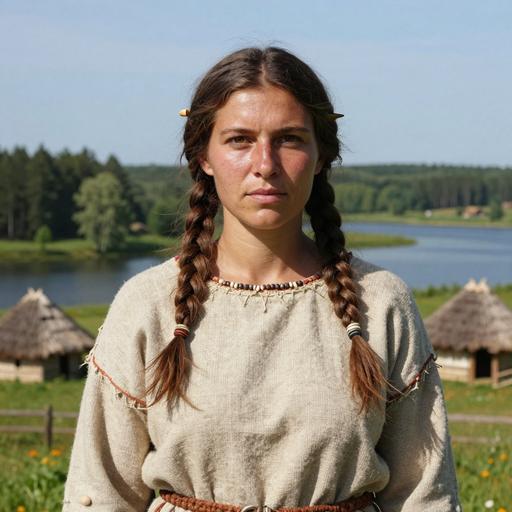
A woman buried in Latvia in the era

Download PDF creates a visual, rasterized copy. Use Print for selectable text and better assistive-technology support.

Loading Report

Preparing your ancestry journey

Preparing the available report content...

Your report will open automatically.

Skip to main content
Reference library / Sample profile

A woman buried in Latvia in the era

Explore the recorded context, genetic comparisons and research behind this reference sample.

LatviaMiddle Neolithic Baltic

A reference profile describes this sample. It does not establish a personal or family relationship.

AI portrait reconstruction for A woman buried in Latvia in the  era
AI-generated artistic reconstruction, not a photograph of the individual.
Record

Sample details

Recorded details and available lineage markers.

Individual

Baltic Mn individual, Latvia

Sample ID: I4631

Date Range

4236 BCE - 3818 BCE

Cultural Period

Middle Neolithic Baltic

Biological Sex

Female

mtDNA Haplogroup

U4

Y-DNA Haplogroup

Not available

Social Role

Gatherer (AI estimate, era-typical)

Geography

Location

Where this individual was discovered

Country Latvia
Locality Zvejnieki

A location map is not available for this record.

Chronology

Date range

When this individual lived in the broader context of human history

Baltic Mn individual, Latvia 4236 BCE - 3818 BCE
Context

Historical context

Background information associated with the reference record.

Region & Environment

The Middle Neolithic Baltic was situated in a landscape dominated by forests, river systems, lakes, and coastal zones. Wetlands and variable soils shaped settlement locations, often favoring stable access to water routes, timber, and cultivable patches.

Historical Context

By the Middle Neolithic, Neolithic lifeways were established in many areas of northern Europe, though regional trajectories differed. In the Baltic, this period reflects the continued growth and local adjustment of farming and herding practices alongside hunting and fishing.

Populations & Lifeways

Populations likely lived in relatively small, community-based settlements. Subsistence mixed agriculture with gathered and hunted resources; river and coastal environments provided fish and water-related resources that reduced risk in years when farming yields fluctuated. Daily life would have included producing ceramics, making stone tools, and using organic materials—such as wood and plant fibers—that rarely preserve in the same way as stone and clay.

Archaeology & Material Culture

Middle Neolithic material culture in the Baltic is commonly recognized through pottery styles and lithic technologies, along with settlement and burial evidence where preserved. Ceramics—often tempered and decorated in regionally distinctive ways—serve as important chronological and cultural markers. Stone tools, including ground or polished implements where present, indicate activities such as woodworking and food preparation. Settlement debris and features can help reconstruct how communities used the landscape over repeated generations.

Culture & Society

Cultural identity is often visible through patterned choices in ceramic decoration and tool types, suggesting shared traditions among neighboring groups. Social learning and mobility are typically inferred at a high level from similarities in material style, without assuming direct political unity.

Legacy & Transition

Toward the later Neolithic, changing ceramic traditions and shifts in subsistence strategies mark transitions toward subsequent cultural developments in the Baltic. The Middle Neolithic legacy lies in the consolidation of Neolithic practices—especially pottery-based household production and the long-term use of settlement zones near water—which continued to shape later lifeways.

Analysis

Genetic comparisons

These comparisons show genetic similarity, not identity or origin. The populations listed are those whose genomes show statistical alignment to this ancient individual.

Similarity reflects shared history, not shared identity. These are analytical comparisons, not claims about who this person was.

Modern Genetic Admixture

This analysis compares the DNA profile with present-day reference populations, showing statistical similarity to modern reference populations from different regions. The excavation site records where this individual was found, not a fixed modern genetic identity.

Europe 92.5%
Eastern European 56.1%
Northwestern European 36.4%
Finnish 28.2%
Scandinavian 8.3%
America 7.5%
America 7.5%
Native American 7.5%

Closest Modern Populations

These are the modern populations showing the closest statistical alignment to A woman buried in Latvia in the era, ranked by genetic distance. Lower distance values indicate closer statistical similarity. Cross-region similarity can reflect shared ancestry, population movement, continuity, or later admixture.

1
Russian Leshukonsky
3.3738
2
Komi A
3.6877
3
Russian Pinezhsky
4.0192
4
Russian Pinega
4.1634
5
Tatar Mishar
4.6610
6
Vepsian
4.7706
7
Russian Krasnoborsky
4.8485
8
Karelian
5.0738
9
Finnish North
5.3195
10
Mordovian
5.3493
Context

Related Samples

This individual exists within a broader network of ancient samples. No ancient genome stands alone.

Individual Culture/Period Date Location Action
Proto-Indo-European individual, Ukraine Neolithic Ukraine 5400 BCE Vovnigi, Ukraine View
European Hunter-Gatherers individual, Latvia Hunter-Gatherer Latvia 5838 BCE Zvejnieki, Latvia View
European Neolithic individual, Latvia Middle Neolithic Comb Ware Culture, Latvia 4236 BCE Zvejnieki, Latvia View
Eastern European Hunter-Gatherers individual, Ukraine Mesolithic Ukraine 9107 BCE Vasylivka-3 (Zaporizhia Oblast, Vasylivka District, Vasylivska municipality), Ukraine View
Proto-Indo-European individual, Ukraine Neolithic Ukraine 5400 BCE Vovnihy-2 (Dnipropetrovsk Oblast, Dnipro District, Solone municipality), Ukraine View
Baltic Hunter-Gatherers individual, Latvia Middle Neolithic Latvia 4311 BCE Zvejnieki (Zemgale, Neretas District), Latvia View
Pre-Baltic individual, Latvia Latvian Mesolithic Culture 5304 BCE Zvejnieki (Zemgale, Neretas District), Latvia View
MN Comb Ware individual, Latvia Middle Neolithic Comb Ware Culture, Latvia 4236 BCE Zvejnieki (Zemgale, Neretas District), Latvia View
Middle Mesolithic Kunda individual, Latvia Latvian Mesolithic Culture 6465 BCE Zvejnieki (Zemgale, Neretas District), Latvia View
Ukraine M individual, Ukraine 9107 BCE Vasil'evka, Ukraine View
Ukraine N individual, Ukraine 5400 BCE Vovnigi, Ukraine View
Baltic Hg individual, Latvia 5838 BCE Zvejnieki, Latvia View
Baltic Mn individual, Latvia 4311 BCE Zvejnieki, Latvia View
Baltic Hg individual, Latvia 5304 BCE Zvejnieki, Latvia View
Baltic Ln individual, Latvia 3091 BCE Zvejnieki, Latvia View
Baltic Mn individual, Latvia 4236 BCE Zvejnieki, Latvia View
Baltic Hg individual, Latvia 6465 BCE Zvejnieki, Latvia View
Ukraine M individual, Ukraine 9107 BCE Vasil'evka, Ukraine View
Baltic Hg individual, Latvia 6465 BCE Zvejnieki, Latvia View
Baltic Hg individual, Latvia 5304 BCE Zvejnieki, Latvia View
Baltic Ln individual, Latvia 3091 BCE Zvejnieki, Latvia View
Baltic Mn individual, Latvia 4311 BCE Zvejnieki, Latvia View
Page 1
Individual Culture/Period Date Location Action
Baltic Mn individual, Latvia 4311 BCE Zvejnieki, Latvia View
Baltic Mn individual, Latvia 4236 BCE Zvejnieki, Latvia View
Baltic Mn individual, Latvia 4311 BCE Zvejnieki, Latvia View
Page 1
Sources

References

Scientific publications and genetic data that inform this profile.

G25 Coordinates

These coordinates represent a position in genetic space, a tool for comparison, not a conclusion. You can use these to perform custom admixture analysis in G25 Studio.

I4631,0.11982422,0.04804878,0.08657922,0.07219088,0.01087198,0.0192841,-0.00520606,-0.00229588,-0.0055822,-0.03331182,0.00830822,-0.00899568,0.01589436,0.00309962,-0.00953146,-0.00920386,-0.00505176,-0.00354358,-0.0050025,-0.00675196,0.00038722,0.00144188,-0.01401496,0.0057693,-0.00275382
Continue in G25 Studio
Use code for 30% off • Expires Nov 16