A woman buried in Latvia in the era

Download PDF creates a visual, rasterized copy. Use Print for selectable text and better assistive-technology support.

Loading Report

Preparing your ancestry journey

Preparing the available report content...

Your report will open automatically.

Skip to main content
Reference library / Sample profile

A woman buried in Latvia in the era

Explore the recorded context, genetic comparisons and research behind this reference sample.

LatviaLate Neolithic Baltic

A reference profile describes this sample. It does not establish a personal or family relationship.

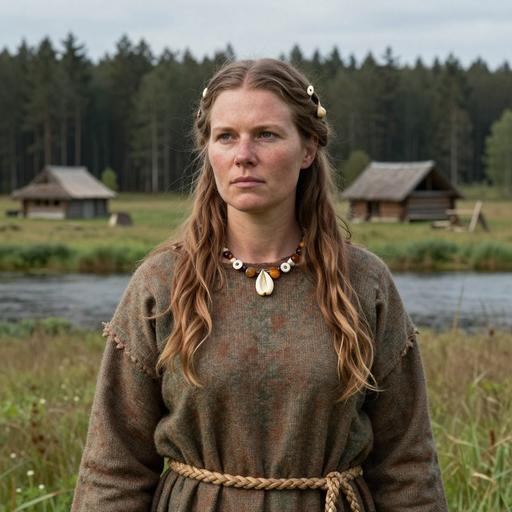
AI portrait reconstruction for A woman buried in Latvia in the  era
AI-generated artistic reconstruction, not a photograph of the individual.
Record

Sample details

Recorded details and available lineage markers.

Individual

Baltic Ln individual, Latvia

Sample ID: I4629

Date Range

3091 BCE - 2671 BCE

Cultural Period

Late Neolithic Baltic

Biological Sex

Female

mtDNA Haplogroup

U5a1b

Y-DNA Haplogroup

Not available

Social Role

Farmer (AI estimate, era-typical)

Geography

Location

Where this individual was discovered

Country Latvia
Locality Zvejnieki

A location map is not available for this record.

Chronology

Date range

When this individual lived in the broader context of human history

Baltic Ln individual, Latvia 3091 BCE - 2671 BCE
Context

Historical context

Background information associated with the reference record.

In the Late Neolithic Baltic, communities occupied a mosaic of environments across what is now the Baltic Sea region. Forests, wetlands, and fertile patches supported mixed strategies that typically combined farming with hunting and fishing, while coastlines and navigable waterways provided routes for exchange.

Region & Environment

The Baltic “late Neolithic” is best understood as a broad zone rather than a single polity. People lived alongside lakes, rivers, boglands, and coastal areas where fish, waterfowl, and game could supplement cultivars. Seasonal movement within territories is commonly inferred from settlement patterns and site types, though the specific rhythms varied by locality.

Historical Context

This period falls after earlier Neolithic lifeways had taken root. Communities were part of wider interaction networks that carried technologies and stylistic influences across the region. Over time, local social identities and material traditions remained visible in how people built settlements, manufactured tools, and decorated pottery.

Populations & Lifeways

The population is usually envisioned as small-scale farming communities organized at the level of households and villages. Diet likely blended cultivated plants and domestic animals with foraged resources such as fish and game. Lifeways would have included field maintenance, storage of food, craft production (notably ceramic and lithic work), and seasonal activities tied to local water and forest resources.

Archaeology & Material Culture

Archaeological visibility in the Late Neolithic Baltic commonly comes from settlements, cemeteries, and findspots associated with everyday tasks and burial practices. Material culture often emphasizes:

  • Pottery styles and decorative techniques used to signal local tradition
  • Lithic industries, including chipped-stone toolkits for cutting, scraping, and woodworking
  • Ground stone implements associated with processing and craft activities Preservation and regional survey intensity affect what is known, so interpretations should remain cautious where site samples are small.

Culture & Society

Social organization is not directly recoverable from material alone, but durable stylistic choices in ceramics and recurring patterns in site layout suggest shared norms within local groups. Communication and exchange—likely along rivers and the Baltic coast—help explain why some features and styles resonate across broader areas.

Legacy & Transition

Late Neolithic practices created the foundations for subsequent Bronze Age developments. Shifts in metal use, changing trade networks, and evolving mortuary and settlement patterns mark the transition, but the exact pathways vary by sub-region. What remains clear is that regional traditions and knowledge of land use persisted even as new technologies and cultural forms emerged.

Analysis

Genetic comparisons

These comparisons show genetic similarity, not identity or origin. The populations listed are those whose genomes show statistical alignment to this ancient individual.

Similarity reflects shared history, not shared identity. These are analytical comparisons, not claims about who this person was.

Modern Genetic Admixture

This analysis compares the DNA profile with present-day reference populations, showing statistical similarity to modern reference populations from different regions. The excavation site records where this individual was found, not a fixed modern genetic identity.

Europe 88.6%
Eastern European 54.0%
Northwestern European 34.7%
English 28.5%
Finnish 5.1%
Northwestern European 1.1%
Asia 10.4%
Central Asian, Northern Indian & Pakistani 10.4%
Pakistan 10.4%
America 1.0%
America 1.0%
Native American 1.0%

Closest Modern Populations

These are the modern populations showing the closest statistical alignment to A woman buried in Latvia in the era, ranked by genetic distance. Lower distance values indicate closer statistical similarity. Cross-region similarity can reflect shared ancestry, population movement, continuity, or later admixture.

1
Tatar Mishar
5.1474
2
Moksha
5.3265
3
Mordovian
5.4209
4
Erzya
5.5341
5
Russian Kostroma
5.7399
6
Russian Krasnoborsky
5.7448
7
Finnish Southwest
5.8927
8
Finnish Central
5.9354
9
Finnish North
6.1148
10
Ingrian
6.4131
Context

Related Samples

This individual exists within a broader network of ancient samples. No ancient genome stands alone.

Individual Culture/Period Date Location Action
Proto-Indo-European individual, Ukraine Neolithic Ukraine 5400 BCE Vovnigi, Ukraine View
European Hunter-Gatherers individual, Latvia Hunter-Gatherer Latvia 5838 BCE Zvejnieki, Latvia View
European Neolithic individual, Latvia Middle Neolithic Comb Ware Culture, Latvia 4236 BCE Zvejnieki, Latvia View
Eastern European Hunter-Gatherers individual, Ukraine Mesolithic Ukraine 9107 BCE Vasylivka-3 (Zaporizhia Oblast, Vasylivka District, Vasylivska municipality), Ukraine View
Proto-Indo-European individual, Ukraine Neolithic Ukraine 5400 BCE Vovnihy-2 (Dnipropetrovsk Oblast, Dnipro District, Solone municipality), Ukraine View
Baltic Hunter-Gatherers individual, Latvia Middle Neolithic Latvia 4311 BCE Zvejnieki (Zemgale, Neretas District), Latvia View
Pre-Baltic individual, Latvia Latvian Mesolithic Culture 5304 BCE Zvejnieki (Zemgale, Neretas District), Latvia View
MN Comb Ware individual, Latvia Middle Neolithic Comb Ware Culture, Latvia 4236 BCE Zvejnieki (Zemgale, Neretas District), Latvia View
Middle Mesolithic Kunda individual, Latvia Latvian Mesolithic Culture 6465 BCE Zvejnieki (Zemgale, Neretas District), Latvia View
Ukraine M individual, Ukraine 9107 BCE Vasil'evka, Ukraine View
Ukraine N individual, Ukraine 5400 BCE Vovnigi, Ukraine View
Baltic Hg individual, Latvia 5838 BCE Zvejnieki, Latvia View
Baltic Mn individual, Latvia 4311 BCE Zvejnieki, Latvia View
Baltic Hg individual, Latvia 5304 BCE Zvejnieki, Latvia View
Baltic Ln individual, Latvia 3091 BCE Zvejnieki, Latvia View
Baltic Mn individual, Latvia 4236 BCE Zvejnieki, Latvia View
Baltic Hg individual, Latvia 6465 BCE Zvejnieki, Latvia View
Ukraine M individual, Ukraine 9107 BCE Vasil'evka, Ukraine View
Baltic Hg individual, Latvia 6465 BCE Zvejnieki, Latvia View
Baltic Hg individual, Latvia 5304 BCE Zvejnieki, Latvia View
Baltic Ln individual, Latvia 3091 BCE Zvejnieki, Latvia View
Baltic Mn individual, Latvia 4311 BCE Zvejnieki, Latvia View
Page 1
Individual Culture/Period Date Location Action
Baltic Ln individual, Latvia 3091 BCE Zvejnieki, Latvia View
Baltic Ln individual, Estonia 2575 BCE Kursi. Jõgeva, Estonia View
Baltic Ln individual, Latvia 3091 BCE Zvejnieki, Latvia View
Baltic Ln individual, Estonia 2575 BCE Kursi. Jõgeva, Estonia View
Baltic Ln individual, Lithuania 2620 BCE Gyvakarai, Lithuania View
Page 1
Sources

References

Scientific publications and genetic data that inform this profile.

G25 Coordinates

These coordinates represent a position in genetic space, a tool for comparison, not a conclusion. You can use these to perform custom admixture analysis in G25 Studio.

I4629,0.12019938,0.07511576,0.05202332,0.05675186,0.01067236,0.01880202,0.0063143,0.01033534,-0.00303704,-0.01744066,0.00228408,-0.00290434,0.00249178,-0.00879868,0.00436784,-0.0065178,-0.01609574,-4.028E-05,-0.00668578,-0.00891078,-0.00058546,0.00504612,-0.00910704,0.00913752,-0.00188922
Continue in G25 Studio
Use code for 30% off • Expires Nov 16