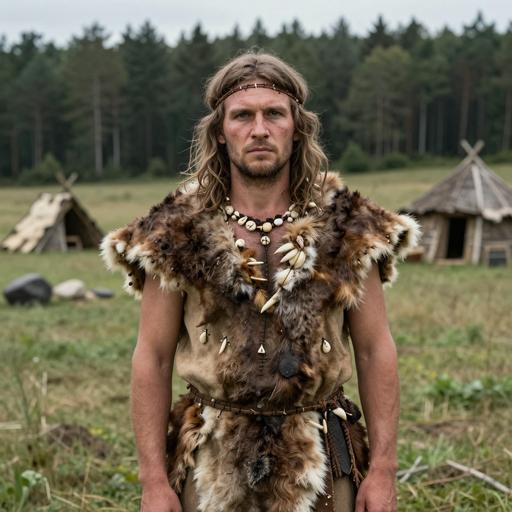
A man buried in Ukraine in the era

Download PDF creates a visual, rasterized copy. Use Print for selectable text and better assistive-technology support.

Loading Report

Preparing your ancestry journey

Preparing the available report content...

Your report will open automatically.

Skip to main content
Reference library / Sample profile

A man buried in Ukraine in the era

Explore the recorded context, genetic comparisons and research behind this reference sample.

UkraineThe Mesolithic Period in Ukraine

A reference profile describes this sample. It does not establish a personal or family relationship.

AI portrait reconstruction for A man buried in Ukraine in the  era
AI-generated artistic reconstruction, not a photograph of the individual.
Record

Sample details

Recorded details and available lineage markers.

Individual

Ukraine M individual, Ukraine

Sample ID: I1819

Date Range

9107 BCE - 8556 BCE

Cultural Period

The Mesolithic Period in Ukraine

Biological Sex

Male

mtDNA Haplogroup

U5b2e*

Y-DNA Haplogroup

R-M459

Social Role

Hunter (AI estimate, era-typical)

Geography

Location

Where this individual was discovered

Country Ukraine
Locality Vasil'evka
Coordinates 48.3000, 35.1400
Chronology

Date range

When this individual lived in the broader context of human history

Ukraine M individual, Ukraine 9107 BCE - 8556 BCE
Context

Historical context

Background information associated with the reference record.

Region & Environment

Mesolithic Ukraine was shaped by the aftermath of the last glacial period, with environments gradually stabilizing into post-glacial forests, wetlands, and open areas. River systems and varied ecological zones offered shifting opportunities for hunting and foraging.

As climates warmed, the distribution of plants and animals changed, influencing where groups camped and when they moved.

Historical Context

The Mesolithic is a long archaeological interval rather than a single political era. In this time, communities continued to rely primarily on hunting and gathering, while steadily adjusting to environmental and ecological change.

Populations & Lifeways

Populations were primarily mobile hunter-gatherers. Lifeways likely included seasonal movements to exploit fish, game, and plant resources as they became available.

Archaeological evidence for repeated use of particular landscapes suggests planning around seasonal cycles, with some sites functioning as short-term task areas and others as longer-use camps.

Archaeology & Material Culture

Stone tools are the most common Mesolithic evidence, including implements suited to hunting and processing tasks. Toolkits often show adaptation to local raw material availability and to changing subsistence targets.

Preservation varies, so organic artifacts such as wood and fiber items may survive only under favorable conditions, but the overall pattern is one of light, versatile technologies appropriate for mobile lifestyles.

Culture & Society

Mesolithic communities likely maintained knowledge of landscapes and resource patterns, enabling cooperation during seasonal activities. Shared stylistic features in stone tool assemblages across regions can indicate communication networks or shared traditions.

Social organization would have been flexible, with group size and mobility patterns responding to local resources and environmental conditions.

Legacy & Transition

As the Mesolithic progressed into the Neolithic, some areas of Ukraine saw increasing reliance on farming and domesticated resources. The Mesolithic record therefore marks the background stage for later shifts toward village life and ceramic technologies, grounded in long experience of adapting to changing environments.

Analysis

Genetic comparisons

These comparisons show genetic similarity, not identity or origin. The populations listed are those whose genomes show statistical alignment to this ancient individual.

Similarity reflects shared history, not shared identity. These are analytical comparisons, not claims about who this person was.

Modern Genetic Admixture

This analysis compares the DNA profile with present-day reference populations, showing statistical similarity to modern reference populations from different regions. The excavation site records where this individual was found, not a fixed modern genetic identity.

Europe 96.3%
Eastern European 51.4%
Northwestern European 45.0%
Finnish 20.4%
Scandinavian 11.5%
English 11.4%
Northwestern European 1.8%
America 3.3%
America 3.3%
Native American 3.3%

Closest Modern Populations

These are the modern populations showing the closest statistical alignment to A man buried in Ukraine in the era, ranked by genetic distance. Lower distance values indicate closer statistical similarity. Cross-region similarity can reflect shared ancestry, population movement, continuity, or later admixture.

1
Russian Krasnoborsky
2.4375
2
Russian Kostroma
2.6480
3
Karelian
2.7435
4
Vepsian
2.7929
5
Finnish Central
2.9855
6
Finnish North
2.9879
7
Mordovian
3.0214
8
Russian Pinega
3.0366
9
Russian Pinezhsky
3.1364
10
Erzya
3.2032
Context

Related Samples

This individual exists within a broader network of ancient samples. No ancient genome stands alone.

Individual Culture/Period Date Location Action
Proto-Indo-European individual, Ukraine Neolithic Ukraine 5400 BCE Vovnigi, Ukraine View
European Hunter-Gatherers individual, Latvia Hunter-Gatherer Latvia 5838 BCE Zvejnieki, Latvia View
European Neolithic individual, Latvia Middle Neolithic Comb Ware Culture, Latvia 4236 BCE Zvejnieki, Latvia View
Eastern European Hunter-Gatherers individual, Ukraine Mesolithic Ukraine 9107 BCE Vasylivka-3 (Zaporizhia Oblast, Vasylivka District, Vasylivska municipality), Ukraine View
Proto-Indo-European individual, Ukraine Neolithic Ukraine 5400 BCE Vovnihy-2 (Dnipropetrovsk Oblast, Dnipro District, Solone municipality), Ukraine View
Baltic Hunter-Gatherers individual, Latvia Middle Neolithic Latvia 4311 BCE Zvejnieki (Zemgale, Neretas District), Latvia View
Pre-Baltic individual, Latvia Latvian Mesolithic Culture 5304 BCE Zvejnieki (Zemgale, Neretas District), Latvia View
MN Comb Ware individual, Latvia Middle Neolithic Comb Ware Culture, Latvia 4236 BCE Zvejnieki (Zemgale, Neretas District), Latvia View
Middle Mesolithic Kunda individual, Latvia Latvian Mesolithic Culture 6465 BCE Zvejnieki (Zemgale, Neretas District), Latvia View
Ukraine M individual, Ukraine 9107 BCE Vasil'evka, Ukraine View
Ukraine N individual, Ukraine 5400 BCE Vovnigi, Ukraine View
Baltic Hg individual, Latvia 5838 BCE Zvejnieki, Latvia View
Baltic Mn individual, Latvia 4311 BCE Zvejnieki, Latvia View
Baltic Hg individual, Latvia 5304 BCE Zvejnieki, Latvia View
Baltic Ln individual, Latvia 3091 BCE Zvejnieki, Latvia View
Baltic Mn individual, Latvia 4236 BCE Zvejnieki, Latvia View
Baltic Hg individual, Latvia 6465 BCE Zvejnieki, Latvia View
Ukraine M individual, Ukraine 9107 BCE Vasil'evka, Ukraine View
Baltic Hg individual, Latvia 6465 BCE Zvejnieki, Latvia View
Baltic Hg individual, Latvia 5304 BCE Zvejnieki, Latvia View
Baltic Ln individual, Latvia 3091 BCE Zvejnieki, Latvia View
Baltic Mn individual, Latvia 4311 BCE Zvejnieki, Latvia View
Page 1
Individual Culture/Period Date Location Action
Ukraine M individual, Ukraine 9107 BCE Vasil'evka, Ukraine View
Ukraine M individual, Ukraine 8543 BCE Vasil'evka, Ukraine View
Ukraine M individual, Ukraine 6392 BCE Dereivka I, Ukraine View
Page 1
Sources

References

Scientific publications and genetic data that inform this profile.

G25 Coordinates

These coordinates represent a position in genetic space, a tool for comparison, not a conclusion. You can use these to perform custom admixture analysis in G25 Studio.

I1819,0.124756,0.07611694,0.0845833,0.07122216,0.02190938,0.02332858,0.00467716,0.01001986,-0.00375112,-0.03138982,0.0058214,-0.00754442,0.014595,0.00400908,-0.0056608,-0.0065337,-0.00420924,-0.00322038,-0.00280164,-0.00476048,0.00144282,0.0001632,-0.01138338,0.00697948,-0.00164885
Continue in G25 Studio
Use code for 30% off • Expires Nov 16