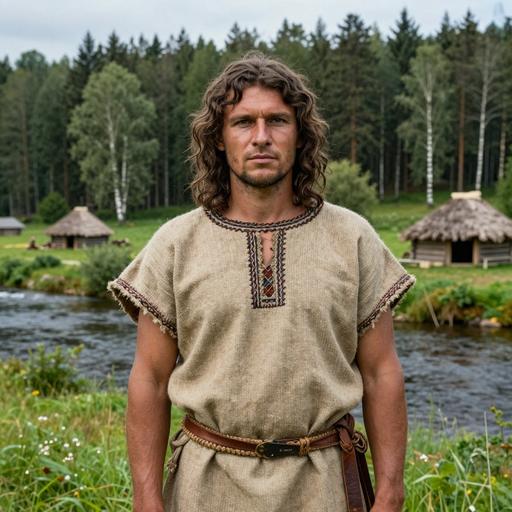
A man buried in Latvia in the Middle Neolithic era

Download PDF creates a visual, rasterized copy. Use Print for selectable text and better assistive-technology support.

Loading Report

Preparing your ancestry journey

Preparing the available report content...

Your report will open automatically.

Skip to main content
Reference library / Sample profile

A man buried in Latvia in the Middle Neolithic era

Explore the recorded context, genetic comparisons and research behind this reference sample.

LatviaMiddle Neolithic Latvia

A reference profile describes this sample. It does not establish a personal or family relationship.

AI portrait reconstruction for A man buried in Latvia in the Middle Neolithic era
AI-generated artistic reconstruction, not a photograph of the individual.
Record

Sample details

Recorded details and available lineage markers.

Individual

Baltic Hunter-Gatherers individual, Latvia

Sample ID: Latvia_MN1

Date Range

4311 BCE - 3978 BCE

Cultural Period

Middle Neolithic Latvia

Biological Sex

Male

mtDNA Haplogroup

U4a1

Y-DNA Haplogroup

R-P297

Social Role

Gatherer (AI estimate, era-typical)

Geography

Location

Where this individual was discovered

Country Latvia
Locality Zvejnieki (Zemgale, Neretas District)
Coordinates 56.2833, 25.1333
Chronology

Date range

When this individual lived in the broader context of human history

Baltic Hunter-Gatherers individual, Latvia 4311 BCE - 3978 BCE
Context

Historical context

Background information associated with the reference record.

The Middle Neolithic period in Latvia, generally spanning from around 4000 to 2000 BCE, is characterized by the presence and influence of Baltic hunter-gatherer communities. During this era, the region that we now know as Latvia was dominated by this prehistoric group, who were adept at utilizing the abundant natural resources provided by the temperate forests, rivers, and the expansive coastline of the eastern Baltic Sea.

Environment and Geography

Middle Neolithic Latvia was marked by a diverse landscape that included dense forests, numerous rivers, and fertile coastal areas. This environment was rich in resources, which significantly impacted the lifestyle and culture of the hunter-gatherer communities. The lush woodlands were populated with a variety of flora and fauna, providing ample opportunities for hunting and foraging. Rivers and lakes were teeming with fish, and the Baltic Sea offered maritime resources, encouraging a semi-sedentary lifestyle based around seasonal migration within their territories.

Subsistence and Economy

The Baltic hunter-gatherers continued to rely heavily on hunting, fishing, and gathering, but there was a gradual shift towards more sedentary settlement patterns as they began to exploit the region's rich natural resources more intensively. Archaeological evidence, such as bone assemblages and artifacts, suggests that they hunted deer, wild boar, and beaver, while fishing remained a crucial part of their diet, with pike, perch, and other fish being staples. Plant gathering also played a significant role, with evidence of hazelnuts, berries, and tubers being part of their diet.

Technology and Tools

The technological toolkit of Middle Neolithic Baltic hunter-gatherers saw gradual advancements. Stone tools remained prevalent, with flint being a favored material for crafting sharp implements like arrowheads, scrapers, and knives. The period also saw the introduction of pottery, a significant innovation that provided new ways of storing and cooking food. Pottery styles were typically simple but began to incorporate distinctive decoration styles, such as comb-impressed patterns, which indicate a growing sense of cultural identity and aesthetic development.

Social Structure and Settlements

The social structure of these communities is less well understood but is thought to have been relatively egalitarian, typical of hunter-gatherer societies. However, the development of more permanent settlements during this period suggests some level of social organization and cooperation. Settlements were usually situated near water sources, reflecting the importance of fishing and easy access to water routes for transportation and trade. Excavated sites have uncovered evidence of semi-subterranean dwellings, reflecting adaptations to the climate and environment.

Culture and Beliefs

The cultural practices and beliefs of Middle Neolithic Latvian hunter-gatherers remain largely speculative, but archaeological findings suggest some engagement with ritualistic or symbolic behavior. The burial practices during this time became more elaborate, with bodies often interred alongside tools, ornaments, and other grave goods indicating a belief in an afterlife or the symbolic importance of certain items.

Interaction and Trade

There is evidence that these communities engaged in trade or interaction with neighboring groups, as indicated by the presence of non-local materials such as amber and exotic stones found in archaeological sites. These items may have served not just as trade goods but also as items of social or cultural significance within the community. This trade network indicates a broader interaction sphere encompassing parts of the Baltic region, suggesting that these communities were not isolated but engaged in long-distance exchanges.

Conclusion

The Middle Neolithic period in Latvia represents a pivotal era in the region's prehistoric development. The Baltic hunter-gatherers of this time were marked by a balance between traditional subsistence strategies and gradual societal advancements that set the stage for more profound changes during the ensuing Late Neolithic period. As such, they were a vital link in the prehistoric chain that led to the more complex societies that would emerge in the Baltic region in subsequent millennia.

Analysis

Genetic comparisons

These comparisons show genetic similarity, not identity or origin. The populations listed are those whose genomes show statistical alignment to this ancient individual.

Similarity reflects shared history, not shared identity. These are analytical comparisons, not claims about who this person was.

Modern Genetic Admixture

This analysis compares the DNA profile with present-day reference populations, showing statistical similarity to modern reference populations from different regions. The excavation site records where this individual was found, not a fixed modern genetic identity.

Europe 99.4%
Northwestern European 69.3%
Scandinavian 34.3%
Finnish 29.4%
English 5.6%
Eastern European 30.1%
Africa 0.6%
West African 0.6%
Nigerian 0.6%

Closest Modern Populations

These are the modern populations showing the closest statistical alignment to A man buried in Latvia in the Middle Neolithic era, ranked by genetic distance. Lower distance values indicate closer statistical similarity. Cross-region similarity can reflect shared ancestry, population movement, continuity, or later admixture.

1
Estonian
2.6030
2
Polish Kashubian
3.0625
3
Russian Pskov
3.2629
4
Russian Kaluga
3.3276
5
Russian Kursk
3.4415
6
Russian Tver
3.4572
7
Russian Yaroslavl
3.4786
8
Finnish Southwest
3.4940
9
Lithuanian PA
3.5718
10
Russian Voronez
3.5764
Context

Related Samples

This individual exists within a broader network of ancient samples. No ancient genome stands alone.

Individual Culture/Period Date Location Action
Proto-Indo-European individual, Ukraine Neolithic Ukraine 5400 BCE Vovnigi, Ukraine View
European Hunter-Gatherers individual, Latvia Hunter-Gatherer Latvia 5838 BCE Zvejnieki, Latvia View
European Neolithic individual, Latvia Middle Neolithic Comb Ware Culture, Latvia 4236 BCE Zvejnieki, Latvia View
Eastern European Hunter-Gatherers individual, Ukraine Mesolithic Ukraine 9107 BCE Vasylivka-3 (Zaporizhia Oblast, Vasylivka District, Vasylivska municipality), Ukraine View
Proto-Indo-European individual, Ukraine Neolithic Ukraine 5400 BCE Vovnihy-2 (Dnipropetrovsk Oblast, Dnipro District, Solone municipality), Ukraine View
Baltic Hunter-Gatherers individual, Latvia Middle Neolithic Latvia 4311 BCE Zvejnieki (Zemgale, Neretas District), Latvia View
Pre-Baltic individual, Latvia Latvian Mesolithic Culture 5304 BCE Zvejnieki (Zemgale, Neretas District), Latvia View
MN Comb Ware individual, Latvia Middle Neolithic Comb Ware Culture, Latvia 4236 BCE Zvejnieki (Zemgale, Neretas District), Latvia View
Middle Mesolithic Kunda individual, Latvia Latvian Mesolithic Culture 6465 BCE Zvejnieki (Zemgale, Neretas District), Latvia View
Ukraine M individual, Ukraine 9107 BCE Vasil'evka, Ukraine View
Ukraine N individual, Ukraine 5400 BCE Vovnigi, Ukraine View
Baltic Hg individual, Latvia 5838 BCE Zvejnieki, Latvia View
Baltic Mn individual, Latvia 4311 BCE Zvejnieki, Latvia View
Baltic Hg individual, Latvia 5304 BCE Zvejnieki, Latvia View
Baltic Ln individual, Latvia 3091 BCE Zvejnieki, Latvia View
Baltic Mn individual, Latvia 4236 BCE Zvejnieki, Latvia View
Baltic Hg individual, Latvia 6465 BCE Zvejnieki, Latvia View
Ukraine M individual, Ukraine 9107 BCE Vasil'evka, Ukraine View
Baltic Hg individual, Latvia 6465 BCE Zvejnieki, Latvia View
Baltic Hg individual, Latvia 5304 BCE Zvejnieki, Latvia View
Baltic Ln individual, Latvia 3091 BCE Zvejnieki, Latvia View
Baltic Mn individual, Latvia 4311 BCE Zvejnieki, Latvia View
Page 1
Individual Culture/Period Date Location Action
MN-3 individual, Latvia Middle Neolithic Latvia 4214 BCE Zvejnieki, Latvia View
MN-2 individual, Latvia Middle Neolithic Latvia 4318 BCE Zvejnieki, Latvia View
EMN individual, Latvia Middle Neolithic Latvia 4330 BCE Zvejnieki, Latvia View
MN-3 individual, Latvia Middle Neolithic Latvia 4048 BCE Zvejnieki, Latvia View
Baltic Hunter-Gatherers individual, Latvia Middle Neolithic Latvia 4311 BCE Zvejnieki, Latvia View
Baltic Hunter-Gatherers individual, Latvia Middle Neolithic Latvia 4311 BCE Zvejnieki (Zemgale, Neretas District), Latvia View
Page 1
Sources

References

Scientific publications and genetic data that inform this profile.

G25 Coordinates

These coordinates represent a position in genetic space, a tool for comparison, not a conclusion. You can use these to perform custom admixture analysis in G25 Studio.

Latvia_MN1,0.13182192,0.11771702,0.08444642,0.07308378,0.03960166,0.0315603,0.00772774,0.01549788,-0.00045668,-0.02782422,0.00018134,-0.0048393,0.01124078,0.00962096,0.0027725,0.00022592,-0.00067608,-0.00228278,0.00342174,0.00054474,0.00363826,-0.00322866,-0.00467958,0.00898546,0.00116264
Continue in G25 Studio
Use code for 30% off • Expires Nov 16