A man buried in Ireland in the era

Download PDF creates a visual, rasterized copy. Use Print for selectable text and better assistive-technology support.

Loading Report

Preparing your ancestry journey

Preparing the available report content...

Your report will open automatically.

Skip to main content
Reference library / Sample profile

A man buried in Ireland in the era

Explore the recorded context, genetic comparisons and research behind this reference sample.

IrelandEarly Bronze Age Britain

A reference profile describes this sample. It does not establish a personal or family relationship.

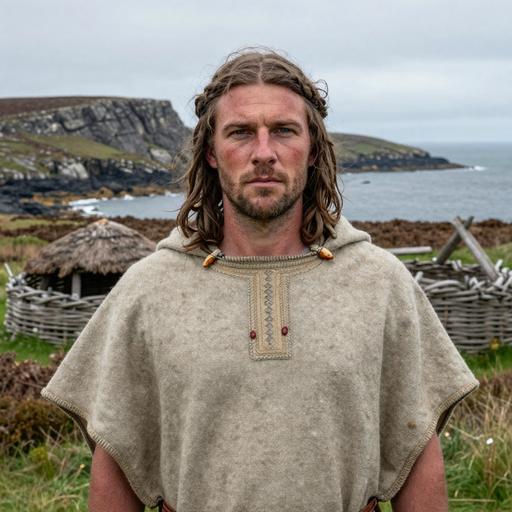
AI portrait reconstruction for A man buried in Ireland in the  era
AI-generated artistic reconstruction, not a photograph of the individual.
Record

Sample details

Recorded details and available lineage markers.

Individual

Britain Ca Eba individual, Ireland

Sample ID: rath2

Date Range

2026 BCE - 1700 BCE

Cultural Period

Early Bronze Age Britain

Biological Sex

Male

mtDNA Haplogroup

U5b2a2

Y-DNA Haplogroup

R-DF21

Social Role

Pastoralist (AI estimate, era-typical)

Geography

Location

Where this individual was discovered

Country Ireland
Locality Rathlin Island. County Antrim

A location map is not available for this record.

Chronology

Date range

When this individual lived in the broader context of human history

Britain Ca Eba individual, Ireland 2026 BCE - 1700 BCE
Context

Historical context

Background information associated with the reference record.

The Early Bronze Age in Britain covers the transition from the late third to the mid-second millennium BCE and is characterized by the spread and normalization of bronze technology, alongside shifts in how communities expressed status and managed land. Material culture shows both continuity with earlier Neolithic and Beaker-era developments and distinct Bronze Age changes in pottery, metalwork, and monument building.

Region & Environment

Britain’s varied landscapes—from fertile lowlands to upland and coastal zones—supported mixed farming and pastoralism. Soil quality, rainfall patterns, and access to waterways would have influenced where communities settled and how they used fields and pasture.

Historical Context

In the early Bronze Age, bronze metallurgy became increasingly important, and exchange networks connected Britain with broader European corridors. These connections are visible indirectly through similarities in artifacts and metal compositions, though the exact mechanisms of contact vary by region.

Populations & Lifeways

Most people lived in small agricultural communities practicing cultivation and herding, with seasonal rhythms affecting land use. Evidence for more visible social differentiation appears in burial and monument contexts, suggesting that wealth and craft expertise could be emphasized through funerary display and construction.

Archaeology & Material Culture

Typical material signatures include bronze tools and ornaments, new ceramic styles, and changing monument forms such as barrows and related funerary structures. Settlement remains are often less conspicuous than burial evidence, but artifact scatters and domestic features at some sites indicate continued farming and household craft.

Culture & Society

Bronze Age society is frequently reconstructed through mortuary practice and monument building, where certain individuals or groups were singled out. The growth of craft and metalworking capabilities implies specialist knowledge and potentially hierarchical relationships within communities.

Legacy & Transition

The Early Bronze Age helped establish the technological and social frameworks that shaped later Bronze Age developments in Britain. By the end of this period, changing artifact styles, monument preferences, and regional interaction patterns signal a transition into subsequent phases of the Bronze Age.

Analysis

Genetic comparisons

These comparisons show genetic similarity, not identity or origin. The populations listed are those whose genomes show statistical alignment to this ancient individual.

Similarity reflects shared history, not shared identity. These are analytical comparisons, not claims about who this person was.

Modern Genetic Admixture

This analysis compares the DNA profile with present-day reference populations, showing statistical similarity to modern reference populations from different regions. The excavation site records where this individual was found, not a fixed modern genetic identity.

Europe 90.3%
Northwestern European 61.1%
English 45.2%
Scandinavian 9.7%
Northwestern European 4.0%
Finnish 2.2%
Southern European 17.8%
Iberian 17.8%
Eastern European 11.4%
Asia 8.8%
Northern West Asian 7.5%
Caucasian 7.2%
Central Asian, Northern Indian & Pakistani 1.3%
Pakistan 1.3%
Africa 0.7%
West African 0.7%
Ghanaian, Liberian, Sierra Leonean 0.7%

Closest Modern Populations

These are the modern populations showing the closest statistical alignment to A man buried in Ireland in the era, ranked by genetic distance. Lower distance values indicate closer statistical similarity. Cross-region similarity can reflect shared ancestry, population movement, continuity, or later admixture.

1
Orcadian
2.9730
2
Scottish
3.0833
3
Irish
3.3084
4
English
3.3584
5
Afrikaner
3.4150
6
Dutch
3.4166
7
Shetlandic
3.4770
8
English Cornwall
3.5534
9
Welsh
3.6126
10
French Brittany
3.6663
Context

Related Samples

This individual exists within a broader network of ancient samples. No ancient genome stands alone.

Individual Culture/Period Date Location Action
Celtic individual, Ireland Early Bronze Age Ireland 2031 BCE Rathlin Island. County Antrim, Ireland View
Celtic individual, Ireland Neolithic Ireland 3346 BCE Ballynahatty. County Down, Ireland View
Celtic individual, Ireland Early Bronze Age Ireland 2026 BCE Rathlin Island. County Antrim, Ireland View
Celtic individual, Ireland Early Bronze Age Ireland 1736 BCE Rathlin Island. County Antrim, Ireland View
Britain N individual, Ireland 3346 BCE Ballynahatty. County Down, Ireland View
Britain Ca Eba individual, Ireland 2031 BCE Rathlin Island. County Antrim, Ireland View
Britain Ca Eba individual, Ireland 2026 BCE Rathlin Island. County Antrim, Ireland View
Britain Ca Eba individual, Ireland 1736 BCE Rathlin Island. County Antrim, Ireland View
Page 1
Individual Culture/Period Date Location Action
Britain Ca Eba individual, Ireland 2031 BCE Rathlin Island. County Antrim, Ireland View
Britain Ca Eba individual, Ireland 2026 BCE Rathlin Island. County Antrim, Ireland View
Britain Ca Eba individual, Ireland 1736 BCE Rathlin Island. County Antrim, Ireland View
Britain Ca Eba individual, United Kingdom 2140 BCE Scotland. Eweford Cottages, United Kingdom View
Britain Ca Eba individual, United Kingdom 1615 BCE Scotland. City of Edinburgh. Merrilees Close. Leith, United Kingdom View
Britain Ca Eba individual, United Kingdom 2400 BCE Scotland. South Lanarkshire. cist 1. Thankerton. Boatbridge Quarry, United Kingdom View
Page 1
Sources

References

Scientific publications and genetic data that inform this profile.

G25 Coordinates

These coordinates represent a position in genetic space, a tool for comparison, not a conclusion. You can use these to perform custom admixture analysis in G25 Studio.

rath2,0.12238778,0.12053064,0.05732282,0.04329208,0.03366422,0.01402798,0.00256038,-0.00249848,0.00078722,-0.00405946,-0.0070893,0.0082087,-0.01239744,-0.0120067,0.02134784,-0.01270496,-0.01985272,-0.00043154,-0.00029784,-0.00369702,0.0076226,0.00054402,-0.00853074,0.0126083,-0.00522593
Continue in G25 Studio
Use code for 30% off • Expires Nov 16