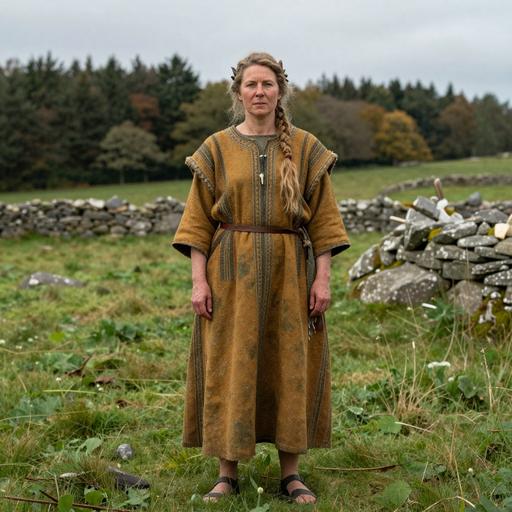
A woman buried in Ireland in the era

Download PDF creates a visual, rasterized copy. Use Print for selectable text and better assistive-technology support.

Loading Report

Preparing your ancestry journey

Preparing the available report content...

Your report will open automatically.

Skip to main content
Reference library / Sample profile

A woman buried in Ireland in the era

Explore the recorded context, genetic comparisons and research behind this reference sample.

IrelandNeolithic Britain

A reference profile describes this sample. It does not establish a personal or family relationship.

AI portrait reconstruction for A woman buried in Ireland in the  era
AI-generated artistic reconstruction, not a photograph of the individual.
Record

Sample details

Recorded details and available lineage markers.

Individual

Britain N individual, Ireland

Sample ID: bally

Date Range

3346 BCE - 3014 BCE

Cultural Period

Neolithic Britain

Biological Sex

Female

mtDNA Haplogroup

HV0-a

Y-DNA Haplogroup

Not available

Social Role

Farmer (AI estimate, era-typical)

Geography

Location

Where this individual was discovered

Country Ireland
Locality Ballynahatty. County Down

A location map is not available for this record.

Chronology

Date range

When this individual lived in the broader context of human history

Britain N individual, Ireland 3346 BCE - 3014 BCE
Context

Historical context

Background information associated with the reference record.

Neolithic Britain is the era when farming lifeways became established and increasingly shaped settlement, technology, and social practice. Archaeological remains emphasize new toolkits, pottery traditions, and the creation and use of landscapes for domestic and ceremonial purposes.

Region & Environment

Neolithic communities occupied a range of environments across Britain, including productive lowlands and more challenging upland settings. Access to arable land, grazing, and water influenced where people settled and how they managed crops and animals. Coastal regions also offered resources and potential travel routes.

Historical Context

The Neolithic in Britain follows earlier Mesolithic lifeways and precedes the Bronze Age. As farming spread and intensified in different regions at different rates, archaeological evidence shows changes in material culture and settlement organization, reflecting new economic priorities.

Populations & Lifeways

Populations were increasingly community-based around cultivated land, with domestic animals and crop production central to subsistence. While not all aspects of Mesolithic practice necessarily disappeared, agricultural routines became a long-term framework for daily life. Burial practices and artifact distributions suggest that Neolithic communities developed recognizable social norms and differentiated access to some goods.

Archaeology & Material Culture

Neolithic material culture is often identified through pottery, polished and flaked stone tools, and features associated with domestic and communal life. Evidence for monument-building and repeated use of particular places indicates that Neolithic groups invested labour in durable social landscapes.

Culture & Society

Neolithic societies expressed identity through shared styles and through patterned practices in burial and deposition. Regional variation in pottery, stone-tool traditions, and monumental forms suggests both local identities and broader interaction among communities.

Legacy & Transition

The Neolithic legacy in Britain includes the entrenchment of farming economies and the integration of ceremonial landscapes into community life. As the sequence progresses toward the Bronze Age, archaeological change in craft and deposition practices signals new social and technological emphases building on Neolithic foundations.

Analysis

Genetic comparisons

These comparisons show genetic similarity, not identity or origin. The populations listed are those whose genomes show statistical alignment to this ancient individual.

Similarity reflects shared history, not shared identity. These are analytical comparisons, not claims about who this person was.

Modern Genetic Admixture

This analysis compares the DNA profile with present-day reference populations, showing statistical similarity to modern reference populations from different regions. The excavation site records where this individual was found, not a fixed modern genetic identity.

Europe 99.3%
Southern European 99.3%
Iberian 47.4%
Sardinian 28.8%
Italian 23.1%
Asia 0.7%
Chinese & Southeast Asian 0.7%
Tibetan 0.7%

Closest Modern Populations

These are the modern populations showing the closest statistical alignment to A woman buried in Ireland in the era, ranked by genetic distance. Lower distance values indicate closer statistical similarity. Cross-region similarity can reflect shared ancestry, population movement, continuity, or later admixture.

1
Sardinian
2.8570
2
French Corsica
5.6631
3
Spanish La Rioja
6.0164
4
Spanish Castilla La Mancha
6.2962
5
Spanish Castello
6.3519
6
Spanish Menorca
6.3871
7
Spanish Pirineu
6.3900
8
Spanish Murcia
6.4118
9
Spanish Aragon
6.4226
10
Spanish Andalucia
6.4336
Context

Related Samples

This individual exists within a broader network of ancient samples. No ancient genome stands alone.

Individual Culture/Period Date Location Action
Celtic individual, Ireland Early Bronze Age Ireland 2031 BCE Rathlin Island. County Antrim, Ireland View
Celtic individual, Ireland Neolithic Ireland 3346 BCE Ballynahatty. County Down, Ireland View
Celtic individual, Ireland Early Bronze Age Ireland 2026 BCE Rathlin Island. County Antrim, Ireland View
Celtic individual, Ireland Early Bronze Age Ireland 1736 BCE Rathlin Island. County Antrim, Ireland View
Britain N individual, Ireland 3346 BCE Ballynahatty. County Down, Ireland View
Britain Ca Eba individual, Ireland 2031 BCE Rathlin Island. County Antrim, Ireland View
Britain Ca Eba individual, Ireland 2026 BCE Rathlin Island. County Antrim, Ireland View
Britain Ca Eba individual, Ireland 1736 BCE Rathlin Island. County Antrim, Ireland View
Page 1
Individual Culture/Period Date Location Action
Britain N individual, United Kingdom 4000 BCE Scotland. Oban. Raschoille, United Kingdom View
Britain N individual, Ireland 3346 BCE Ballynahatty. County Down, Ireland View
Britain N individual, United Kingdom 3800 BCE Scotland. Argyll and Bute. Oban. Raschoille Cave, United Kingdom View
Britain N individual, United Kingdom 3350 BCE Scotland. Orkney. Isbister, United Kingdom View
Britain N individual, United Kingdom 3706 BCE Scotland. Orkney. Point of Cott, United Kingdom View
Britain N individual, United Kingdom 3624 BCE England. Wiltshire. Winterbourne Monkton. North Millbarrow, United Kingdom View
Page 1
Sources

References

Scientific publications and genetic data that inform this profile.

G25 Coordinates

These coordinates represent a position in genetic space, a tool for comparison, not a conclusion. You can use these to perform custom admixture analysis in G25 Studio.

bally,0.1203078,0.1606918,0.0295641,-0.0343141,0.0576768,-0.0176576,-0.0019882,0.0059728,0.0378106,0.0660829,-0.0051159,0.014594,-0.0259712,-0.0134026,-0.0068734,0.0041236,0.0075415,-0.0005305,-0.0007429,-0.0034947,0.0011319,0.0049469,-0.012037,-0.0184605,0.00426638
Continue in G25 Studio
Use code for 30% off • Expires Nov 16